
Your bridge is changing every year. Is your monitoring strategy keeping up?
Divya Koppikar, Product and UI/UX Designer, Nirixense Technologies
Om Narayan Singh, Applications Engineer, Nirixense Technologies
(July 2026)
At Nirixense, our expert conversations are less about answers and more about reframing the questions the industry has been asking for decades.
The same sensors. Different questions.
Why Structural Health Monitoring must evolve with the lifecycle of infrastructure
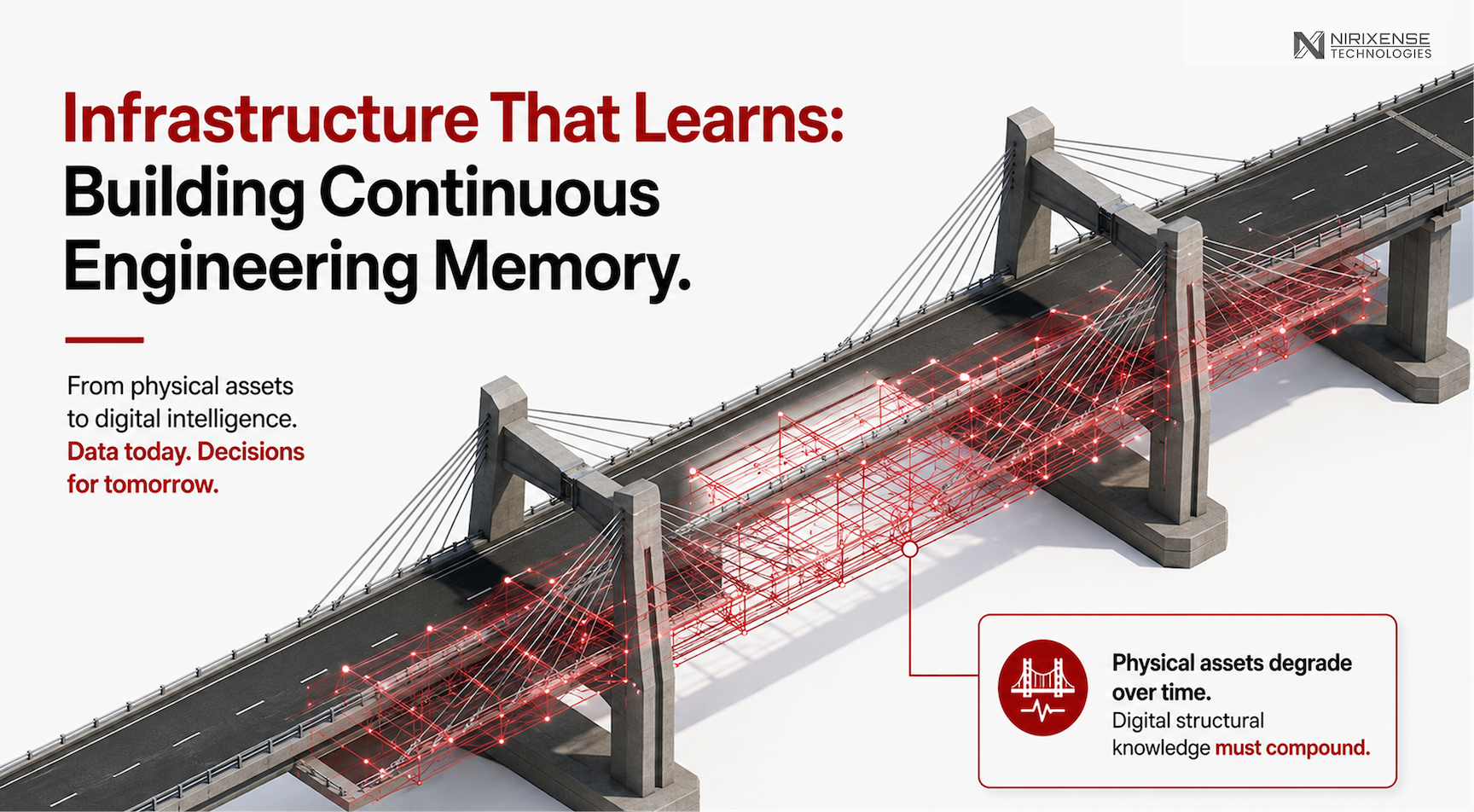
Structural Health Monitoring (SHM) has transformed the way engineers observe infrastructure. Over the past two decades, advances in embedded sensing, wireless communication, cloud computing and structural analytics have enabled engineers to move beyond periodic inspections towards continuous observation of bridges, tunnels, dams and other critical assets. As India’s infrastructure ecosystem continues to expand through programmes led by the Ministry of Road Transport and Highways, the National Highways Authority of India, Indian Railways and numerous state infrastructure agencies, long-term monitoring is becoming an increasingly important component of lifecycle asset management.
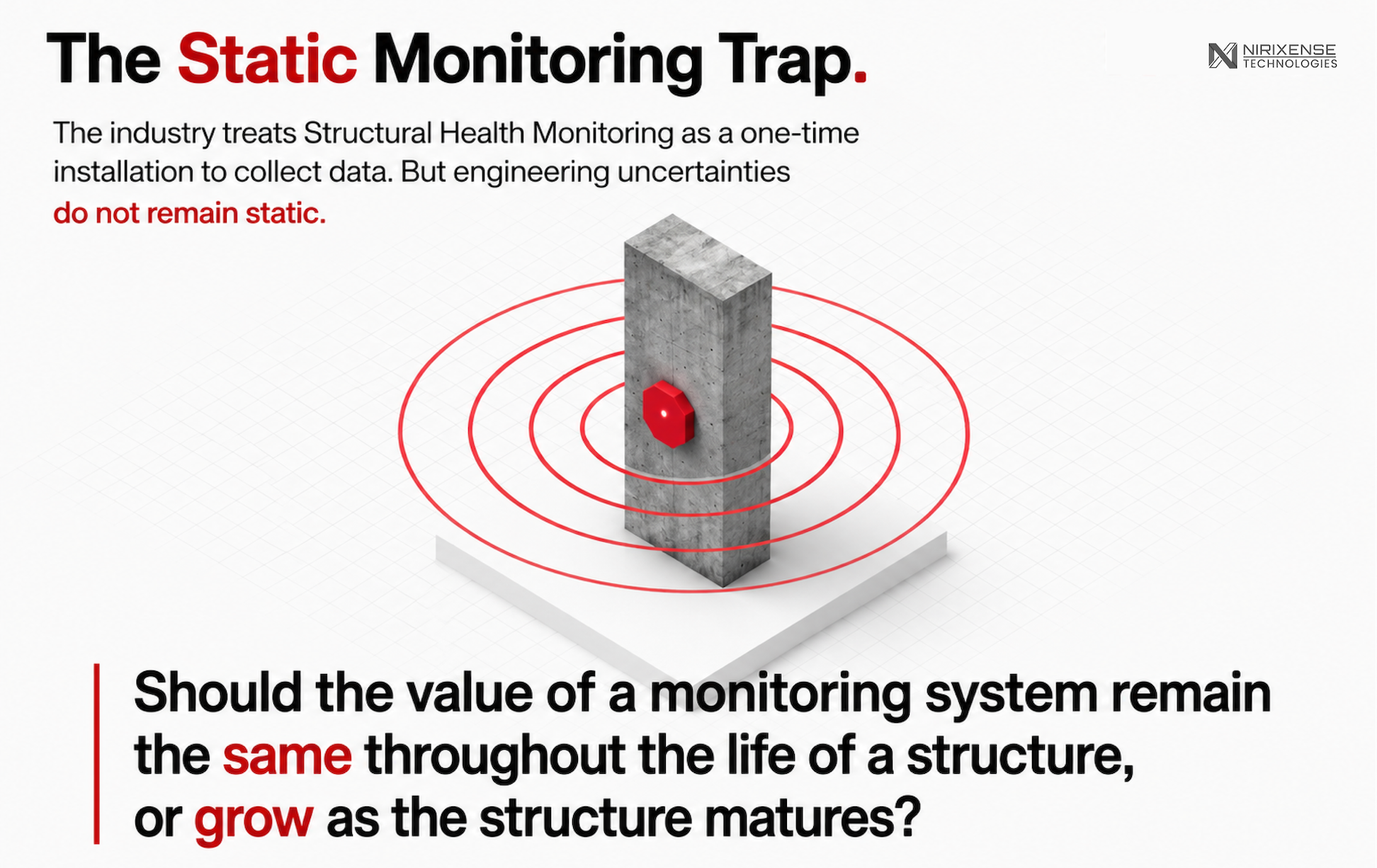
The industry has made remarkable progress in developing better sensors, more reliable communication systems and increasingly sophisticated analytics. Yet one fundamental question often receives less attention than it deserves.
Should the value of a Structural Health Monitoring system remain the same throughout the life of a structure, or should it grow as the structure itself evolves?
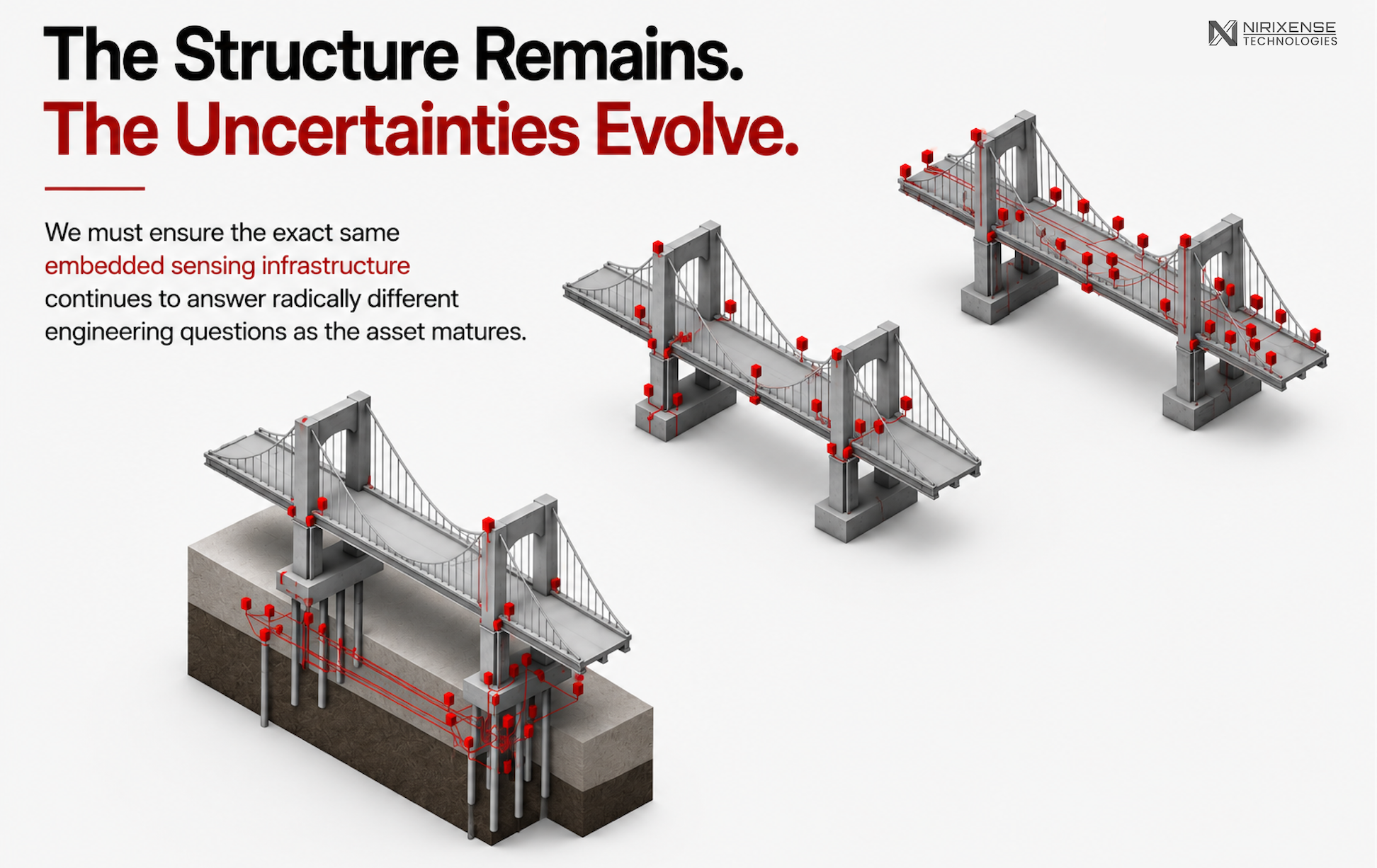
This question emerged repeatedly during a recent technical discussion on bridge monitoring and lifecycle management. The conversation suggested that perhaps the next evolution of SHM is not about deploying different sensors at different stages of a structure’s life. Instead, it is about ensuring that the same sensing infrastructure continues to answer different engineering questions as the structure matures.
This distinction may appear subtle, but it fundamentally changes how long-term monitoring systems should be designed.
Bridges do not experience the same risks throughout their life
Every bridge consists of two interconnected structural systems. The substructure, comprising foundations, piers and abutments, transfers structural loads safely into the supporting ground. The superstructure, including decks, girders, bearings and load-carrying members, carries traffic while distributing loads throughout the structure.
Both systems remain equally critical throughout the bridge’s life. However, the engineering uncertainties associated with them do not remain constant.
One observation from the discussion illustrates this particularly well:
“In the superstructure, you will have failure after 30 years. After 30 years, it will start showing some deformations… Substructure will show in one year.”
This statement should not be interpreted as a universal rule for every bridge. Rather, it highlights an important engineering reality: infrastructure risks evolve with time.
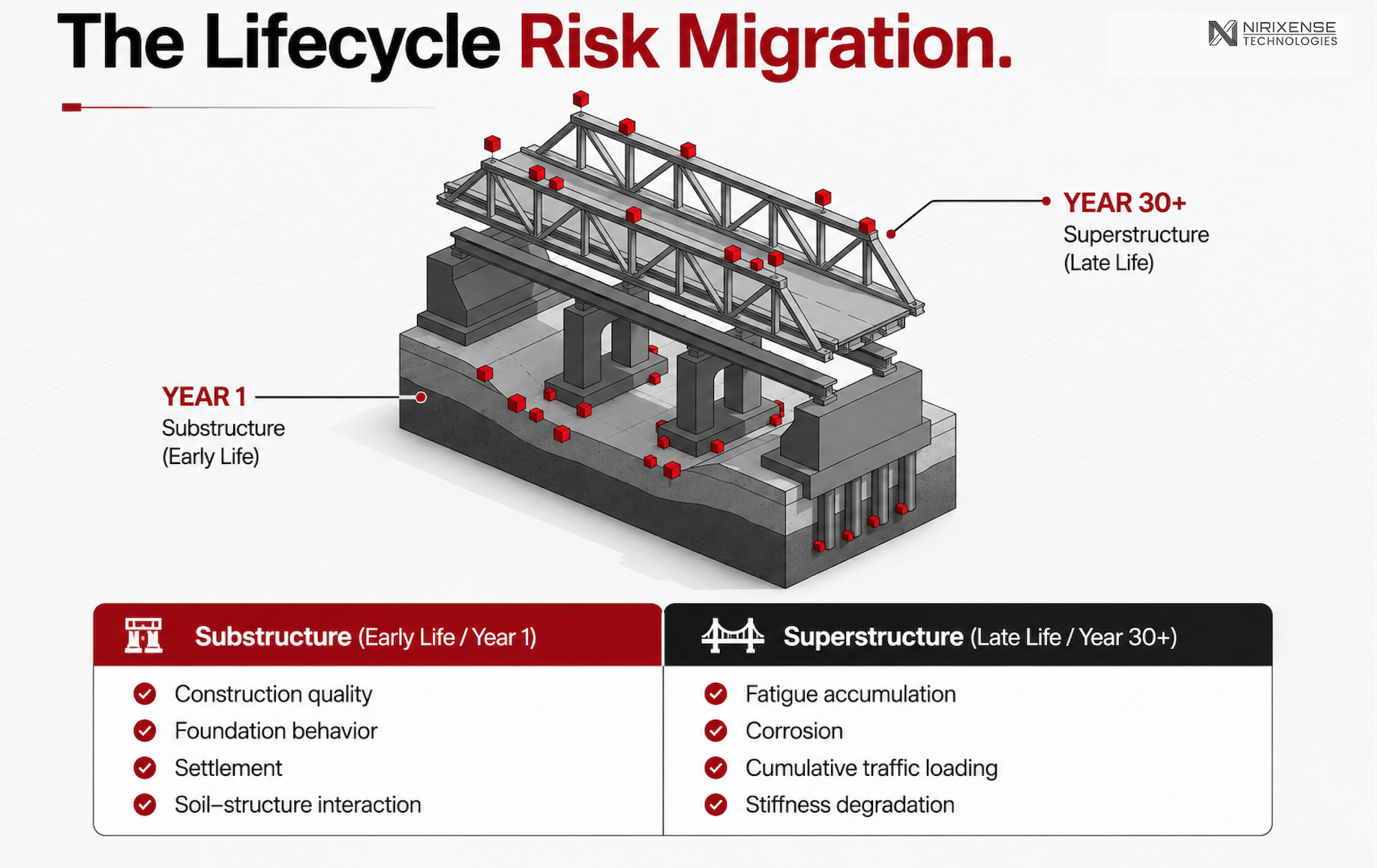
During construction and the early years following commissioning, engineers are primarily concerned with questions surrounding construction quality, foundation behaviour, settlement, soil-structure interaction and whether the asset is performing as intended. In contrast, once a bridge has been in service for several decades, attention increasingly shifts towards fatigue, deterioration, corrosion, cumulative traffic loading, stiffness degradation and remaining service life.
The structure itself has not changed fundamentally.
What has changed is the uncertainty engineers are trying to reduce.
The value of embedded monitoring increases with time
This changing nature of uncertainty presents an important opportunity for Structural Health Monitoring.
An embedded sensing system installed during construction establishes something that cannot be recreated later as a continuous, trustworthy record of how a structure has behaved from the very beginning of its service life. That historical record becomes increasingly valuable as the asset ages because it provides engineers with an objective baseline against which future behaviour can be compared.
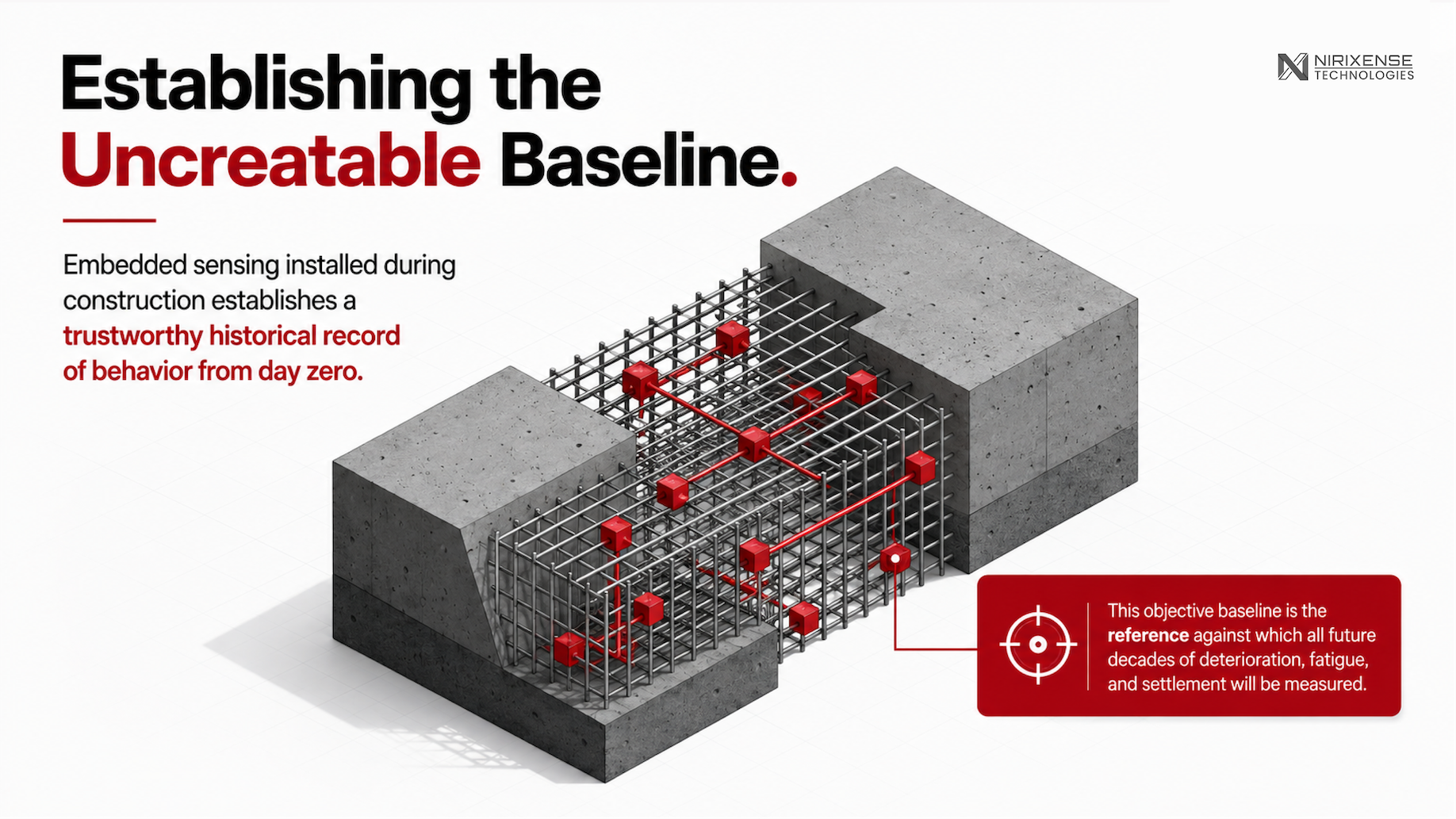
Measurements collected during construction may initially be used to validate design assumptions, confirm structural response and identify early-stage anomalies. Years later, the same data forms the reference against which engineers assess changes in dynamic behaviour, stiffness, long-term deformation, fatigue accumulation or environmental deterioration.
The sensing infrastructure remains embedded within the structure.
The engineering questions continue to evolve.
This perspective shifts the role of SHM from being a system that simply reports structural behaviour to one that continuously builds engineering knowledge throughout the asset’s lifecycle.
Monitoring data must always be interpreted in context
The discussion also highlighted an important reminder for the SHM community: structural measurements alone do not always capture the complete engineering picture.
As one participant observed,
“If you have a rigid body motion, SHM will not give any signal.”
The observation illustrates an important limitation that applies to every monitoring system.
If an entire structural system experiences movement because of foundation settlement or changing boundary conditions, conventional strain measurements may show little variation even though the governing structural conditions have changed significantly.
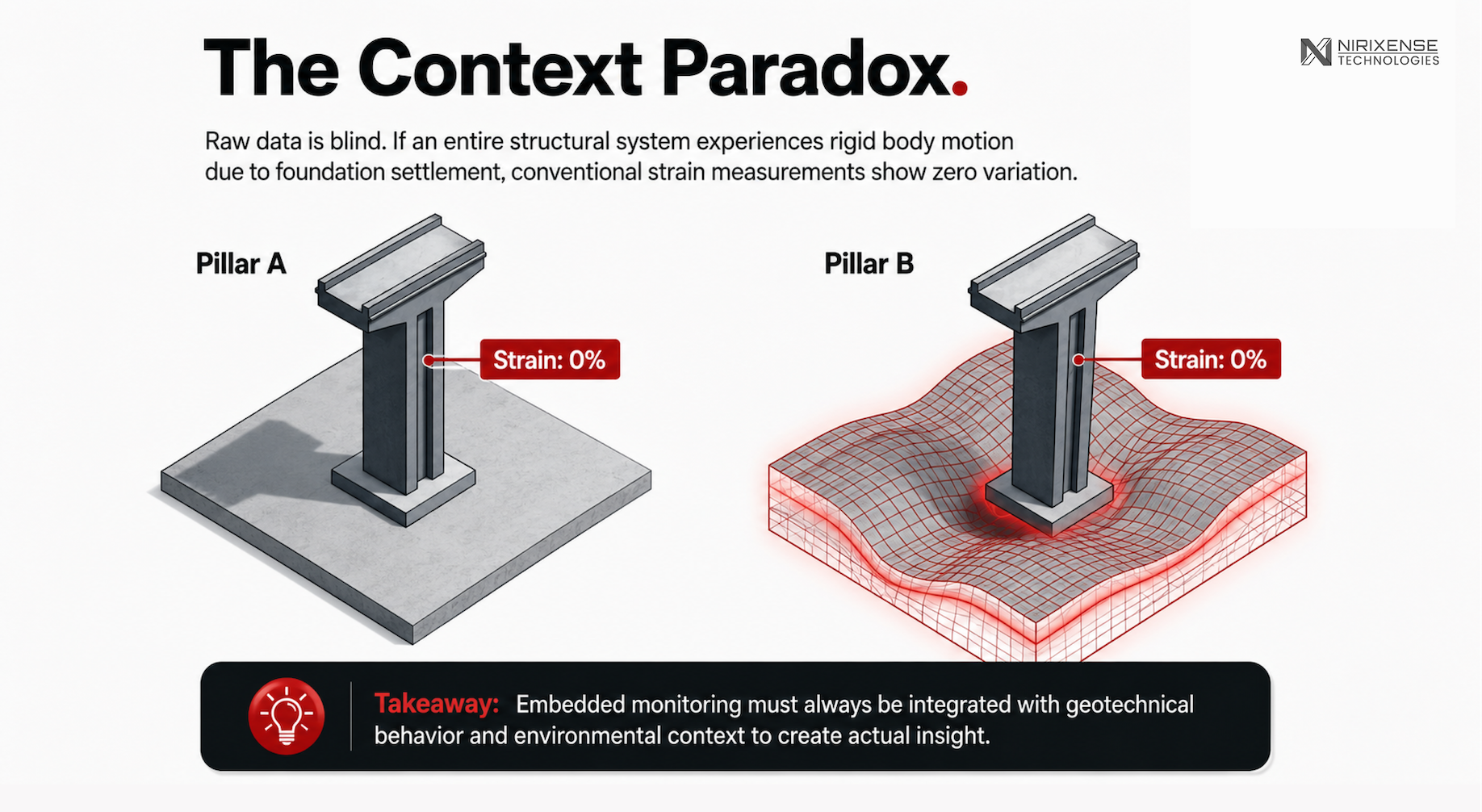
This does not diminish the importance of Structural Health Monitoring. Instead, it reinforces that monitoring systems should always be interpreted alongside geotechnical behaviour, environmental conditions, inspection findings and engineering judgement.
The objective of SHM has never been simply to collect data.
Its purpose is to reduce uncertainty so that engineers can make better decisions.
The future of SHM is not just continuous monitoring. It is continuous understanding.
One of the strongest themes emerging from the discussion was that the industry should move beyond viewing monitoring as a one-time installation exercise.
As noted during the conversation,
“What India needs to do is not just instrument, but to instrument in a smart way.”
Smart instrumentation does not imply fewer sensors, nor does it diminish the importance of embedded, long-term monitoring. On the contrary, permanent sensing infrastructure becomes significantly more valuable when it is designed to support the full lifecycle of the asset.
The engineering questions during construction differ from those during commissioning. The questions asked after a rehabilitation programme differ from those asked following an extreme event such as flooding or seismic activity. Likewise, the priorities for a bridge approaching the latter stages of its design life differ substantially from those for a newly commissioned structure.
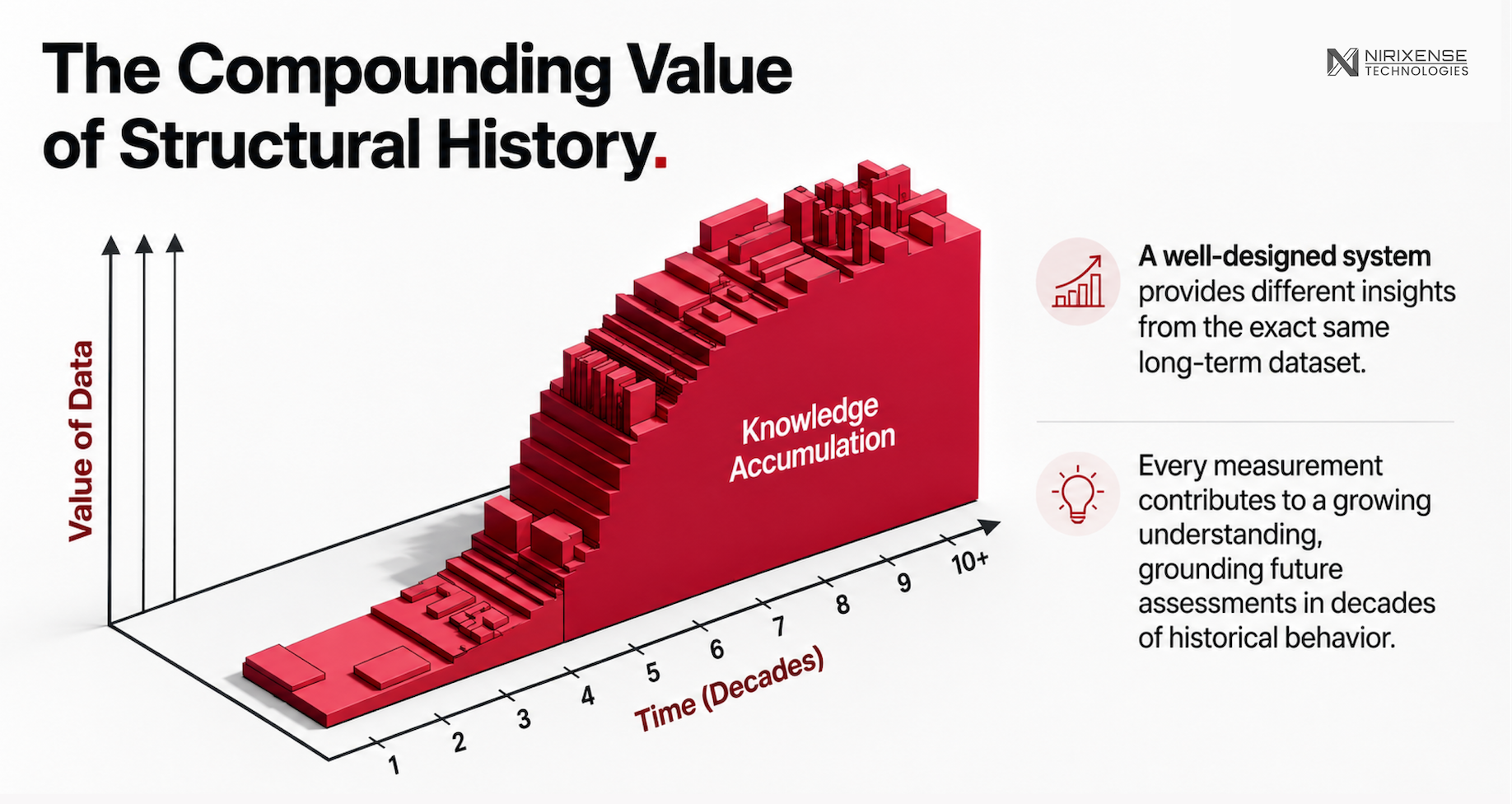
A well-designed SHM system should therefore not be expected to provide the same insight throughout its lifetime. Instead, it should provide different insights from the same long-term dataset, enabling engineers to make informed decisions as the asset and its operating environment evolve.
This is where embedded sensing demonstrates its greatest value. It preserves continuity. Every measurement contributes to a growing understanding of the structure, allowing future assessments to be grounded not only in current observations but also in years or even decades of historical behaviour.
Building infrastructure that learns throughout its life
As India continues investing in resilient infrastructure under the guidance of organizations such as the Indian Roads Congress, the Bureau of Indian Standards, the Ministry of Road Transport and Highways and public agencies responsible for managing critical assets, Structural Health Monitoring has the opportunity to evolve from a measurement system into a long-term knowledge system.
The future of SHM is unlikely to be defined solely by higher sampling rates, lower-power electronics or larger volumes of sensor data. Its real value will lie in preserving a continuous understanding of how infrastructure changes over time and enabling engineers to interpret those changes within the context of the asset’s complete lifecycle.
In this sense, the question is no longer whether bridges should be monitored continuously.
The more important question is whether the monitoring systems we deploy today are capable of remaining meaningful thirty years from now.
What we’re building at Nirixense
At Nirixense, this perspective is central to how we think about the future of Structural Health Monitoring.
We believe that embedded sensing should become a permanent part of infrastructure rather than an accessory added for isolated monitoring campaigns. By integrating long-term sensing into the asset itself, engineers gain something far more valuable than periodic snapshots—they gain a continuous record of structural behaviour that grows richer with every passing year.
Our vision is to build monitoring systems that remain relevant throughout the life of a structure. The same embedded sensing network that validates construction quality and establishes an initial behavioural baseline should continue supporting engineers decades later by providing the historical context needed to assess ageing, rehabilitation, changing loading conditions and long-term structural performance.
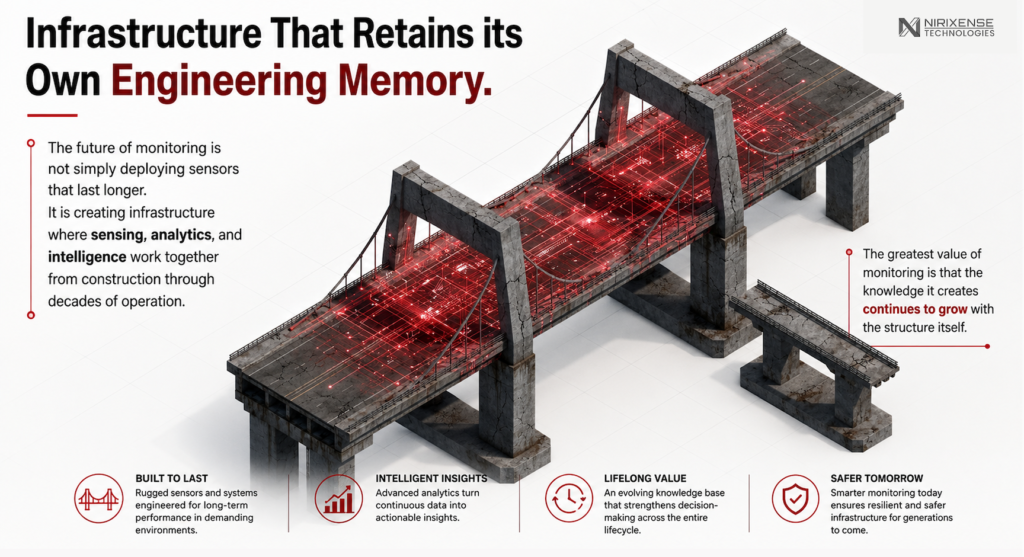
For us, the future of SHM is not simply about deploying sensors that last longer. It is about creating infrastructure that retains its own engineering memory, where embedded sensing, lifecycle analytics and engineering intelligence work together to support better decisions from construction through decades of operation.
Because the greatest value of long-term monitoring is not that sensors remain in place.
It is that the knowledge they create continues to grow with the structure itself.
© 2026 Nirixense Technologies Pvt. Ltd. All rights reserved. email: connect@nirixense.com
About this series: Field Notes in Structural Intelligence is a thought leadership series by Nirixense Technologies, where we engage with experts across structural engineering and monitoring to understand how SHM actually works in practice and where it needs to evolve next.