
Why SHM works but still does not scale
In conversation with Dr. Mahesh Varma
Technology Perspective
Divya Koppikar, Product and UI/UX Designer, Nirixense Technologies
Om Narayan Singh, Applications Engineer, Nirixense Technologies
(May 2026)
Dr. Mahesh Varma is a distinguished structural engineer, Director at Nandadeep Designers and Valuers Pvt. Ltd., and associated with HONE Structural Health Monitoring (India) Pvt. Ltd., with advanced training from Indian Institute of Technology Bombay and Politecnico di Milano.
He is widely recognized for his pioneering work in AVD masonry structures, along with significant contributions to prestressed concrete systems and international projects. Combining research, design, and consulting, he continues to drive innovative structural solutions and monitoring-led engineering practices, with strong academic and industry impact.
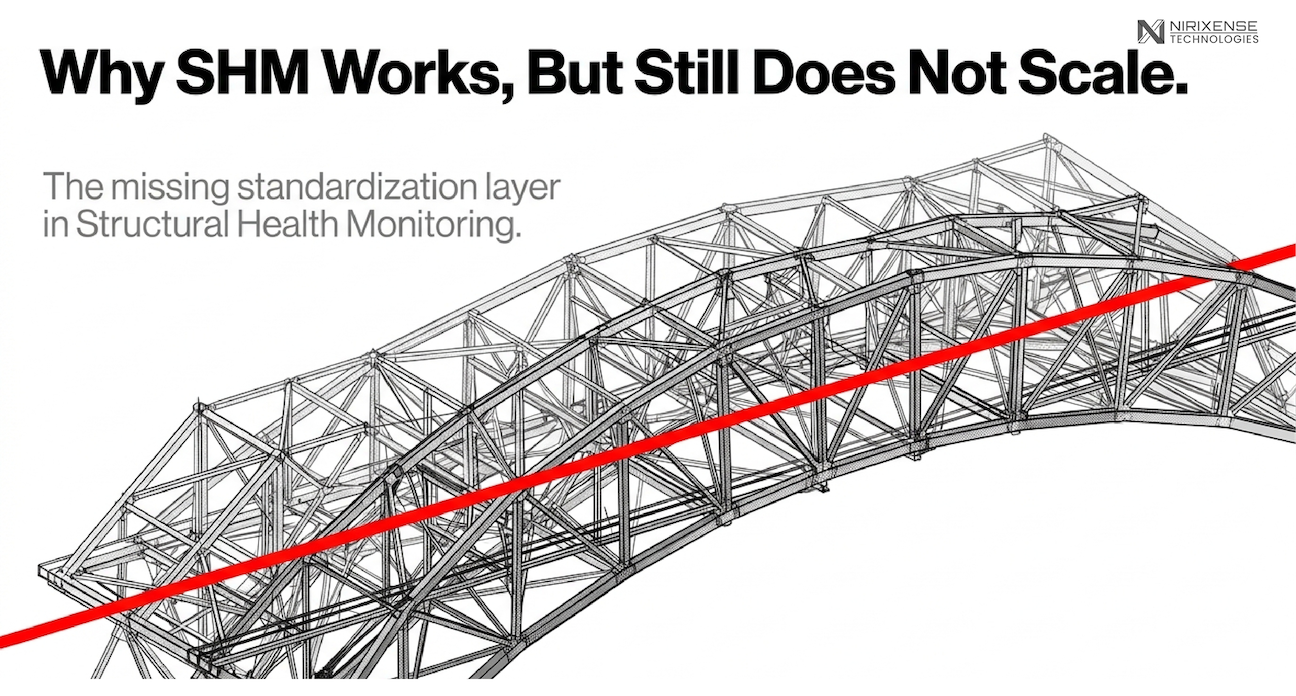
The missing standardization layer in SHM
Structural Health Monitoring is often discussed in terms of sensors, accuracy, and data. One of the most defining limitations of the industry is far less visible and far more systemic, which is the absence of a unified, standardized layer that connects sensing, data acquisition, and decision making into a cohesive workflow. This results in a landscape where every project is rebuilt from the ground up instead of scaled from a common foundation.
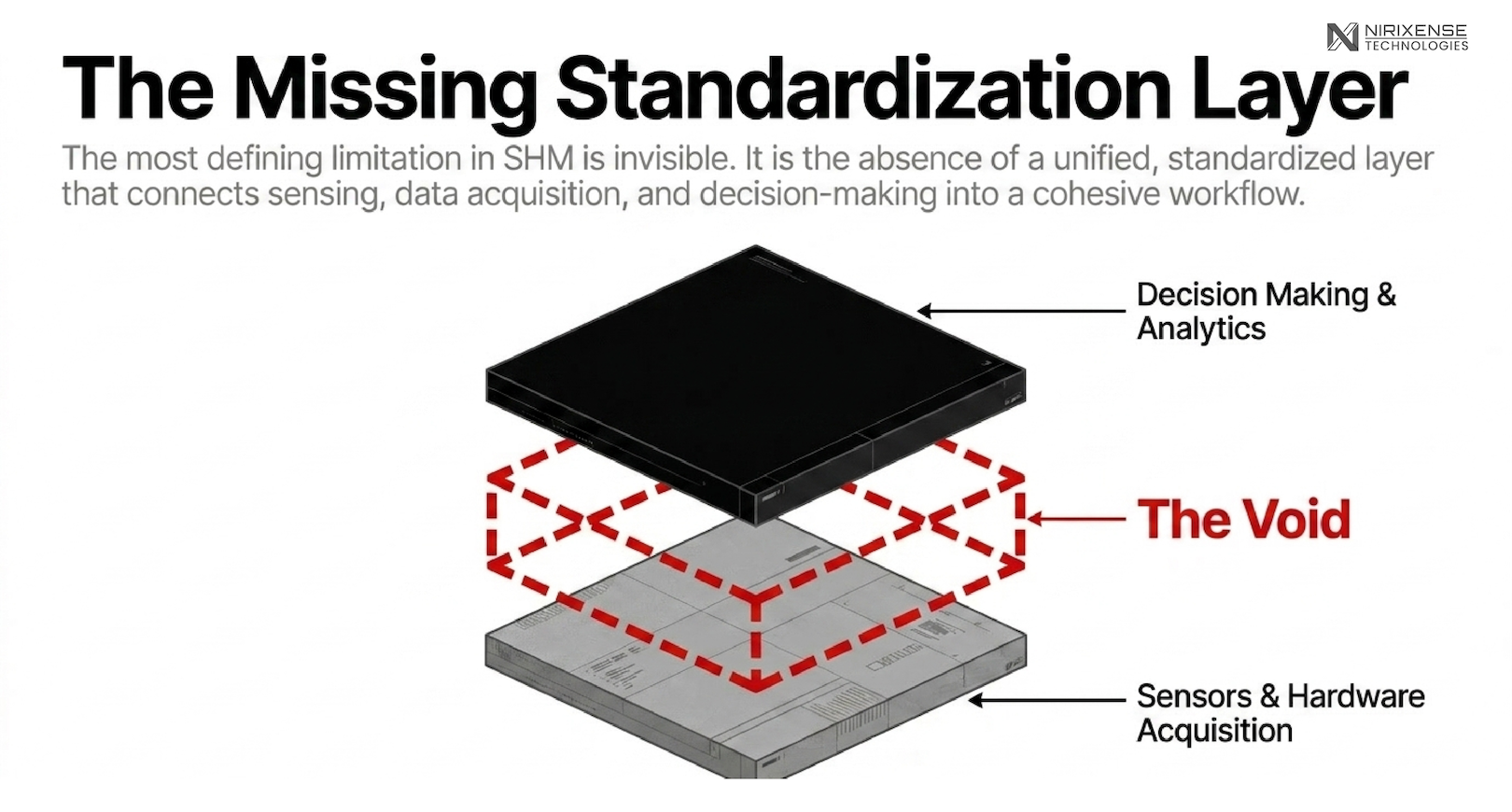
Because in practice, SHM is not a single system that can be deployed consistently across projects, but a collection of sensor specific setups, fragmented software tools, and customized workflows that must be assembled each time based on the requirements of the structure, the engineer, and the available technology.
No universal system, only combinations
At the core of this issue lies a simple but critical reality.
“Few are developed by our own and few are available with the sensors. So depending on the application we implement it.”
This reflects how most SHM systems operate today, where data acquisition and analysis are not handled through a unified platform, but through a combination of proprietary tools, sensor specific software, and custom integrations.
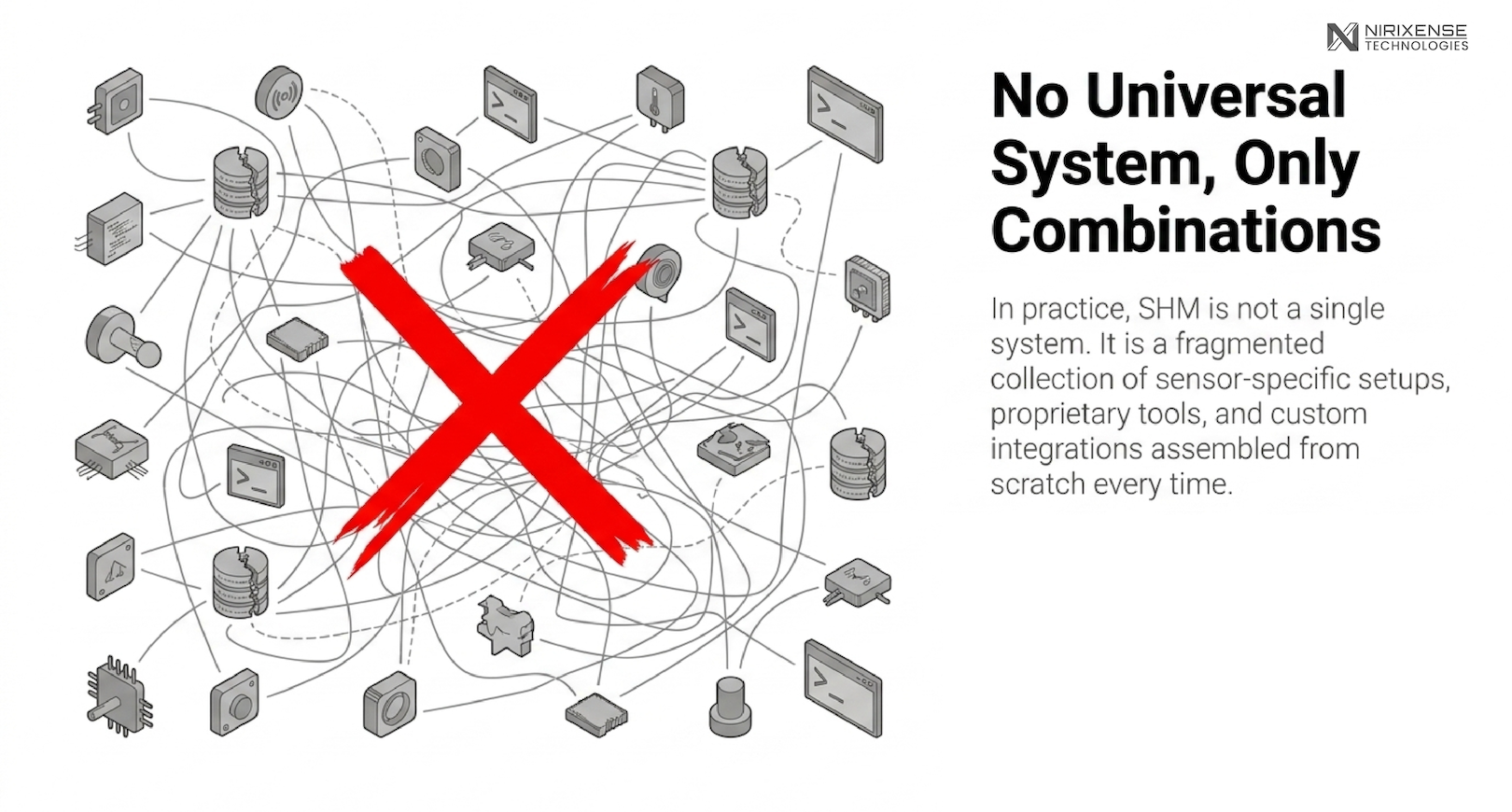
Which leads to an even more explicit gap:
“There is not like a universal software for data acquisition that is currently used.”
And more importantly:
“Structural health monitoring for infrastructure projects is not as matured as it is in other matured sectors. So there is a vacuum for one unique system which can be used for all type of health monitoring work.”
This absence of a standard system is not just a technical inconvenience, it fundamentally shapes how SHM is deployed, scaled, and trusted.
What fragmentation looks like on the ground
In real execution environments, this lack of standardization translates into a workflow that is inherently fragmented and difficult to scale.
- Different sensors come with different software.
- Different projects require different configurations.
- Different stakeholders operate on different data formats.
Which means that even within a single project:
- Data acquisition is tool dependent.
- Data formats are inconsistent.
- Integration requires manual effort.
And across projects, there is no continuity of system architecture, making it nearly impossible to build cumulative efficiency or standardized processes.
Why this slows adoption
The absence of a unified layer introduces friction at every stage of the monitoring lifecycle.
- Engineers must adapt to new systems for each project.
- Installation teams must recalibrate workflows repeatedly.
- Data handling becomes inconsistent and difficult to interpret.
Which ultimately limits SHM adoption not because of lack of value, but because of lack of repeatability.
“Depending on a sensor and type of users we take that path. It’s not a unique approach.”
This reinforces that there is no consistent baseline from which systems can scale, which is why every deployment behaves more like a custom solution than a productized system.
The impact on long term monitoring and ROI
This fragmentation has deeper implications when viewed from a lifecycle perspective, because without standardization:
- Long term monitoring becomes harder to sustain.
- Data continuity across time is compromised.
- Insights remain project specific rather than system driven.
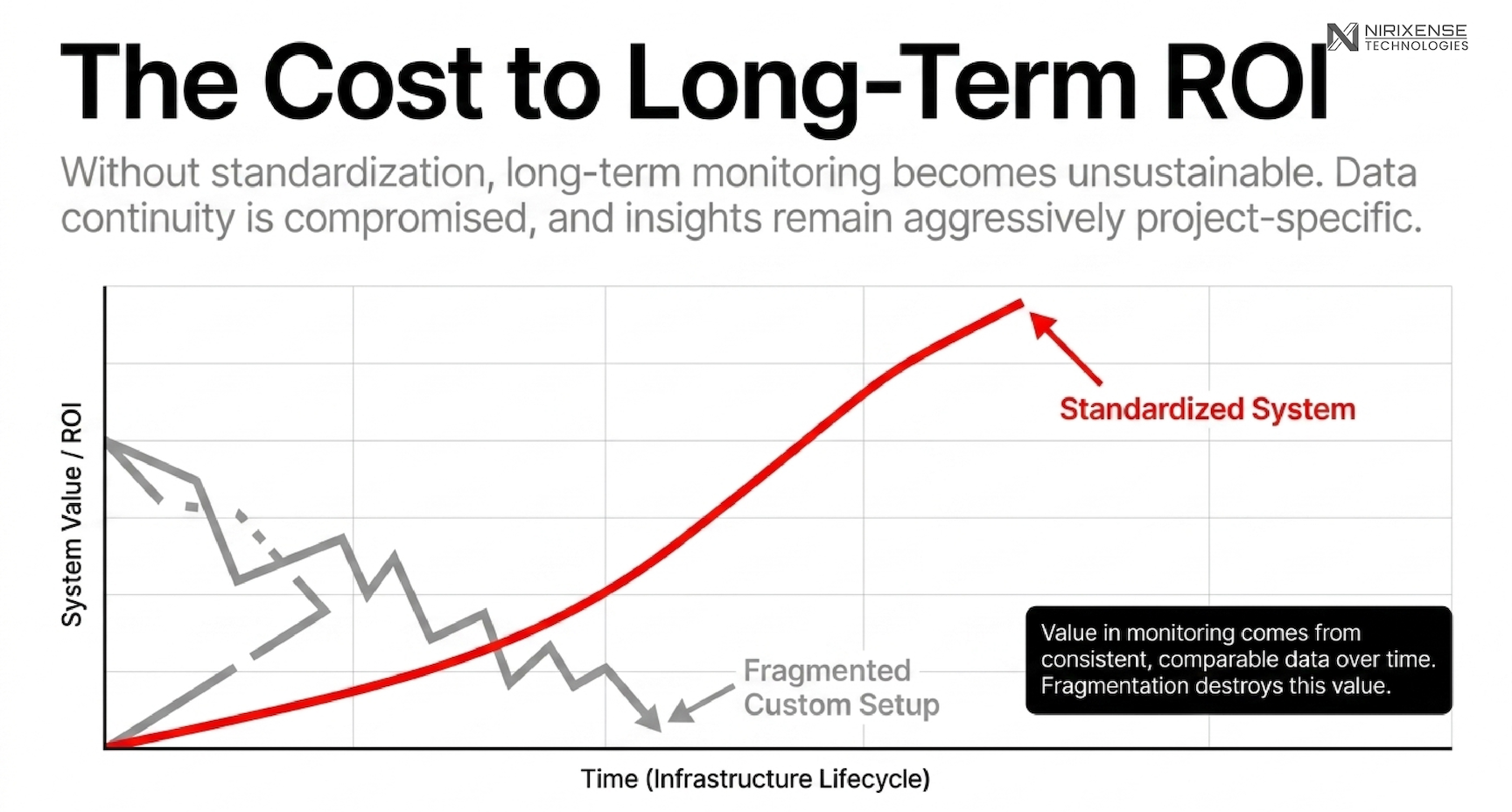
Which directly limits the ability of SHM to extend infrastructure life and improve return on investment, since value in monitoring comes not just from data collection, but from consistent, comparable, and reliable data over time.
Where the opportunity actually lies
The gap is not in sensing capability, but in system integration, because what the industry lacks is not better sensors, but a unified layer that simplifies deployment, standardizes data flow, and reduces dependency on sensor specific ecosystems.
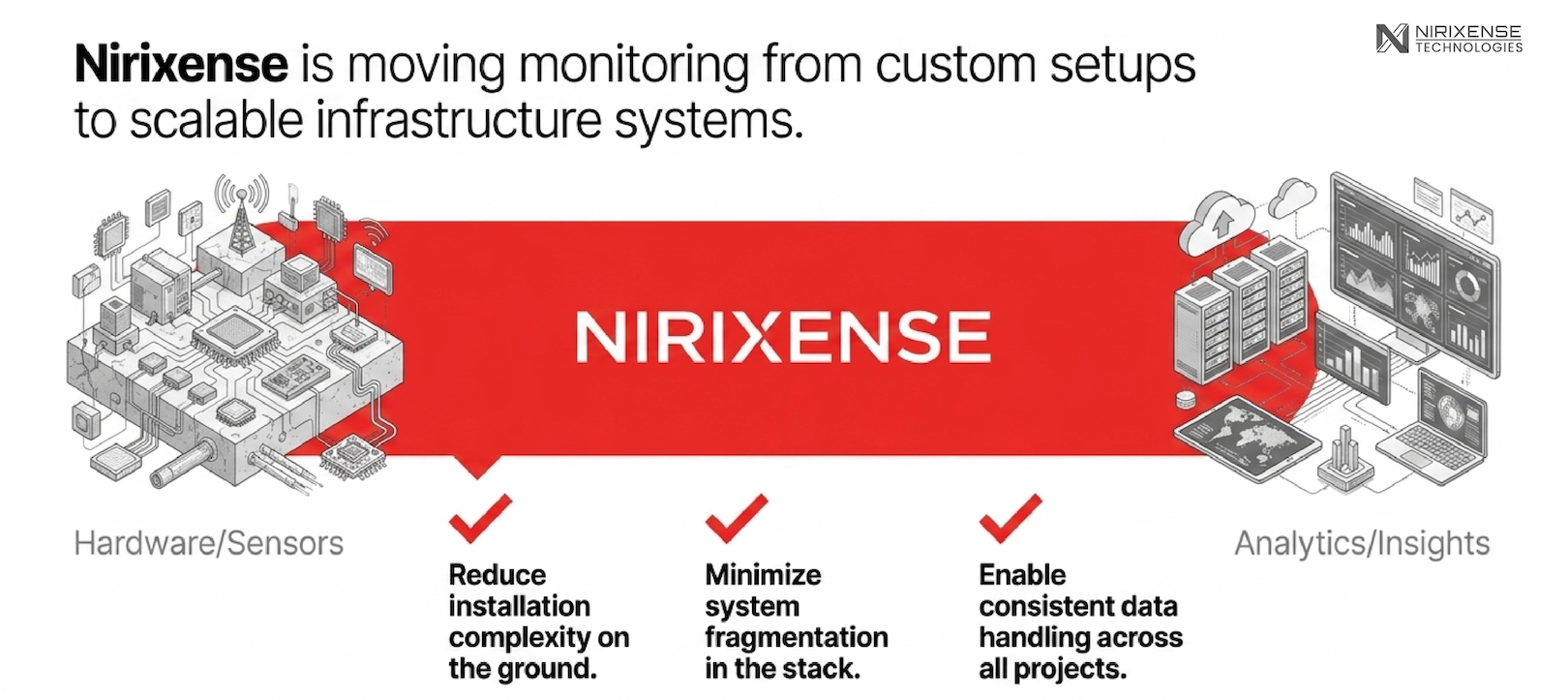
This is where Nirixense is positioned to redefine how SHM systems are built and deployed, by moving towards solutions that reduce installation complexity, minimize system fragmentation, and enable more consistent data handling across projects, allowing monitoring to move from custom setups to scalable infrastructure systems.
From projects to systems
For SHM to evolve into a true infrastructure intelligence layer, it must move beyond project-based execution and towards system-based thinking, where deployment, data, and decision making are part of a continuous and standardized workflow rather than isolated implementations.
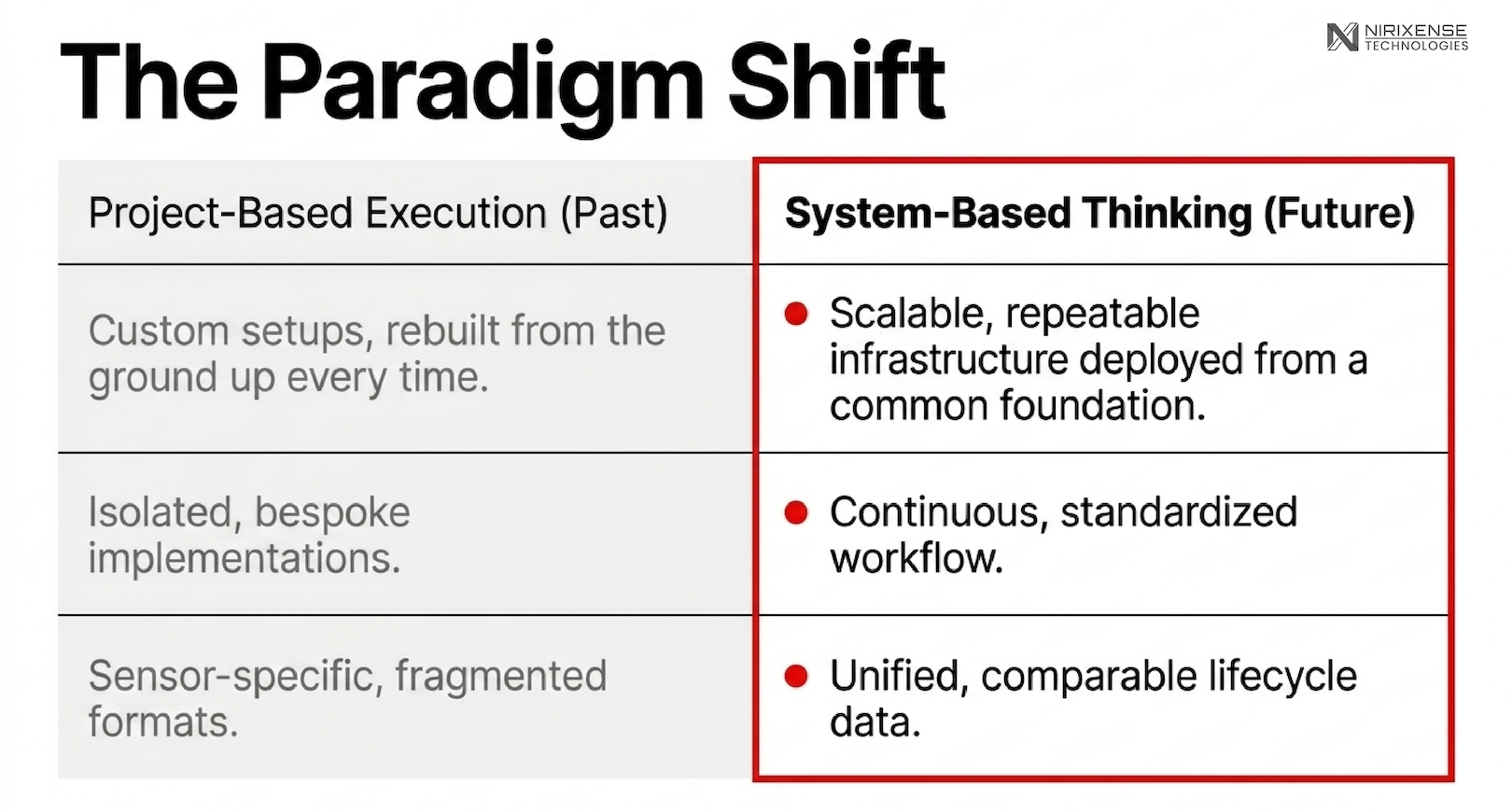
Because until that shift happens, monitoring will continue to restart with every project.
The real question
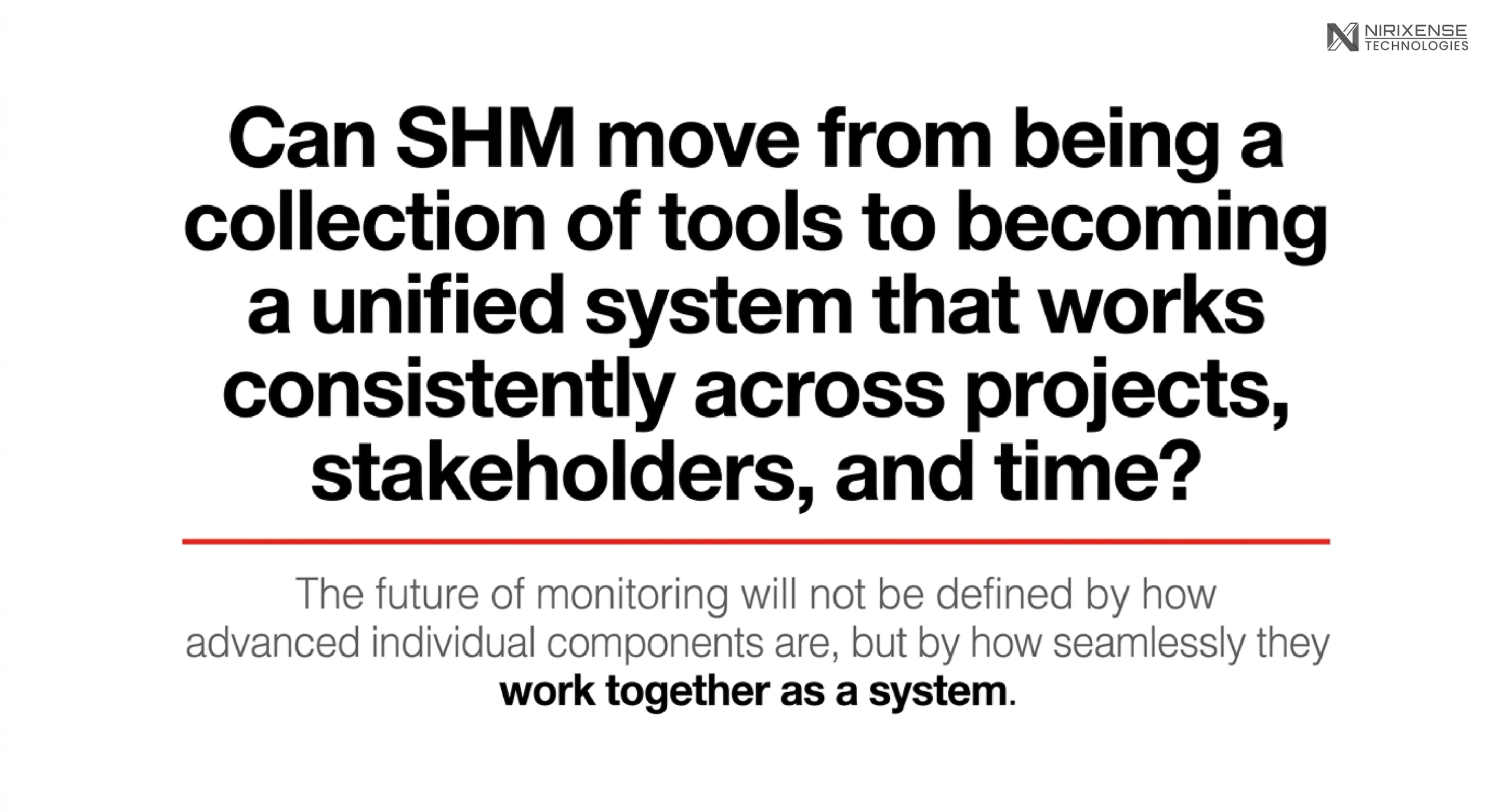
Can SHM move from being a collection of tools to becoming a unified system that works consistently across projects, stakeholders, and time?
Because the future of monitoring will not be defined by how advanced individual components are, but by how seamlessly they work together as a system.
© 2026 Nirixense Technologies Pvt. Ltd. All rights reserved. email: connect@nirixense.com
About this series: Field Notes in Structural Intelligence is a thought leadership series by Nirixense Technologies, where we engage with experts across structural engineering and monitoring to understand how SHM actually works in practice and where it needs to evolve next.