
The role of rebar mapping in structural rehabilitation of aging concrete structures
Case Study
Dr. Sauvik Banerjee, Co-founder & Director, Nirixense Technologies (November 2025)
Introduction:
Structural rehabilitation of aging buildings presents a unique set of challenges. Chief among them is the frequent absence of original structural drawings, which leaves engineers with limited information about reinforcement layouts and load-bearing capacities. In such situations, assumptions can lead to unsafe designs or excessive conservatism, both of which impact safety, cost, and project timelines.
Rebar mapping has emerged as a critical solution for bridging this knowledge gap. A recent case involving a sixty year old building in Mumbai demonstrates how rebar mapping, combined with core testing and other nondestructive testing (NDT), can generate reliable data for structural strengthening and enable the safe adaptation of existing structures to modern demands. In this project, IIT Bombay was tasked with assessing the structural system for additional load requirements in one of the floors arising from suspended HVAC ducts, lighting systems, acoustic panels, and trolleys.
The challenge of absence of drawings:
Old buildings often lack detailed structural documentation. Engineers face uncertainties in:
- Location, spacing, cover depth and size of reinforcement bars
- Actual thickness of slabs and beams
- Degradation of materials due to aging and corrosion
- Load carrying capacity under new usage requirements
These unknowns make it impossible to design strengthening interventions with confidence, unless site-specific data is generated.
Methodology and investigation:
In this case, engineers adopted a systematic approach:
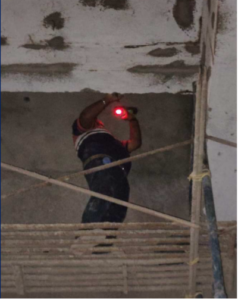
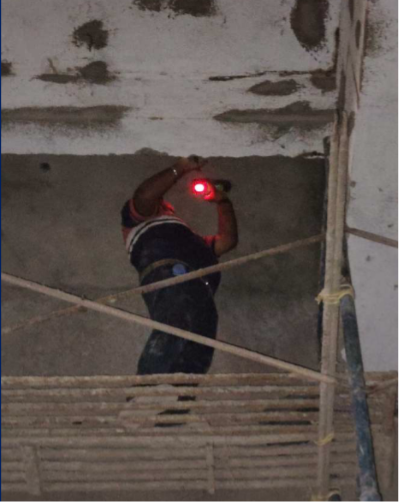
- Rebar mapping using a rebar detector estimated details of reinforcement arrangement within slabs and beams.*
- Core extraction tests were conducted to establish slab thickness and concrete grade.
- UPV measurements were used to assess the quality of concrete. Half-cell potentiometer was used to estimate the probability of corrosion.
- Load recalculations were carried out considering both dead loads and imposed loads from new installations, such as HVAC ducts, lighting, acoustic panels, and trolleys.
- Condition survey identified signs of corrosion and cracking in concrete. This highlighted the importance of addressing durability along with strength.
This method replaced guesswork with accurate data, allowing engineers to design strengthening work to match real structural conditions.
Strengthening strategy:
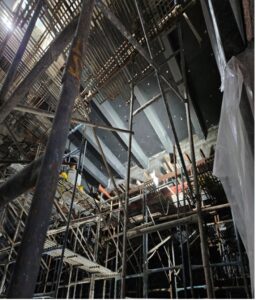
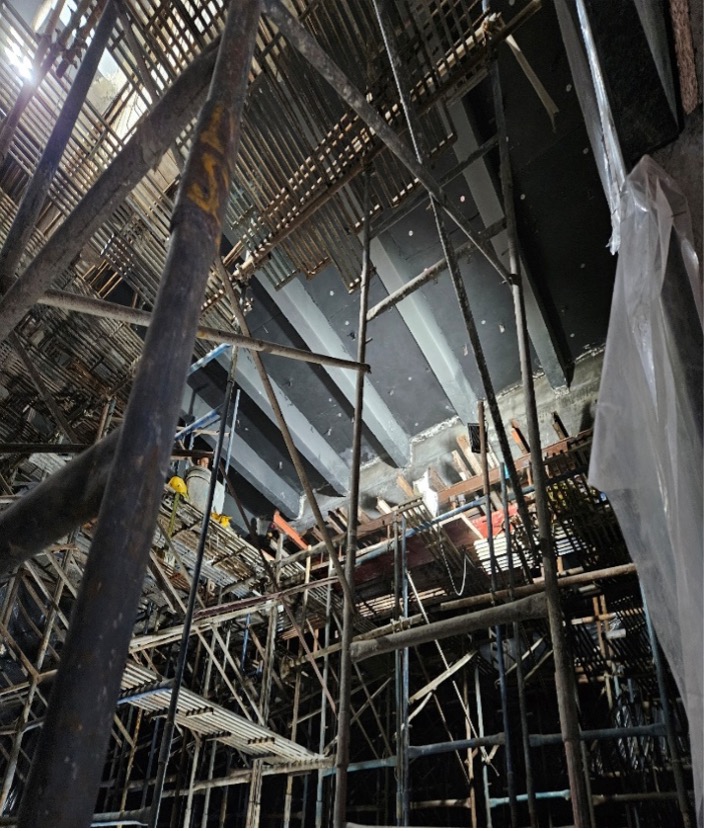
Based on the investigation, both primary and secondary beams required rehabilitation. The adopted measures included:
- Micro concrete jacketing of primary beams for enhanced load capacity
- Carbon fibre strengthening systems applied to both primary and secondary beams to counteract additional hogging moments and to expedite the strengthening process
- Continuous supervision by certified structural engineers to ensure quality and safety during execution
This combination of traditional and advanced techniques delivered robust results while minimizing disruption to building use.
Implications for industry:
This case highlights several important lessons for the construction and infrastructure industry:
- Rebar mapping is indispensable when drawings are missing or unreliable. It is the only way to accurately reveal reinforcement layouts hidden within concrete.
- Data driven retrofitting leads to safer, more economical, and less intrusive interventions.
- Advanced materials and methods such as fibre reinforced polymer systems allow faster and more durable strengthening compared to conventional approaches.
- Ongoing monitoring and audits are essential for long term performance of rehabilitated structures.
Conclusion:
As cities across India and globally continue to rely on buildings constructed decades ago, the demand for structural strengthening will grow. Rebar mapping provides the essential first step in this journey by converting uncertainty into actionable data. By integrating modern nondestructive evaluation technologies with innovative strengthening techniques, engineers can extend the life of critical infrastructure and ensure resilience for the future.
Rebar mapping is not a diagnostic option. It is the foundation of responsible structural rehabilitation.
* Related reading: What makes the ReX 100 a must-have next-generation rebar scanner for such use cases.
© 2025 Nirixense Technologies Pvt. Ltd. All rights reserved. email: connect@nirixense.com
About the Author: Dr. Sauvik Banerjee is Co-founder & Director at Nirixense Technologies, and Professor at Department of Civil Engineering, IIT Bombay. His experience includes structural health monitoring, using wave propagation and vibration-based approaches, quantitative nondestructive evaluation of structures, nondestructive testing, modelling of advanced composite structures, structural retrofitting and impact response of structures. He obtained Ph.D. degree from UCLA (Mechanical Engineering, 2003), M.Tech. from IIT Bombay (Civil Engineering, 2001).
Note: This article presents the author’s personal views and insights drawn from publicly shareable aspects of research and consultancy projects conducted as a faculty member at IIT Bombay. The content is intended solely for thought leadership and knowledge sharing. The views expressed do not necessarily represent those of IIT Bombay.