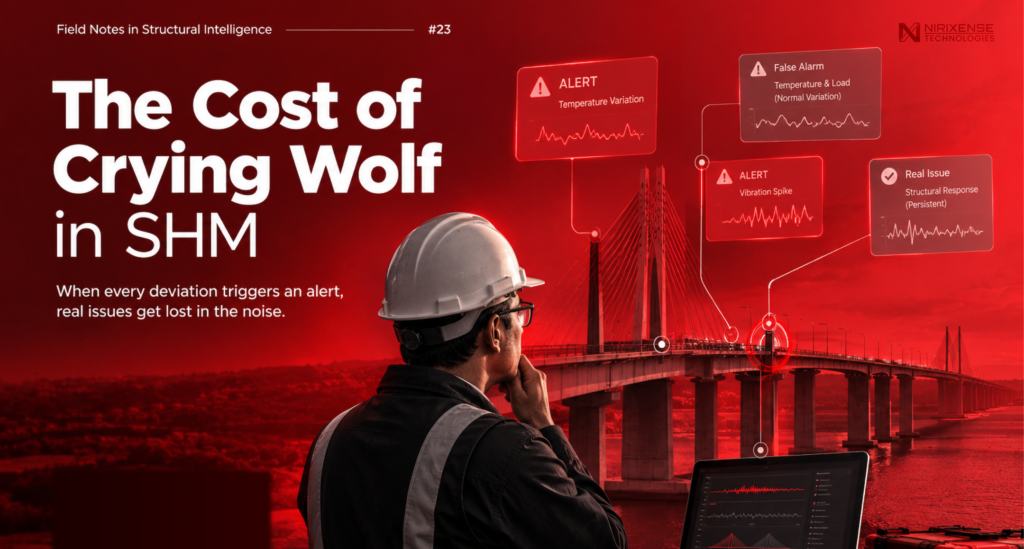
The cost of crying wolf in SHM
Continuous Structural Health Monitoring (SHM) often overwhelms engineering teams by treating routine environmental variations, weather shifts, and normal structural behaviors with the same urgency as genuine damage. This "crying wolf" effect creates a flood of false positives that exhausts engineering resources and risks hiding critical safety hazards in a sea of noise. Because raw thresholds can only flag that a measurement has changed without explaining the underlying cause, an effective monitoring platform must do much more than simply detect anomalies. It needs to systematically verify data integrity to rule out sensor glitches or communication dropouts, and contextualize observations against baseline operating conditions like temperature and traffic loading. By adopting a structured, tiered approach—such as moving from Alert (awareness and review) to Alarm (investigation and cause) and finally Action (intervention or escalation)—SHM systems can successfully bridge the gap between raw data and operational decision-making, ensuring that scarce engineering attention is directed exclusively toward what truly matters.
