
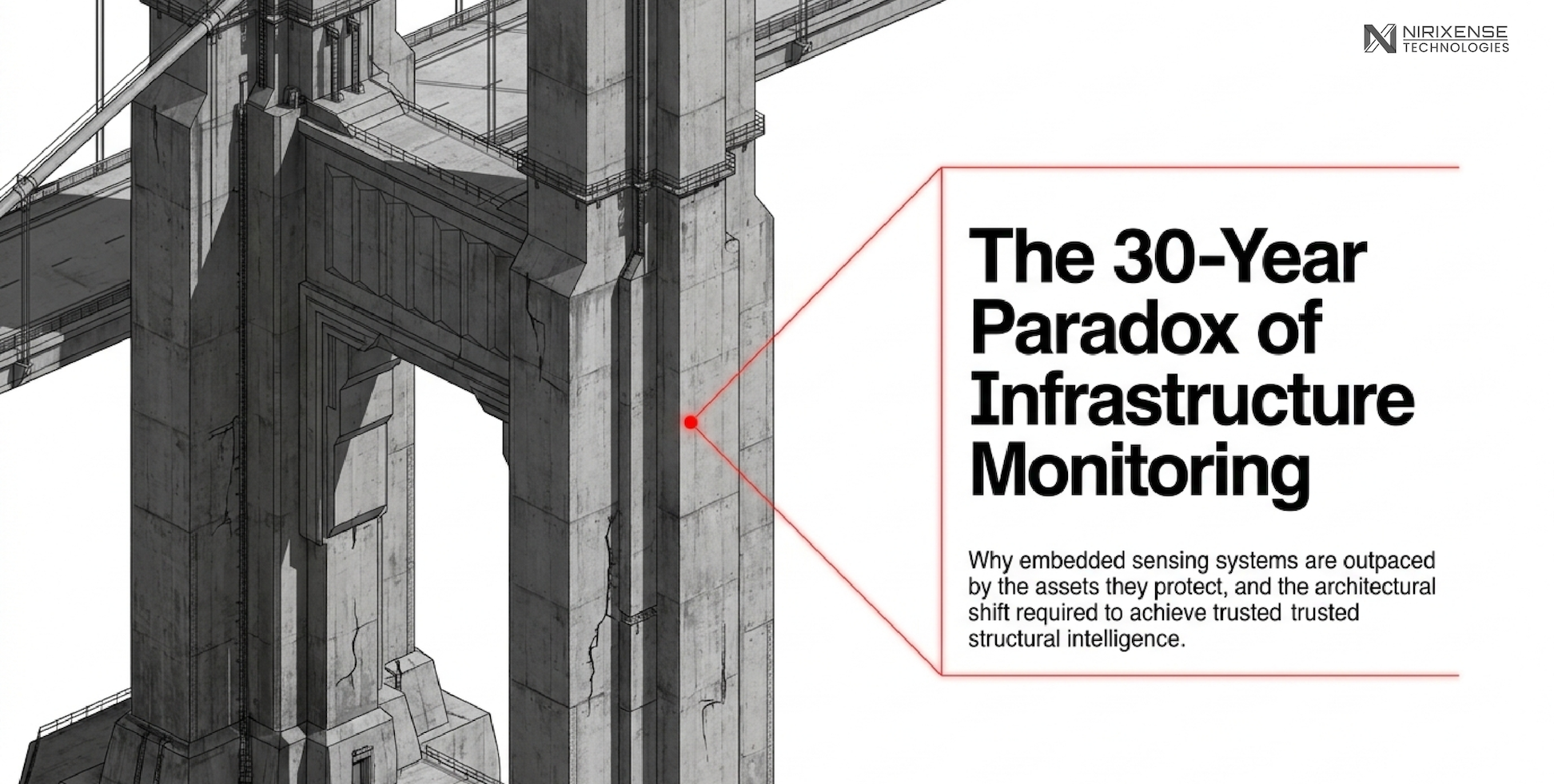
The 30-year paradox of infrastructure monitoring
Divya Koppikar, Product and UI/UX Designer, Nirixense Technologies
Om Narayan Singh, Applications Engineer, Nirixense Technologies
(July 2026)
At Nirixense, our expert conversations are less about answers and more about reframing the questions the industry has been asking for decades.
Structural Health Monitoring (SHM) is built for the long term. Monitoring systems are increasingly deployed across bridges, tunnels, dams, industrial facilities and transportation networks managed by organizations such as the National Highways Authority of India, Indian Railways and infrastructure developers including Larsen & Toubro, Afcons Infrastructure and Tata Projects. Their purpose is to provide continuous visibility into structural performance, enable early detection of deterioration and support informed lifecycle management.
As monitoring technologies continue to advance, much of the conversation has focused on better sensors, predictive analytics and digital twins. Yet one fundamental question remains largely overlooked:
Can the monitoring system itself remain as dependable as the infrastructure it is designed to monitor?
When physical infrastructure outlives its digital infrastructure
Bridges, tunnels and dams are designed to remain in service for 50, 75 or even 100 years. The technologies monitoring them, however, operate on very different timelines. Batteries degrade, sensors drift, communication technologies evolve and electronic components eventually become obsolete.
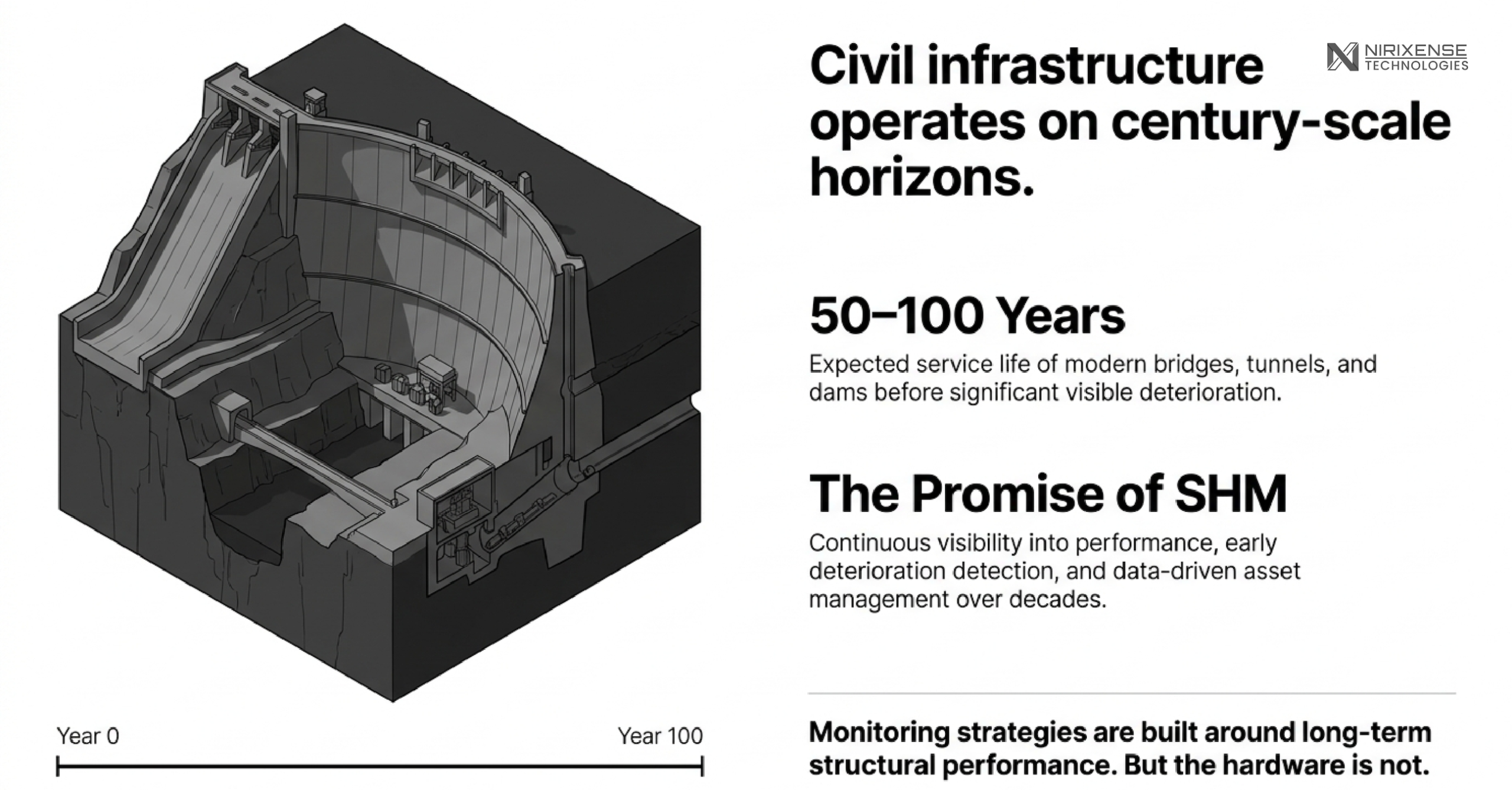
This creates an inherent mismatch between the lifespan of the asset and the lifespan of the technology monitoring it. While civil infrastructure is designed to endure for generations, monitoring hardware evolves at the pace of the electronics industry.
Infrastructure lasts for generations. Electronics don’t.
Infrastructure managed by agencies such as the Ministry of Road Transport and Highways, National Highways Authority of India and Indian Railways is expected to deliver reliable service over decades, making long-term monitoring an essential part of asset management.
Monitoring hardware follows a very different lifecycle. Sensors, communication modules, embedded electronics and power systems evolve rapidly through firmware updates, changing communication standards and component obsolescence. As a result, monitoring systems may require multiple upgrades long before the infrastructure reaches the stage where long-term historical data becomes most valuable.
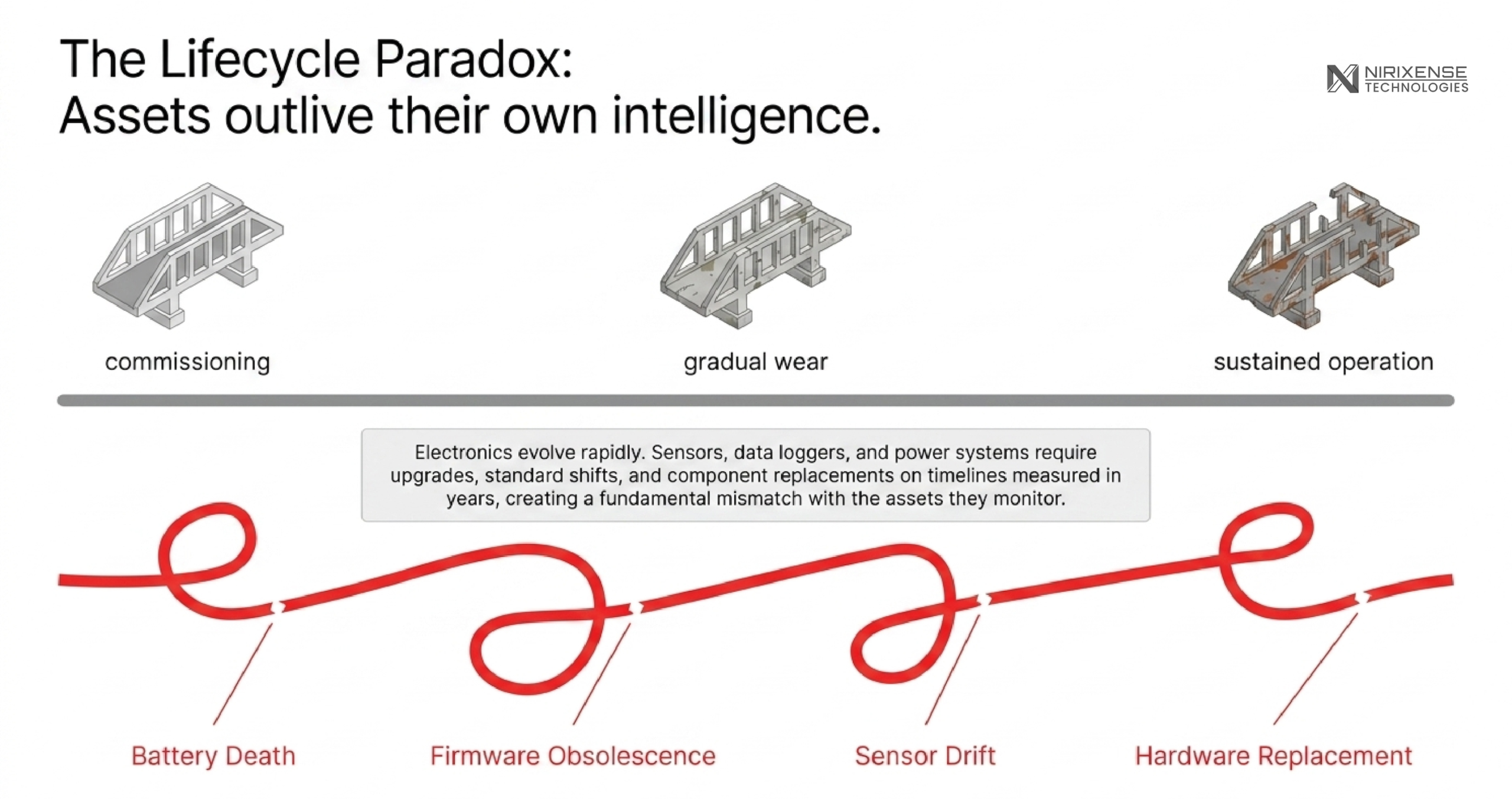
As SHM becomes central to infrastructure management, ensuring the longevity and reliability of the monitoring system itself will become just as important as monitoring the structure it serves.
Is the structure changing, or is the sensor?
One of the most important challenges in long-duration monitoring is distinguishing structural behaviour from instrumentation behaviour.
Engineers typically interpret changes in measurements as indicators of changing structural conditions. Over extended periods, however, the monitoring system itself can introduce uncertainty. Sensors may drift, calibration may change, electrical noise may influence measurements, and environmental exposure can affect system performance.
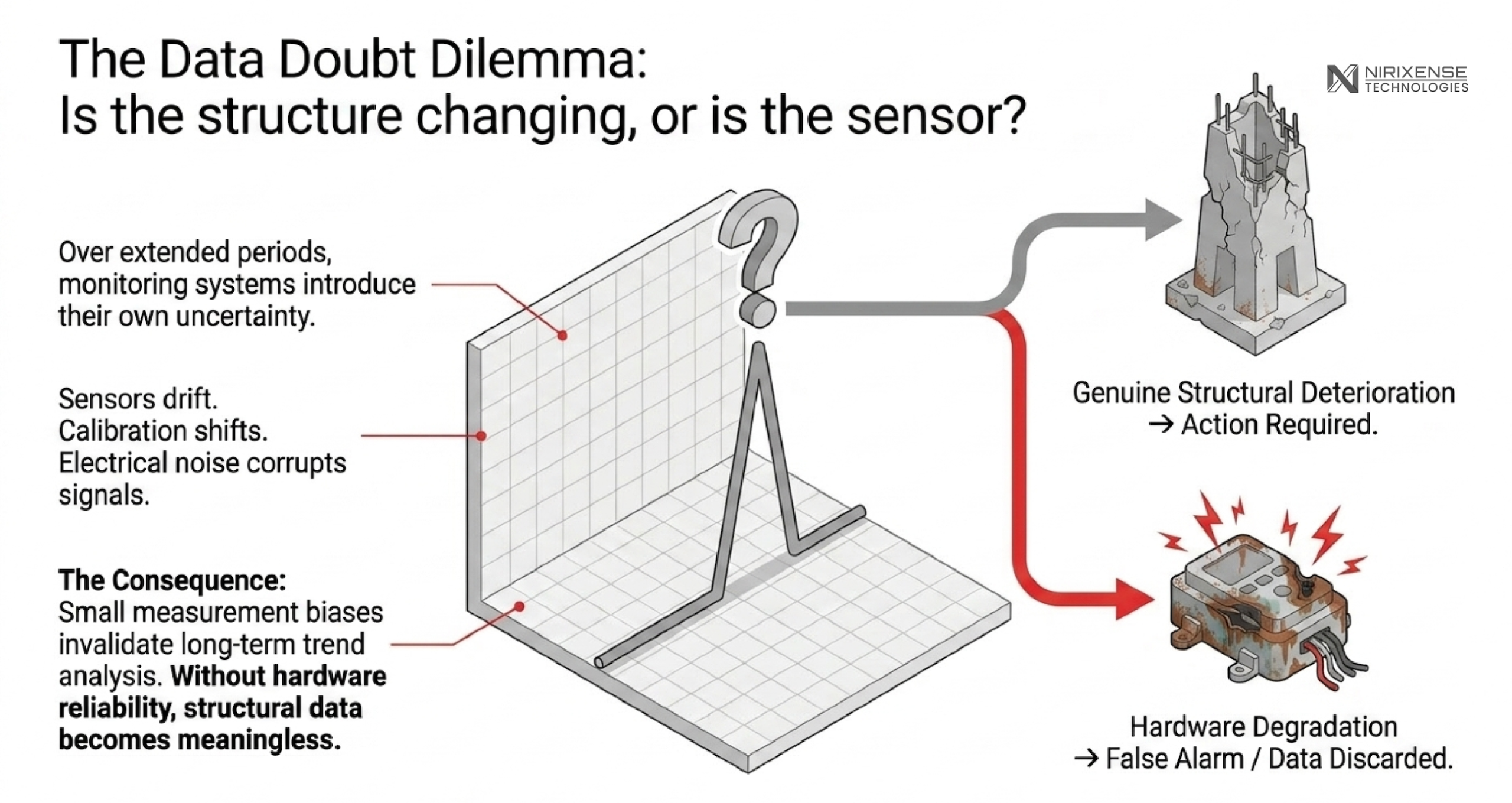
The consequence is a question that becomes increasingly difficult to answer as monitoring programs mature:
“Is the structure changing, or is the monitoring system changing?”
For assets that deteriorate slowly over decades, even small measurement biases can influence trend analysis, condition assessment, and maintenance decisions. The challenge is not simply collecting data over long periods. It is maintaining confidence in the quality and consistency of that data throughout the monitoring lifecycle.
Reliability in the field is different from reliability in the laboratory
Monitoring systems operate in some of the harshest environments encountered by engineering systems. Unlike laboratory instruments, field-deployed sensors must withstand temperature fluctuations, humidity, rainfall, corrosion, dust accumulation, vibration, power interruptions, and electromagnetic disturbances over extended periods.
A sensor that performs well during commissioning may face a very different reality after years of continuous exposure to real operating conditions.
This raises an important consideration for infrastructure owners. The challenge is not proving that a monitoring system works immediately after installation. The challenge is demonstrating that it can continue producing reliable and trustworthy measurements after years of operation with minimal intervention.
As monitoring programs increasingly move toward lifecycle-based asset management, long-term reliability is becoming just as important as measurement accuracy.
The industry’s next challenge may be lifecycle reliability
The SHM industry has made significant progress in sensing technologies, wireless communication, cloud platforms, and data analytics. These developments have improved the ability to collect and process structural information at unprecedented scale.
The next challenge may be less visible but considerably more important.
Infrastructure owners are increasingly evaluating monitoring systems through a lifecycle lens. Questions around maintenance requirements, component replacement, calibration intervals, system resilience, and long-term operating costs are becoming central to deployment decisions.
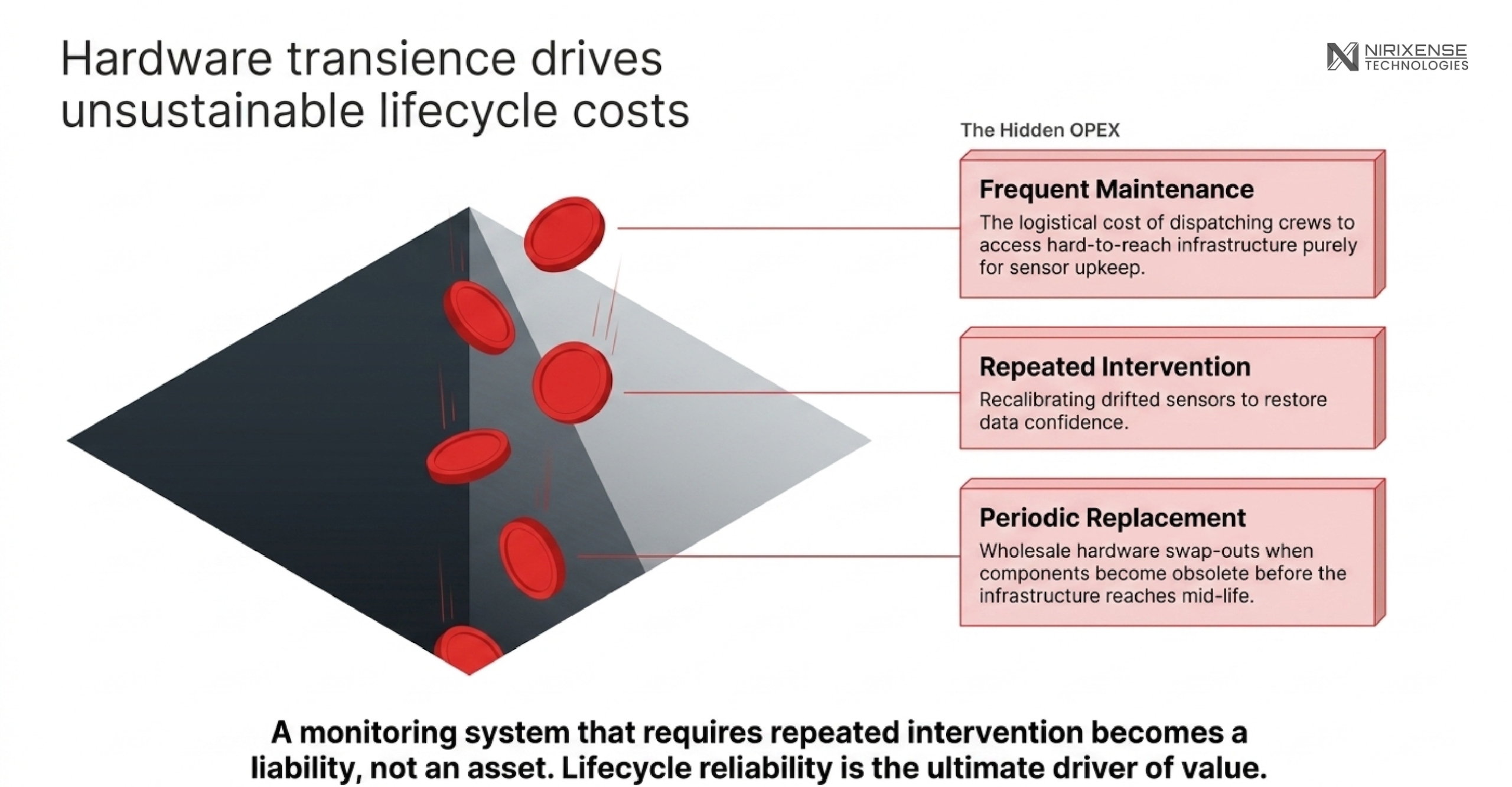
A monitoring system that requires frequent maintenance, repeated intervention, or periodic replacement can significantly increase ownership costs over time. In such cases, lifecycle reliability becomes a critical component of the overall value proposition.
The discussion is gradually shifting from how monitoring systems are deployed to how sustainably they can be operated over decades.
The rise of self-monitoring infrastructure systems
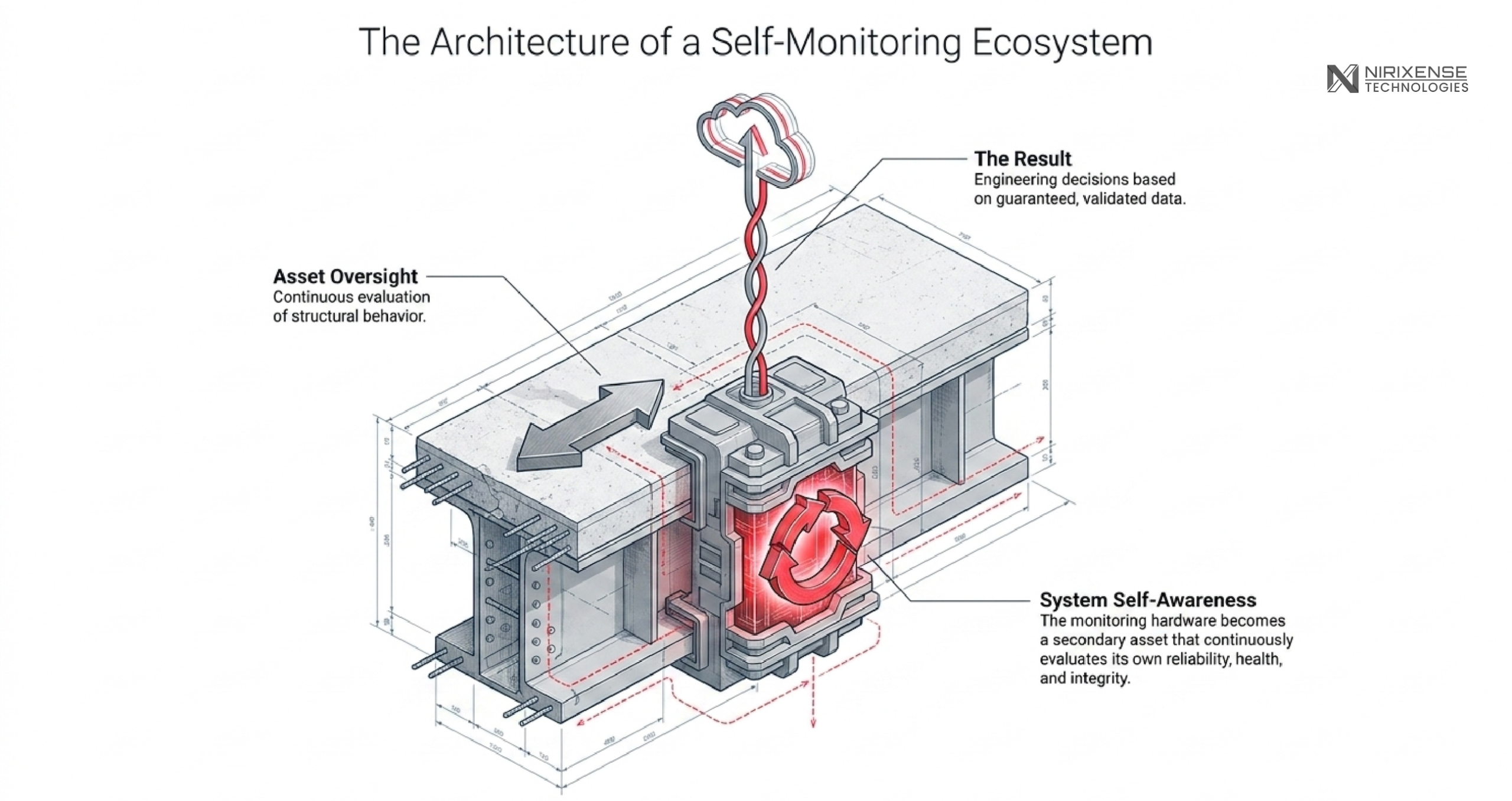
As Structural Health Monitoring systems become more sophisticated, the next evolution is not only monitoring infrastructure but continuously monitoring the monitoring system itself.
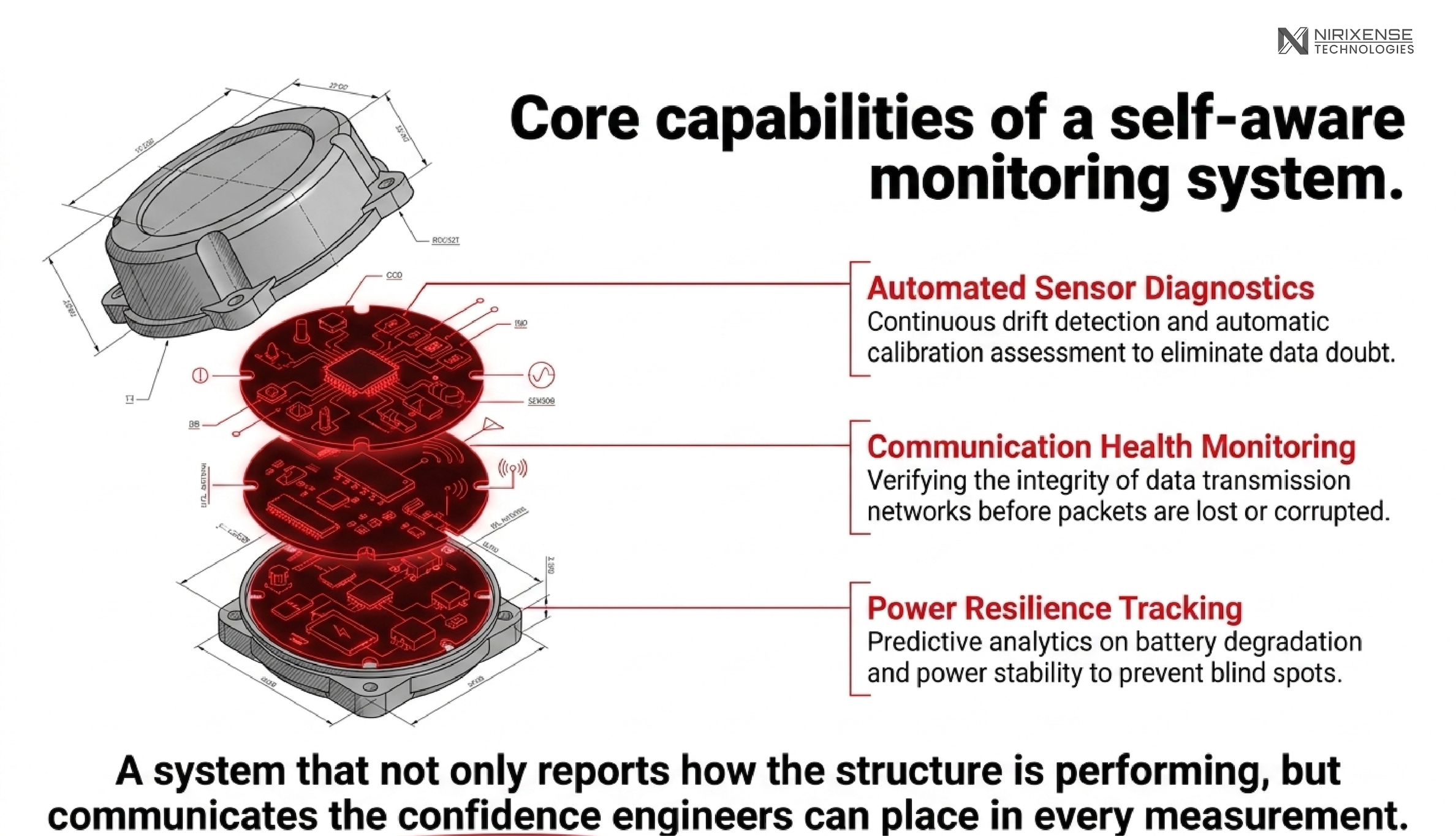
Capabilities such as sensor validation, drift detection, communication diagnostics, calibration assessment and system health checks are becoming essential to ensure that engineering decisions are based on reliable data. In this sense, the monitoring system becomes an asset that also requires continuous oversight.
Ultimately, trustworthy structural intelligence depends not only on understanding the health of infrastructure, but also on understanding the health of the technologies generating that intelligence.
How we’re building towards this at Nirixense
At Nirixense, we believe the future of SHM lies in building monitoring systems that are as resilient and intelligent as the infrastructure they are designed to protect.
Our vision extends beyond developing embedded, long-term sensing networks. We are working towards creating monitoring ecosystems that continuously evaluate not only the structural behaviour of an asset but also the health, reliability and integrity of the sensing infrastructure itself. From automated sensor diagnostics and communication health monitoring to data quality validation and system-level self-awareness, our goal is to ensure that engineers can trust the information they rely on throughout the entire lifecycle of an asset.
As embedded monitoring becomes a permanent layer within critical infrastructure, maintaining confidence in both the structure and the monitoring system will become equally important. We believe the next generation of SHM will combine long-term embedded sensing with intelligent self-diagnostics, enabling infrastructure that not only reports how it is performing but also communicates the confidence engineers can place in every measurement.
Because the future of Structural Health Monitoring is not simply about collecting data over decades it is about delivering trusted structural intelligence over decades. That is the direction we are building towards at Nirixense.
© 2026 Nirixense Technologies Pvt. Ltd. All rights reserved. email: connect@nirixense.com
About this series: Field Notes in Structural Intelligence is a thought leadership series by Nirixense Technologies, where we engage with experts across structural engineering and monitoring to understand how SHM actually works in practice and where it needs to evolve next.