
Safe and efficient core cutting with ReX 100 rebar scanner
Case Study
Om Narayan Singh, Applications Engineer, Nirixense Technologies
Sai Srikar Kolluri, Product Manager, Nirixense Technologies
Divya Koppikar, Product and UI/UX Designer, Nirixense Technologies
(December 2025)
Core cutting may look simple from the outside, but inside every RCC column or slab lies a dense, invisible world of steel reinforcement. Cutting blindly through it isn’t just risky; it can damage rebars, weaken the structure, destroy expensive tools, and derail project timelines.
During a recent field test at an active construction site amid 32°C heat, 62% humidity, dust, vibration, and constant occupational activity, we deployed the ReX 100 to scan a column and slab before drilling. The goal was to assess how ReX 100 performs in a tough environment such as an active construction site. The outcome: 100% accurate detection even in challenging field conditions.
Watch the on-site operation in our YouTube videos:
ReX 100 technology overview:
The ReX 100 uses pulsed eddy current (PEC) technology, enhanced by a real‑time, on‑device AI engine called TriDynamic Intelligence. Unlike traditional scanners that require sequential scans or parameter inputs, the ReX 100 captures three independent measurements simultaneously in a single scan:
- Precise rebar location
- Cover depth up to 120 mm
- Rebar diameter
This means no guesswork, no entering values manually, and no calibration before each use. The ReX 100 comes with an Android app for visualizing data instantly, and delivers accurate performance even under heavy dust or vibration, thanks to robust edge‑AI interference filtering.
Methodology:
A standardized procedure was followed to maximize scan accuracy and efficiency:
- Grid marking: Chalk lines defined on the column face and on the slab to localize scanning zones precisely.
- Horizontal scanning: Multiple passes captured main reinforcement longitudinal positions.
- Vertical scanning: Captured stirrups and mesh reinforcement orientations.
- Double verification: For the column, two complete scan sets per face (four total) ensured data consistency; four complete scans covered the slab.
- Data visualization: Detected reinforcement locations were marked on the surface; data was simultaneously visualized and logged via the ReX 100 app.
- Safe zone identification: Clear, reinforcement-free areas were confirmed and marked for core drilling.
This approach minimized downtime since repeated scans were quick thanks to the device’s simultaneous tri-parameter detection. The app enabled rapid assessment and verification without post-processing delays.
Observation note: Double scans filtered vibration noise; app provided instant grid maps for on-site decisions.
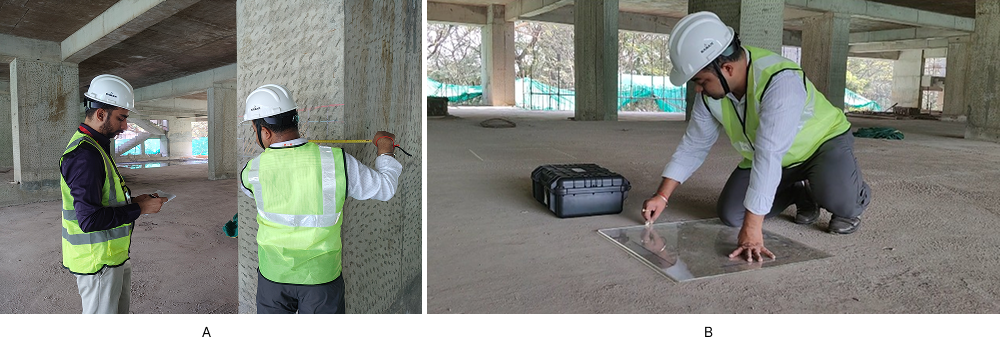
Figure 1: Grid marking carried out on the RCC column (A) and RCC slab (B) to establish accurate reference lines for scanning.
Results and observations:
Performance summary:
| Metric | ReX 100 result |
|---|---|
| Detection accuracy | 100% in challenging conditions |
| Scan time per element | Significantly reduced due to 3‑in‑1 measurement |
| Interference handling | Edge-AI mitigates errors due to electromagnetic interference and vibration; dust-proof design ensures reliability |
| Output delivery | Real-time reports generated in Android app |
Observation note: PEC technology penetrated up to required depths reliably; independent measurements eliminated sequential errors.
Scan results by element:
RCC column
Scans performed on an RCC column of length 750mm revealed clear and well-spaced main rebars along the horizontal axis and regularly spaced stirrups vertically. The identified core cutting zone was confirmed free of reinforcement, reducing the risk of damage drastically. (Please see video recording of the entire process for step by step walk through)
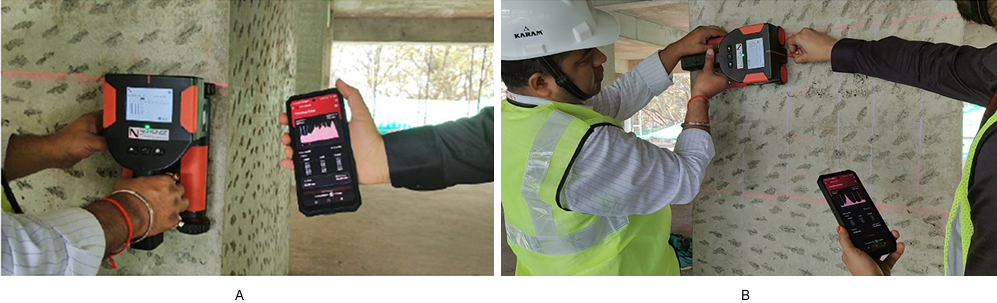
Figure 2: (A) Horizontal scanning for locating main reinforcements, and (B) Vertical scanning for locating stirrups.
| Scan type | Findings | Status |
|---|---|---|
| Main reinforcement | Main rebars clearly spaced | Detected |
| Stirrups | Stirrups at consistent intervals | Detected |
| Core cutting zone | No reinforcement detected | Safe for drilling |
Observation Note: Clear zone confirmed after verification; no risk to steel reinforcement or core cutting machine during core extraction.
RCC slab
Scans performed on a slab of area 610mm x 613mm showed uniform top rebar mesh with clear intersections, and a small, safe extraction point that was confidently determined. The ability to capture all required parameters in one scan ensured high efficiency and reliability despite the challenging site environment. (Please see video recording of the entire process for step by step walk through)
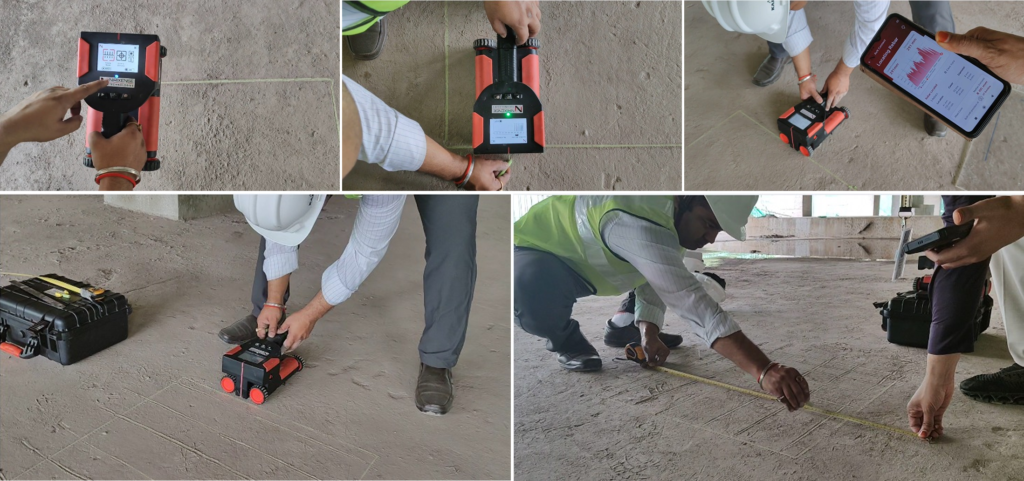
Figure 3: Slab scan results showed a uniform top rebar mesh with clear intersections and allowed drawing of precisely marked core cutting grid.
| Scan type | Findings | Status |
|---|---|---|
| Main reinforcement | Main rebars clearly spaced | Detected |
| Stirrups | Stirrups at consistent intervals | Detected |
| Core cutting zone | No reinforcement detected | Safe for drilling |
Observation Note: Uniform mesh detection validated layout; safe point selected without overlaps.
Key observations:
- Column: Reinforcement-free core cutting zone clearly confirmed after double verification.
- Slab: Uniform mesh pattern mapped precisely; safe drilling spot identified.
- Speed: Reduced scanning and assessment time compared to conventional multi-step scanners.
- Reliability: Edge-AI processed out noise from dust and vibrations effectively.
Efficiency impact on core cutting operation:
By providing fast, accurate, and complete data in a single scan per location, ReX 100 substantially improves workflow efficiency in core cutting projects. This technology reduces the number of scans needed, shortens on-site decision time, and eliminates costly mistakes from undetected rebars.
Operators can act confidently on scan results immediately, avoiding delays from damaged diamond core bits or structural repairs. The integration with an easy-to-use app streamlines reporting, allowing core cutting operations to proceed faster with secured safety margins.
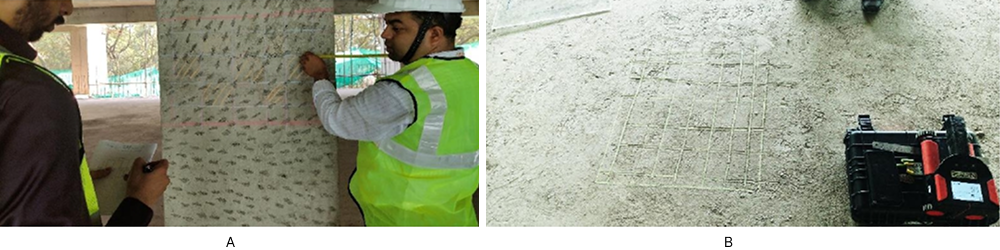
Figure 4: Final core cutting zones on the (a) RCC colum, and (B) RCC slab as determined by the ReX 100.
Potential cost of undetected rebar in core cutting operation
- Destroyed diamond core bit
- Structural repair if bar is damaged
- Schedule delays and associated costs
- Total potential impact: Overhead costs + project delays
Conclusion:
ReX 100’s advanced scanning technology enhances core cutting efficiency by delivering rapid, precise reinforcement detection under real-world conditions. This helps reduce overhead, prevents structural damage, and keeps schedules on track.