
Rebar layout and cover evaluation for safety audits and redevelopment of old RCC structures
Technology Perspective
Dr. Sauvik Banerjee, Co-founder & Director, Nirixense Technologies (November 2025)
Revival and redevelopment of older reinforced concrete structures is crucial for keeping cities safe and functional. With age, these older structures (those exceeding 30 years of service life) undergo material degradation caused by factors such as inadequate cover, increased load demand, rebar misplacement, environmental exposure and corrosion. These issues weaken the bond and tensile behavior between the steel reinforcement and the concrete.
Ensuring a building’s safety and long life requires regular structural audits. A structural audit is a detailed inspection carried out by a certified structural engineer to evaluate a building’s condition and stability. The audit identifies signs of damage or deterioration and recommends repairs or strengthening measures where needed. During the audit, the engineer checks the structure’s load-bearing capacity, and looks for issues such as corrosion, cracks, water leakage, and material aging.
In many parts of India, especially Maharashtra, these audits are mandatory under government regulations. According to the Bye-laws of Cooperative Housing Societies under the Maharashtra Co-operative Societies Act, these audits must be done every five years for societies with building age between 15 to 30 years and every three years for buildings that are older than 30 years. Prior to safety audits and redevelopment decisions it is essential to assess concrete cover, rebar layout and evaluate quality of such structures.
Many older buildings, typically those over 30 to 50 years old, often lack updated structural drawings. This makes it challenging to locate embedded rebars, and understand their cover depth and diameter. Since drawings are unavailable for such older structures, core drilling is required to guide the rebar location. When core drilling is performed without precise knowledge of rebar locations, there is a significant risk of damaging the reinforcing steel. Such damage can compromise the strength of concrete structures and potentially lead to costly repairs.
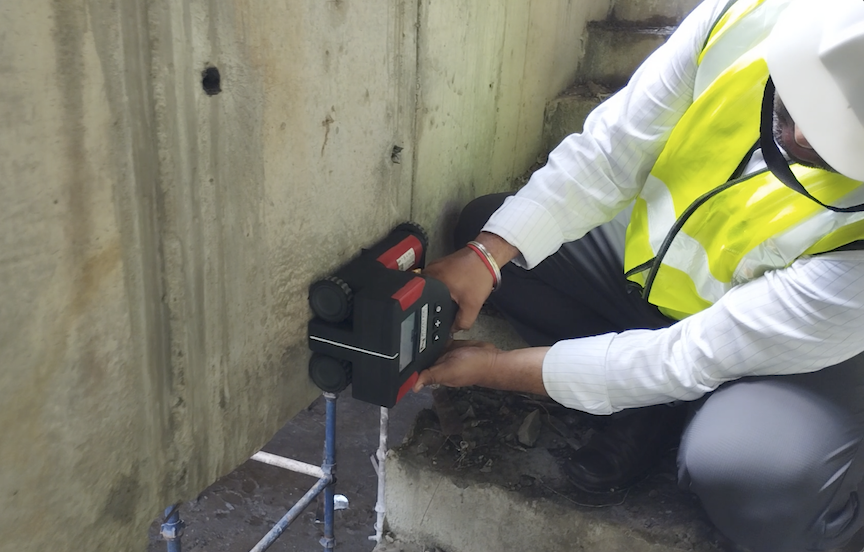
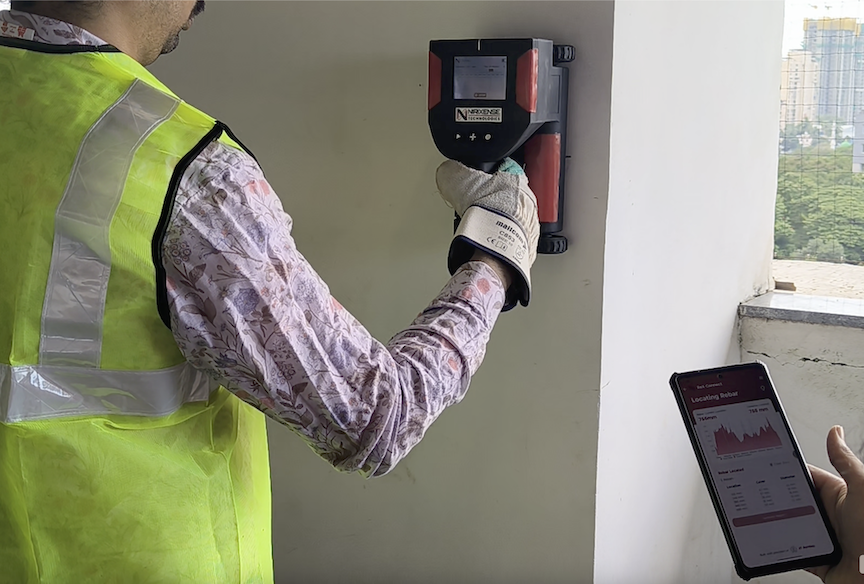
To prevent such issues, auditors use a rebar locator and cover meter to identify the exact location and depth of rebar within concrete, enabling safer core drilling operations. Cover depth can vary significantly due to corrosion induced loss, which influences both durability and structural performance. Water intrusion, carbonation, and chloride attack speed up rebar corrosion in older buildings, weakening the concrete-rebar connection. In India, IS 456: 2000 mandates minimum cover requirements for various RC elements, for corrosion protection and fire resistance.
Surface coatings, paint, plaster, and tiles may interfere with the electromagnetic signal in conventional equipment. GPR-based devices operate poorly in moist situations due to decreased signal transmission. In such cases auditors faced challenges in detecting the location, diameter and cover depth of rebar using traditional GPR based instruments. Moreover, many cover meters available are large and difficult to scan at the complex geometry of the structures. ReX 100 effectively addresses above challenges and providing real-time insights of embedded rebar layout configurations. ReX 100 is a handheld rebar cover meter that utilizes advanced pulsed eddy current (PEC) technology for localization of rebar, cover depth, and diameter estimations in different RCC structures. ReX 100 is ideal for contractors who need to measure rebar placement, cover and diameter, for up to 120 mm deep rebars. It is compact, durable, and easy to use in confined or uneven spaces. The free Android app simplifies report generation for audits and redevelopment planning, helping engineers make quick, informed safety assessments.
© 2025 Nirixense Technologies Pvt. Ltd. All rights reserved. email: connect@nirixense.com
About the Author: Dr. Sauvik Banerjee is Co-founder & Director at Nirixense Technologies, and Professor at Department of Civil Engineering, IIT Bombay. His experience includes structural health monitoring, using wave propagation and vibration-based approaches, quantitative nondestructive evaluation of structures, nondestructive testing, modelling of advanced composite structures, structural retrofitting and impact response of structures. He obtained Ph.D. degree from UCLA (Mechanical Engineering, 2003), M.Tech. from IIT Bombay (Civil Engineering, 2001).
Note: This article presents the author’s personal views and insights drawn from publicly shareable aspects of research and consultancy projects conducted as a faculty member at IIT Bombay. The content is intended solely for thought leadership and knowledge sharing. The views expressed do not necessarily represent those of IIT Bombay.