
Reading between the lines of regulations
In conversation with Mr. Atul Bhobe
Technology Perspective
Divya Koppikar, Product and UI/UX Designer, Nirixense Technologies
Om Narayan Singh, Applications Engineer, Nirixense Technologies
(May 2026)
Mr. Atul Bhobe is a highly respected structural engineering expert and industry leader, known for his deep expertise in structural health monitoring, bridge engineering, and infrastructure diagnostics, with decades of consulting experience on complex projects.
He has played a pivotal role in advancing practical SHM applications in India, combining engineering judgment with real-world implementation, and is widely regarded for shaping how monitoring is actually deployed and used in critical infrastructure.
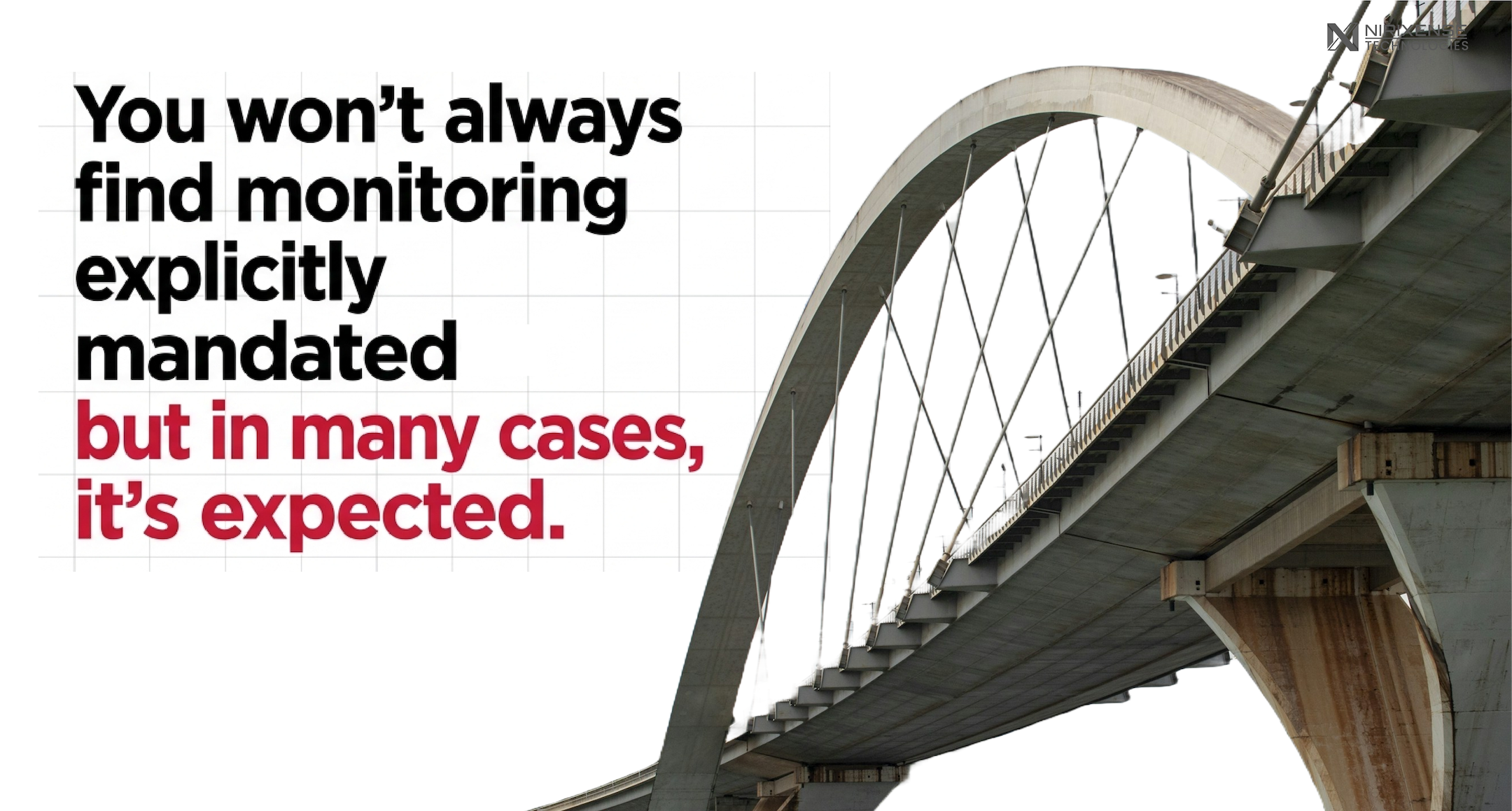
Structural Health Monitoring (SHM) is not uniformly mandated across infrastructure projects today but it is no longer optional in any practical sense. Somewhere between evolving guidelines, agency expectations, and increasing project risk, monitoring has entered a grey zone where it may not always be explicitly required, yet is becoming increasingly difficult to justify excluding.
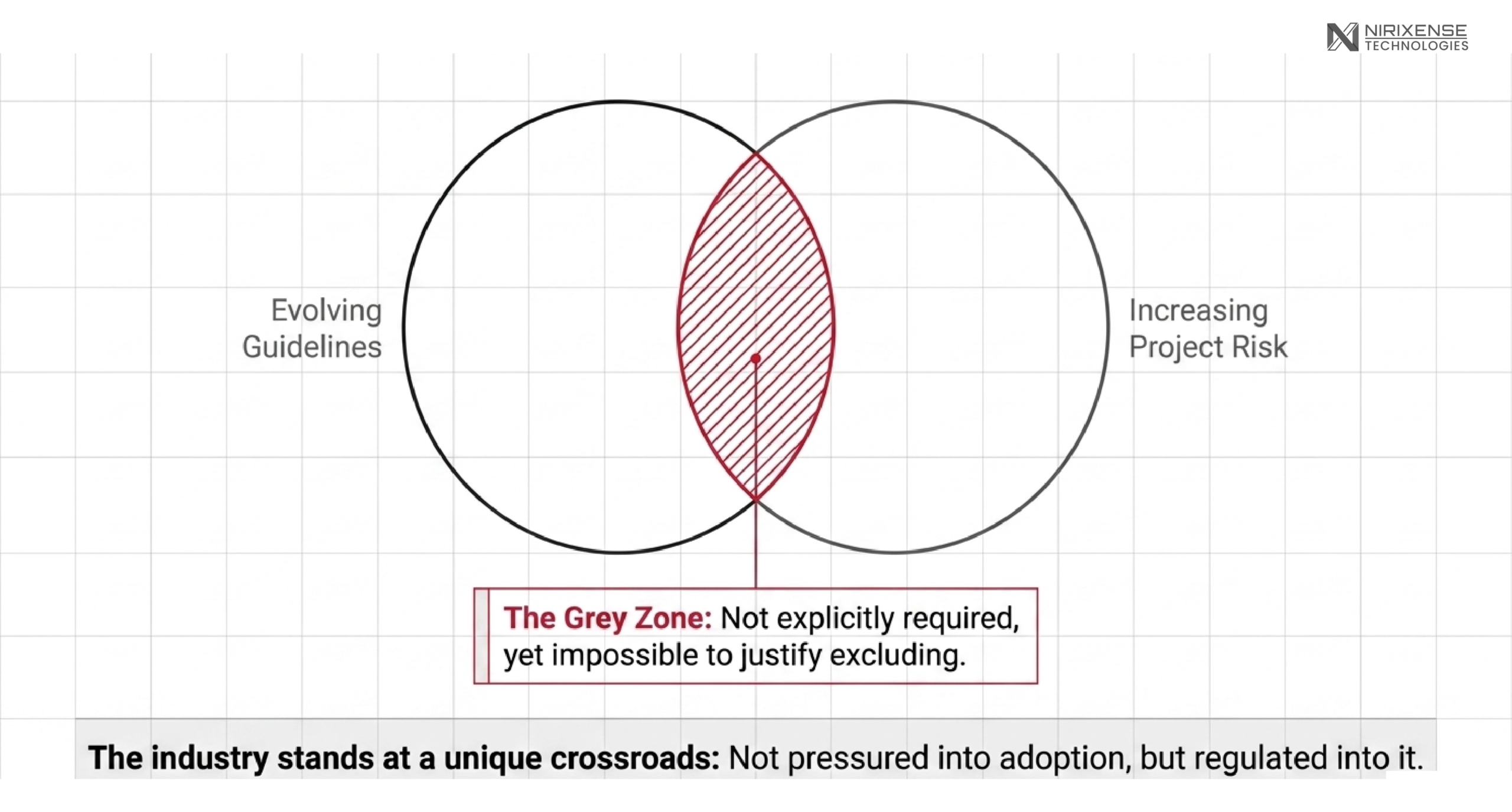
This is exactly where the industry stands today not pressured into adoption, but regulated into it.
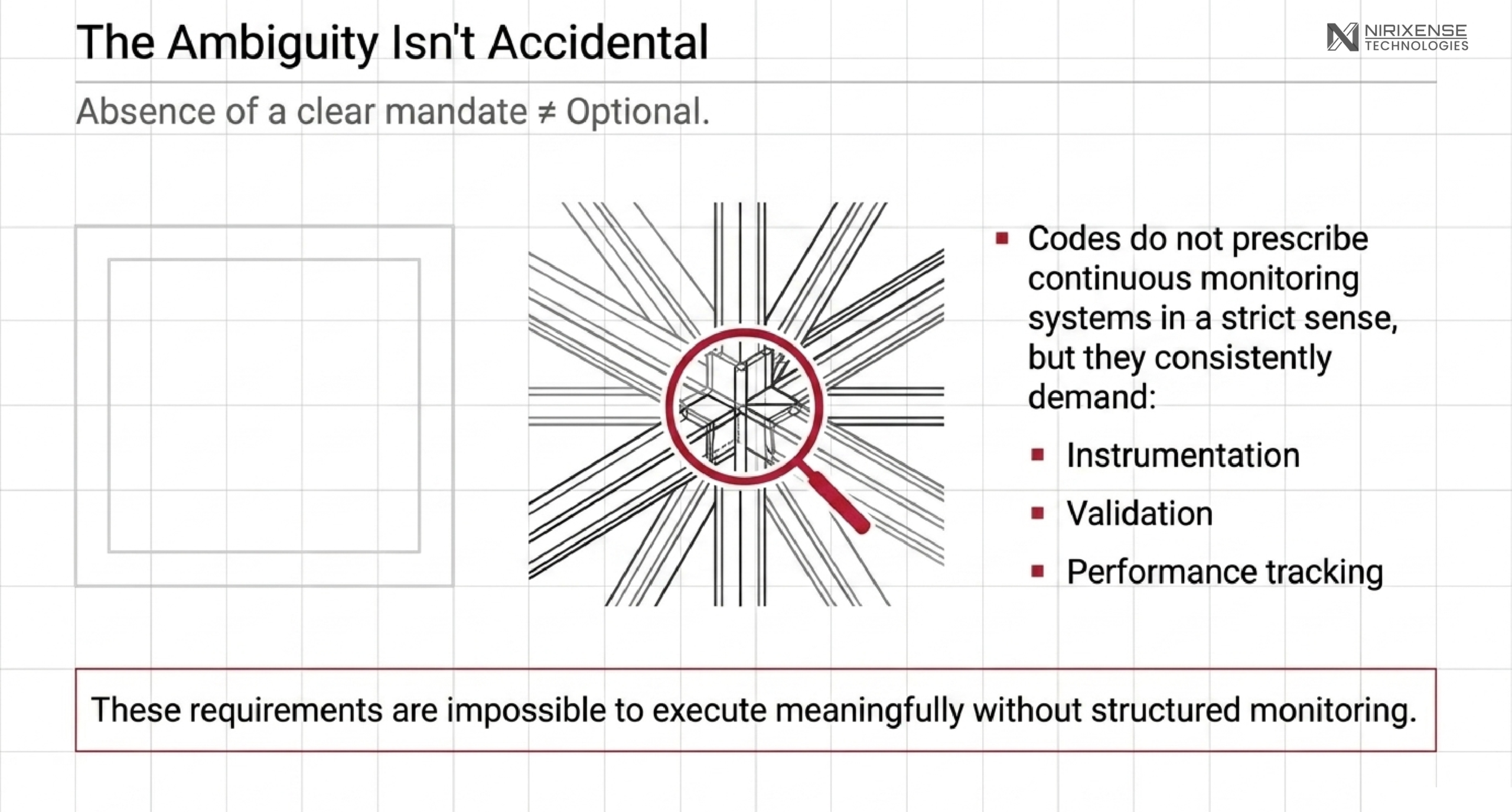
The ambiguity isn’t accidental
If you look for a clear directive mandating SHM across all infrastructure projects, you won’t find one. That absence often leads to a dangerous assumption that monitoring is optional.
In reality, the situation is far more nuanced. Codes may not prescribe continuous monitoring systems in a strict sense, but they consistently point toward:
- Instrumentation
- Validation
- Performance tracking
Which, in practice, are impossible to execute meaningfully without structured monitoring.
As Atul Bhobe puts it:
“You won’t always find monitoring explicitly mandated but in many cases, it’s expected.”
This gap between what is written and what is required in practice is where most projects operate and where the need for reliable SHM systems emerges.
Guidelines set direction, not depth
Frameworks from the Indian Roads Congress (IRC) emphasize load testing, construction-stage instrumentation, and validation, all of which implicitly depend on monitoring, but stop short of defining how monitoring should be implemented, sustained, or used over the lifecycle of the structure.
This creates a critical gap. Monitoring becomes a derived necessity, but not a designed system. And when something is necessary but not well-defined, it is often:
- Underutilized
- Underspecified
- Under-engineered
Where the real push is coming from
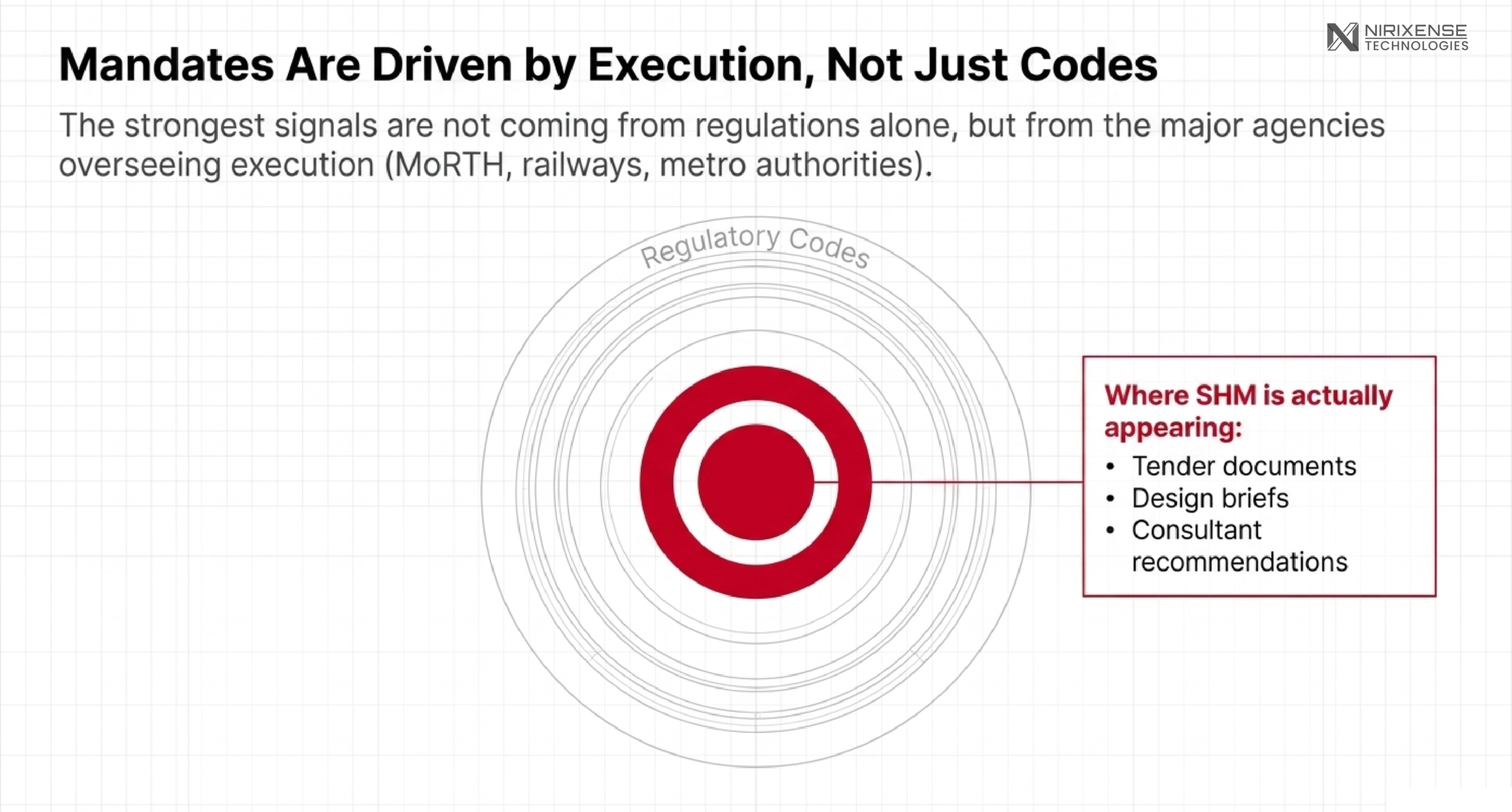
The strongest signals are not coming from regulations alone, but from execution environments, especially in projects involving agencies like the Ministry of Road Transport and Highways (MoRTH), railways, and metro authorities.
Here, monitoring is increasingly appearing in:
- Consultant recommendations
- Tender documents
- Design briefs
“In many projects involving major agencies, monitoring is being specified more frequently, especially during construction or load testing.”
But this inclusion is still inconsistent, which means implementation quality varies widely from meaningful systems to basic instrumentation.
Expectation is replacing mandate
| Project context | Level of necessity | How monitoring is treated | Primary purpose | Typical implementation |
|---|---|---|---|---|
| High-risk / High-value structures (e.g., long-span bridges, complex infrastructure systems) | Expected (quasi-mandatory) | Included in tenders and actively reviewed during execution | Reduce uncertainty and manage critical structural risk | Integrated into project scope with higher attention to deployment and outputs |
| Complex construction scenarios (e.g., tunneling near existing structures, rehabilitation projects) | Functionally indispensable (implicitly required) | Not always mandated, but necessary for engineering validation | Ensure safety, enable real-time decision-making, manage construction risk | Deployed for real-time or near-real-time monitoring during critical phases |
| Routine infrastructure (e.g., standard flyovers, short-span bridges) | Optional / minimal | Often reduced or excluded; if included, treated as a formality | Satisfy testing or compliance requirements | Temporary instrumentation, limited scope, rarely used for long-term insights |
The pattern is clear:
The higher the risk, the less optional monitoring becomes, regardless of regulation.
Why this gap is becoming unsustainable
The push toward monitoring is not being driven by regulation alone, but by:
- Increasing structural complexity
- Dense urban construction environments
- Higher accountability and scrutiny
In such conditions, relying on manual inspection, temporary instrumentation and fragmented data is no longer sufficient.
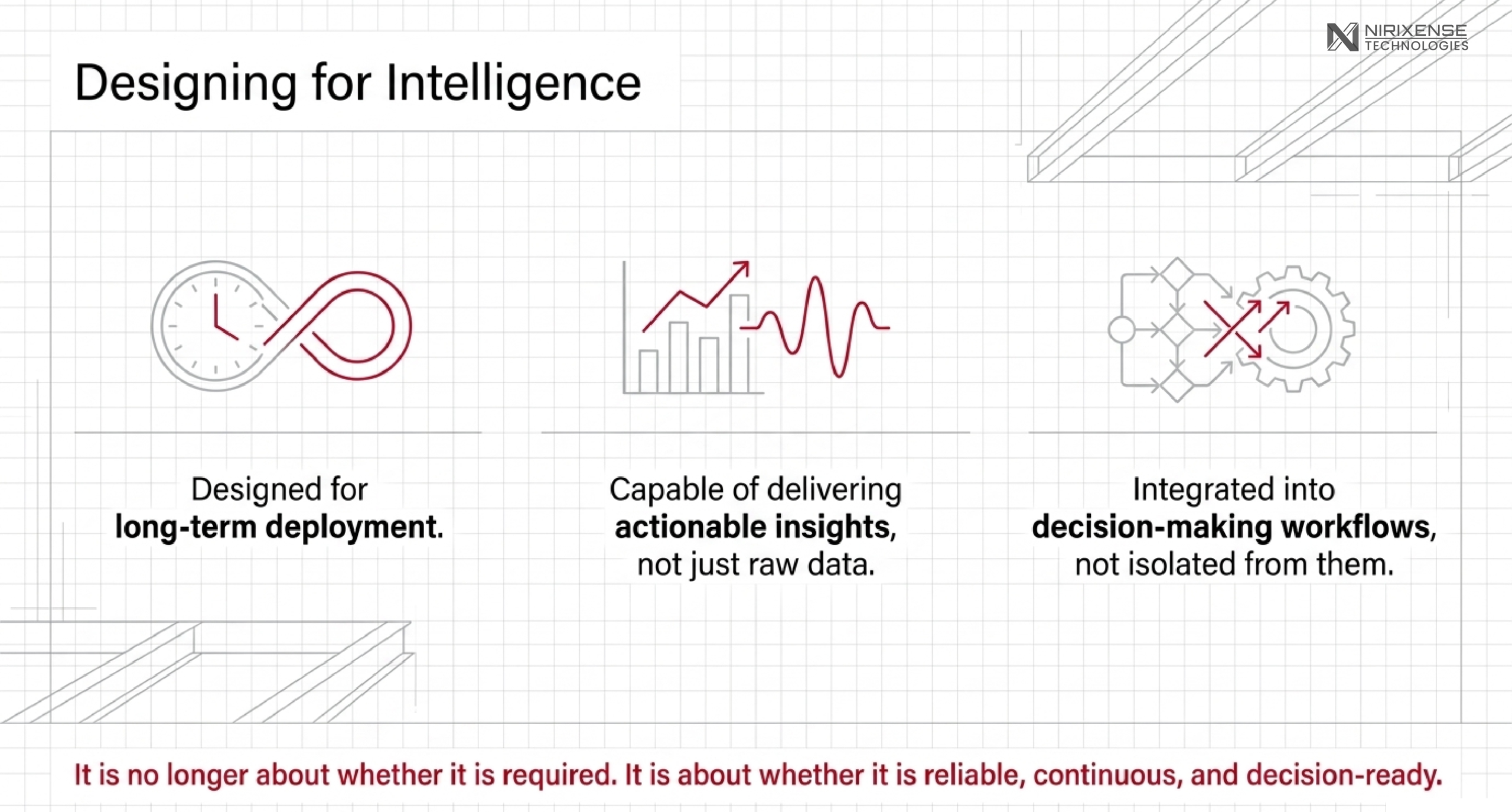
Monitoring is no longer about whether it is required.
It is about whether it is reliable, continuous, and decision-ready.
Where the industry is headed
SHM is transitioning from:
- A temporary setup → to a continuous intelligence system
- A compliance activity → to a risk management system
- A project add-on → to a core engineering layer
But this transition demands a different kind of approach, one that is:
- Designed for long-term deployment
- Capable of delivering actionable insights, not just raw data
- Integrated into decision-making workflows, not isolated from them
The real question
The industry keeps asking:
“Is SHM mandatory?”
But that is no longer the right question.
The real question is:
When monitoring becomes unavoidable in practice, why are we still implementing it like it’s optional?
Because the shift is already underway.
And the difference going forward will not be whether monitoring is used but how well it is implemented, and whether it actually informs decisions.
© 2026 Nirixense Technologies Pvt. Ltd. All rights reserved. email: connect@nirixense.com
About this series: Field Notes in Structural Intelligence is a thought leadership series by Nirixense Technologies, where we engage with experts across structural engineering and monitoring to understand how SHM actually works in practice and where it needs to evolve next.