
Performance evaluation of ReX 100 under various temperature and humidity conditions
Case Study
Om Narayan Singh, Applications Engineer, Nirixense Technologies
Sai Srikar Kolluri, Product Manager, Nirixense Technologies
Divya Koppikar, Product and UI/UX Designer, Nirixense Technologies
(January 2026)
Introduction:
This report presents a systematic evaluation of the ReX 100 rebar scanning device under controlled temperature and humidity conditions. The objective of the study is to assess the operational reliability, data accuracy, and functional stability of the device when exposed to high-temperature–high-humidity environments and low-temperature conditions, which commonly occur during field applications in diverse climatic zones.
Environmental testing is a critical requirement for non-destructive evaluation (NDE) instruments because sensor electronics, signal processing units, display modules, and batteries are sensitive to thermal and moisture-induced stresses. Therefore, this study validates whether ReX 100 maintains consistent performance after thermal conditioning.
Test setup and methodology:
Test facility
A calibrated climatic chamber is used to control temperature and relative humidity precisely. The chamber provides uniform exposure conditions to the entire device. Low temperature tests were performed in a thermal chamber.
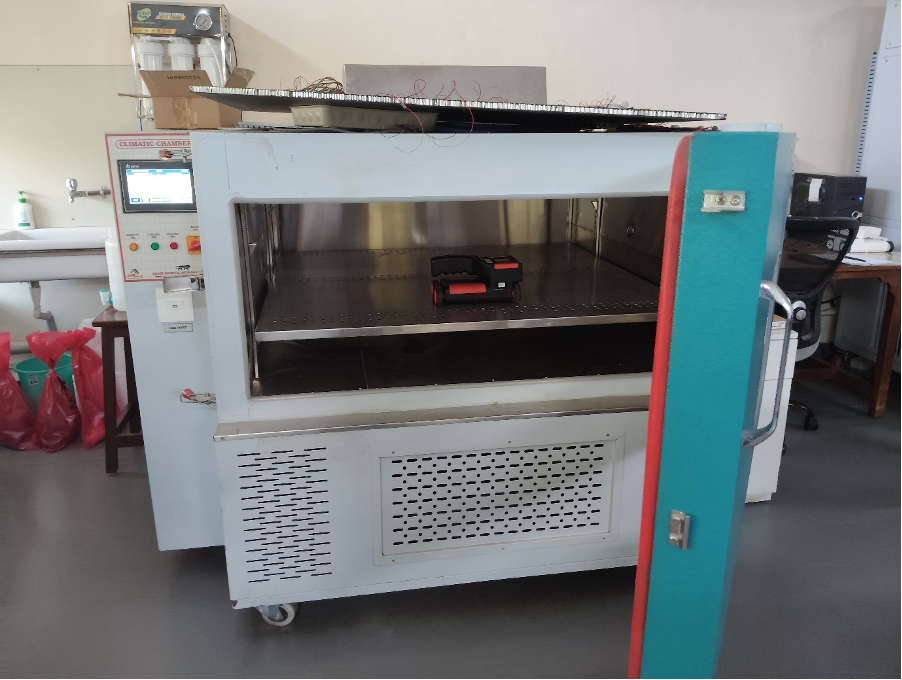
Figure 1: Climatic chamber
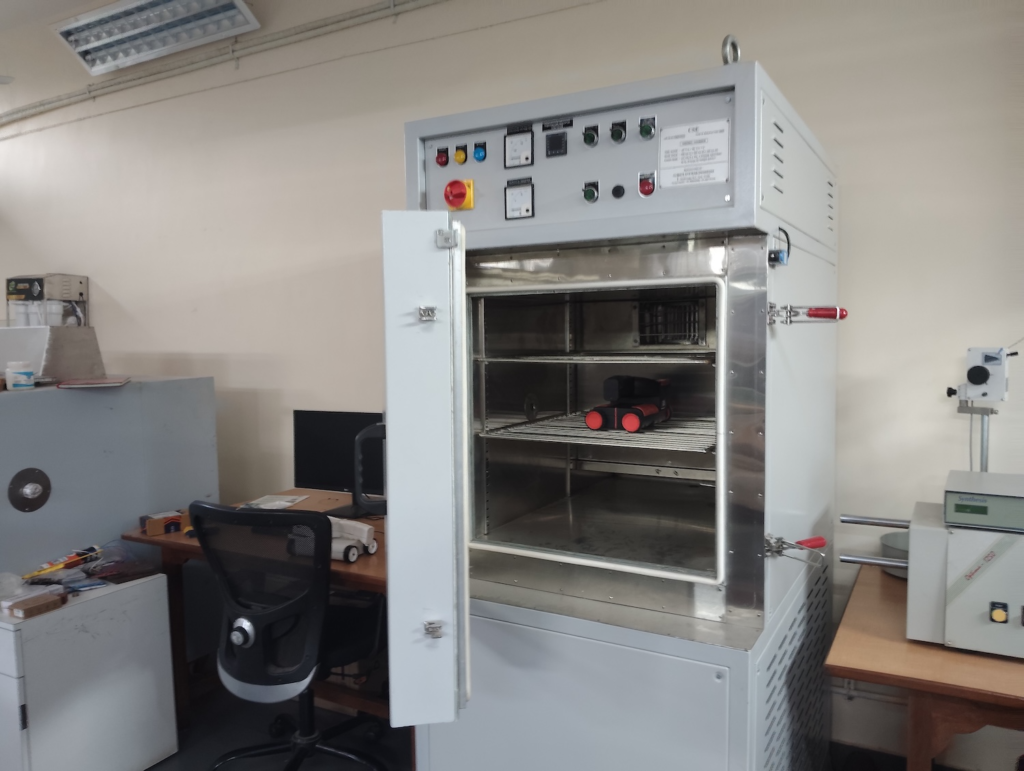
Figure 2: Thermal chamber
Test protocol
- The ReX 100 device is placed inside the climatic chamber.
- The device is exposed to predefined temperature–humidity conditions for a specified duration.
- After exposure, the device is brought back to ambient laboratory conditions (approximately 24°C).
- A stabilization period is allowed to eliminate transient thermal effects.
- Scanning is performed on a reference test surface.
- Recorded data is evaluated for:
- Signal stability
- Repeatability
- Accuracy of reinforcement detection
- Absence of malfunction or display lag
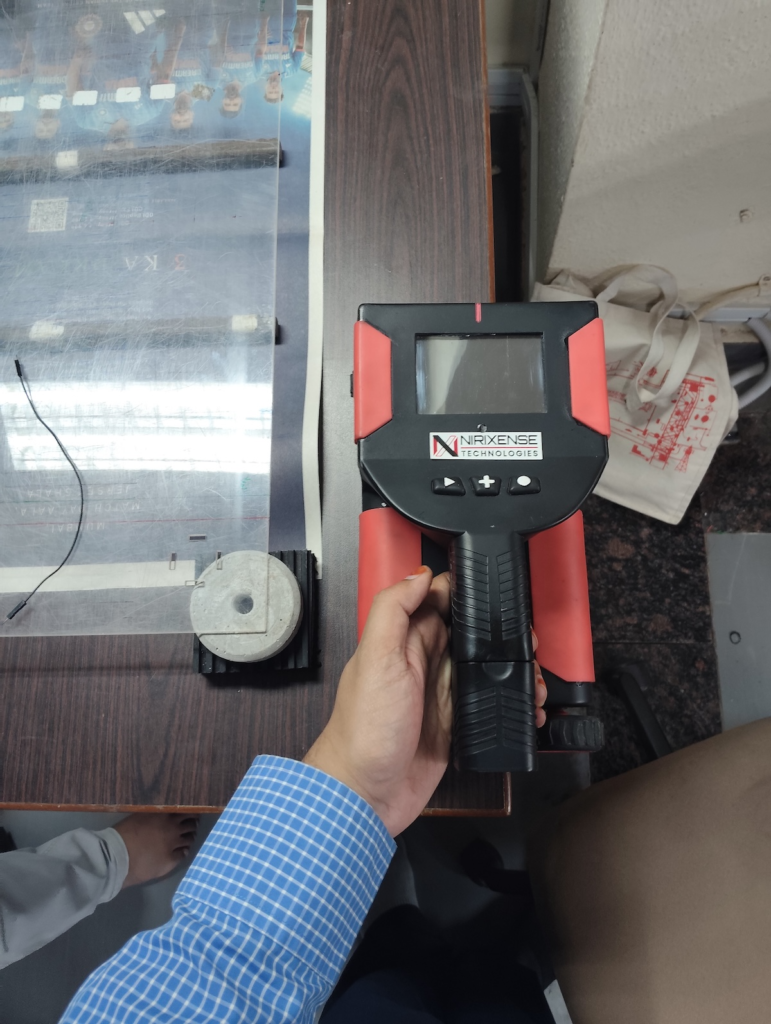
Figure 3: Test surface consisting of rebars with spacers used for introducing cover, and a plexiglass sheet for scanning the ReX 100.
Test cases and observations:
Case I: High temperature & high humidity (Moderate duration)
- Exposure conditions
- Temperature: 55°C
- Relative humidity: 85%
- Exposure duration: 20 minutes
- Post-exposure stabilization
- Cooling at ambient conditions (24°C): 5 minutes
Observations
- The device powers on normally without any delay.
- Display clarity remains unaffected.
- Scanning response is immediate and stable.
- Rebar location, spacing, and depth readings are consistent.
Inference
ReX 100 demonstrates excellent resistance to moisture ingress and thermal stress at elevated humidity levels, indicating effective sealing and stable electronic performance.
Case II: High temperature & moderate humidity (Extended duration)
- Exposure conditions
- Temperature: 75°C
- Relative humidity: 75%
- Exposure duration: 45 minutes
- Post-exposure stabilization
- Cooling at ambient conditions (24°C): 10 minutes
Observations
- No physical deformation or overheating symptoms are observed.
- Buttons and control keys respond normally.
- Signal interpretation remains reliable, without any additional noise.
- Data quality remains comparable to room-temperature operation.
Inference
The device sustains prolonged high-temperature exposure without degradation, confirming thermal robustness of internal circuitry and battery performance.
Case III: Low temperature (Cooling test)
- Exposure conditions
- Temperature: 5°C
- Relative humidity: Ambient
- Exposure duration: 30 minutes
- Post-exposure stabilization
- Return to room temperature before operation
Observations
- The device resumes normal operation after thermal equilibration.
- No lag in display or scanning speed is observed.
- Signal amplitude and detection accuracy remain stable.
Inference
ReX 100 exhibits reliable cold-environment performance, indicating suitability for early-morning, winter, or high-altitude site conditions.
Overall performance assessment
| Parameter evaluated | Performance outcome |
|---|---|
| Temperature resistance | Excellent (5°C to 75°C) |
| Humidity resistance | Excellent (up to 85% RH) |
| Signal stability | Maintained |
| Data accuracy | Consistent |
| Functional reliability | No malfunction observed |
| Recovery after exposure | Immediate and stable |
Engineering interpretation:
From a structural diagnostics and instrumentation perspective:
- The successful post-conditioning operation confirms that internal electronics, enclosure sealing, and firmware logic are well designed for harsh environments.
- The ReX 100 demonstrates high environmental adaptability, which is critical for real-world site applications such as bridges, coastal structures, basements, and industrial buildings.
- Thermal cycling does not introduce drift in sensor response, indicating robust calibration retention.
Conclusion:
Based on controlled climatic chamber testing, the ReX 100 rebar scanner shows consistent, accurate, and reliable performance across a wide range of temperature and humidity conditions. The device remains fully operational after exposure to:
- High temperature and high humidity
- Prolonged high-temperature conditions
- Low-temperature environments
This confirms that ReX 100 is suitable for deployment in diverse climatic conditions, without compromising data quality or operational safety.
Recommendation:
ReX 100 is suitable for:
- Hot and humid tropical sites
- Cold-weather inspections
- Long-duration field scanning assignments
The environmental performance validates its applicability for critical structural assessment and non-destructive testing under variable site conditions.