
Could SHM become a SaaS business?
In conversation with Dr. Sharvil Alex Faroz
Technology Perspective
Divya Koppikar, Product and UI/UX Designer, Nirixense Technologies
Om Narayan Singh, Applications Engineer, Nirixense Technologies
(June 2026)
Dr. Sharvil Alex Faroz is the Founder of Infrastructure Risk Management (IRM) and a structural engineering expert with a Ph.D. from Indian Institute of Technology Bombay, focused on helping infrastructure owners make better lifecycle decisions.
He is recognized for his work in remaining life assessment, structural health monitoring, and asset aging management, advancing practical, risk-based approaches to infrastructure resilience and longevity.
The next evolution of structural health monitoring may have less to do with sensors and more to do with how structural intelligence is delivered.
Structural Health Monitoring (SHM) has traditionally been implemented through a capital expenditure model. Monitoring systems are procured, deployed, commissioned, and subsequently maintained by the asset owner or project stakeholder. This approach has been largely uncontested because monitoring itself was viewed as a hardware-centric activity.
Sensors represented the primary source of value, and ownership naturally followed. However, as monitoring systems become increasingly digital, connected, and analytics-driven, the relationship between hardware ownership and value creation is becoming less straightforward.

A growing proportion of the value generated by SHM now resides in data management, interpretation, predictive assessment, and decision support rather than in the sensing hardware itself. This raises an important question for the industry:
Should monitoring continue to be delivered primarily through ownership of infrastructure, or should it increasingly be delivered as a service?
Monitoring requirements are not always permanent
One reason this discussion is gaining relevance is the nature of many monitoring applications themselves.
Construction-stage monitoring, load testing, rehabilitation assessment, and temporary risk mitigation programs often have clearly defined monitoring horizons. The requirement is not continuous observation throughout the life of the asset, but targeted visibility during a specific period of uncertainty.
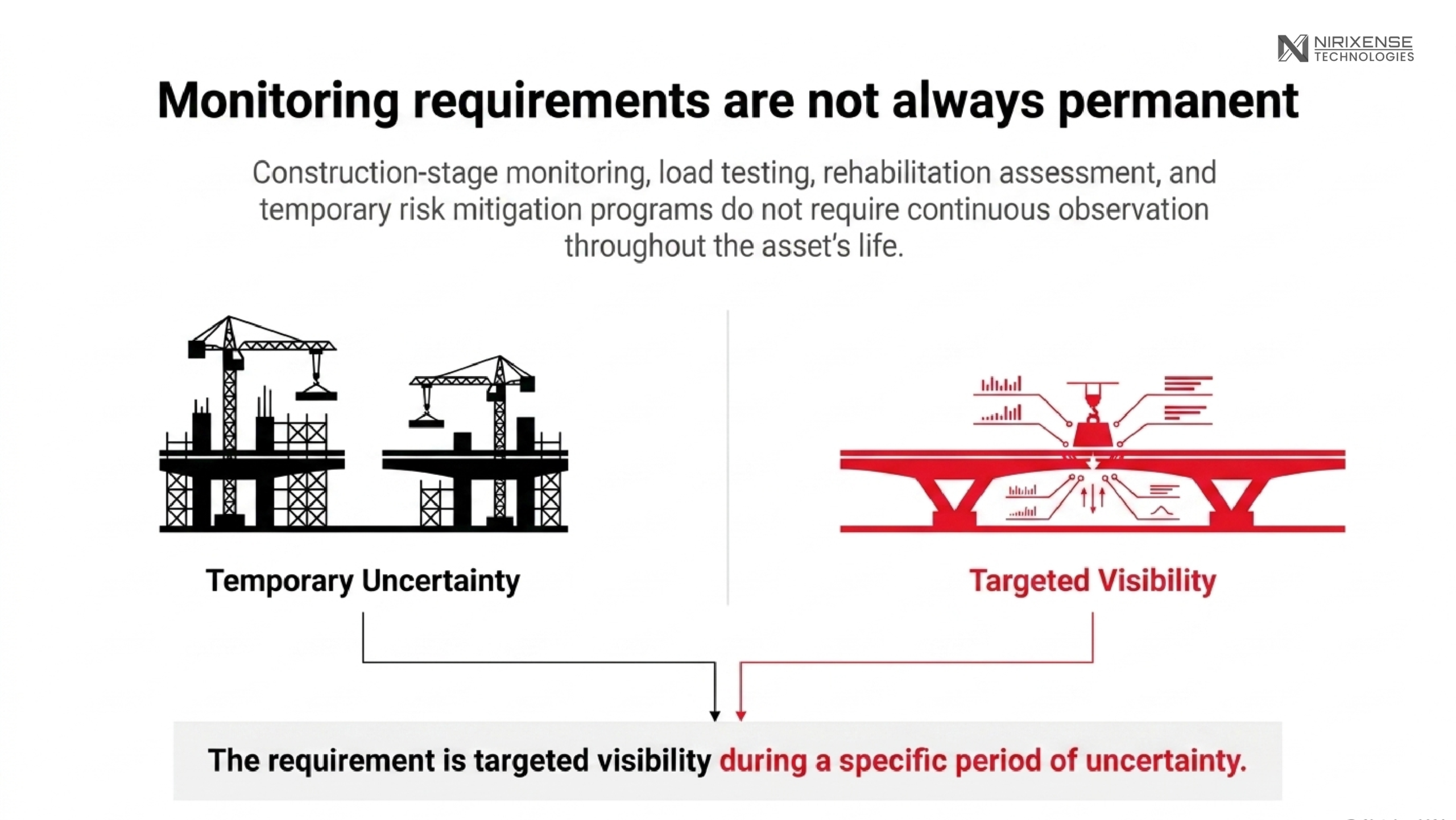
As Dr. Sharvil Faroz observed: “Let’s say one bridge project is there, and he wants to monitor the bridge for six months. After six months, the project is over.”
This observation highlights a mismatch that occasionally exists between the duration of monitoring requirements and the ownership model used to satisfy them. If the monitoring objective is temporary, permanent acquisition of hardware may not always represent the most efficient allocation of resources.
This naturally leads to alternative delivery models where monitoring capability is accessed when required rather than continuously owned.
The case for monitoring-as-a-service
During the discussion, Dr. Faroz posed a simple question: “Why don’t we rent the sensor?”
Although the statement appears to focus on equipment rental, it points toward a broader concept. Under a service-based architecture, the monitoring provider assumes responsibility for deployment, calibration, maintenance, connectivity, data hosting, and platform management while delivering processed information to the end user.
Such an approach offers several advantages in situations where monitoring requirements are temporary, geographically distributed, or operationally complex.
The barrier to deployment is reduced because the asset owner is not required to invest in a complete monitoring ecosystem upfront. Technology upgrades become easier to implement. Monitoring can be scaled across multiple assets without proportional increases in internal technical capacity. Most importantly, attention can shift from managing equipment to interpreting outcomes.
For infrastructure owners seeking periodic visibility rather than long-term system ownership, the model is both technically and economically attractive.
Why ownership will continue to matter
At the same time, it would be incorrect to assume that service-based delivery represents a universal solution.
Many infrastructure assets require continuous monitoring over periods measured in decades rather than months. Critical facilities frequently operate under cybersecurity requirements, data governance policies, or operational constraints that favour direct ownership of monitoring infrastructure.
Long-term deployments also introduce different economic considerations. When monitoring becomes a permanent operational requirement, ownership can provide lower lifecycle costs, greater flexibility in system customization, and tighter integration with existing asset management frameworks.
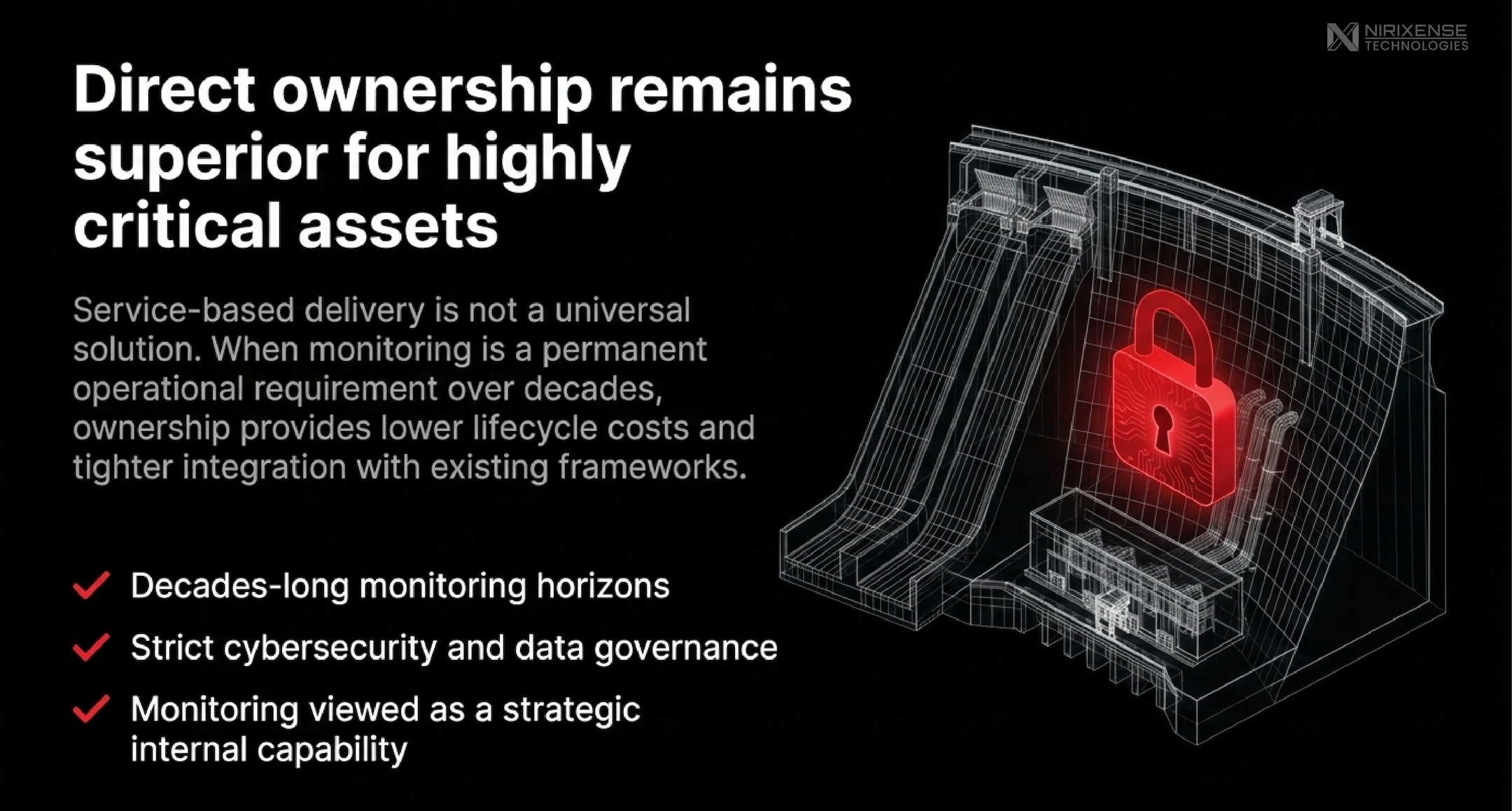
Furthermore, certain asset owners view monitoring infrastructure itself as a strategic capability rather than an outsourced service. In such cases, ownership is not merely a procurement decision; it is an operational philosophy.
The debate therefore should not be framed as ownership versus service. Both approaches address legitimate requirements under different conditions.
The real transition is happening above the hardware layer
Perhaps the more important observation is that the industry’s primary source of value is gradually moving away from hardware altogether.
As Dr. Faroz noted: “The sensor is one thing. Then another thing is the data.”
Historically, SHM systems were differentiated by sensing technology. Today, improvements in sensing hardware continue, but they are no longer the sole determinant of value. Increasing attention is being directed toward data interpretation, Remaining Useful Life estimation, predictive maintenance, anomaly detection, and decision-support systems.

In other words, the competitive landscape is moving upward through the technology stack.
Whether the underlying hardware is owned, rented, or managed through a subscription model becomes secondary to the quality of intelligence generated from it. The long-term differentiator is increasingly the ability to convert measurements into engineering decisions.
Towards flexible monitoring architectures
The future of SHM is unlikely to converge around a single commercial model.
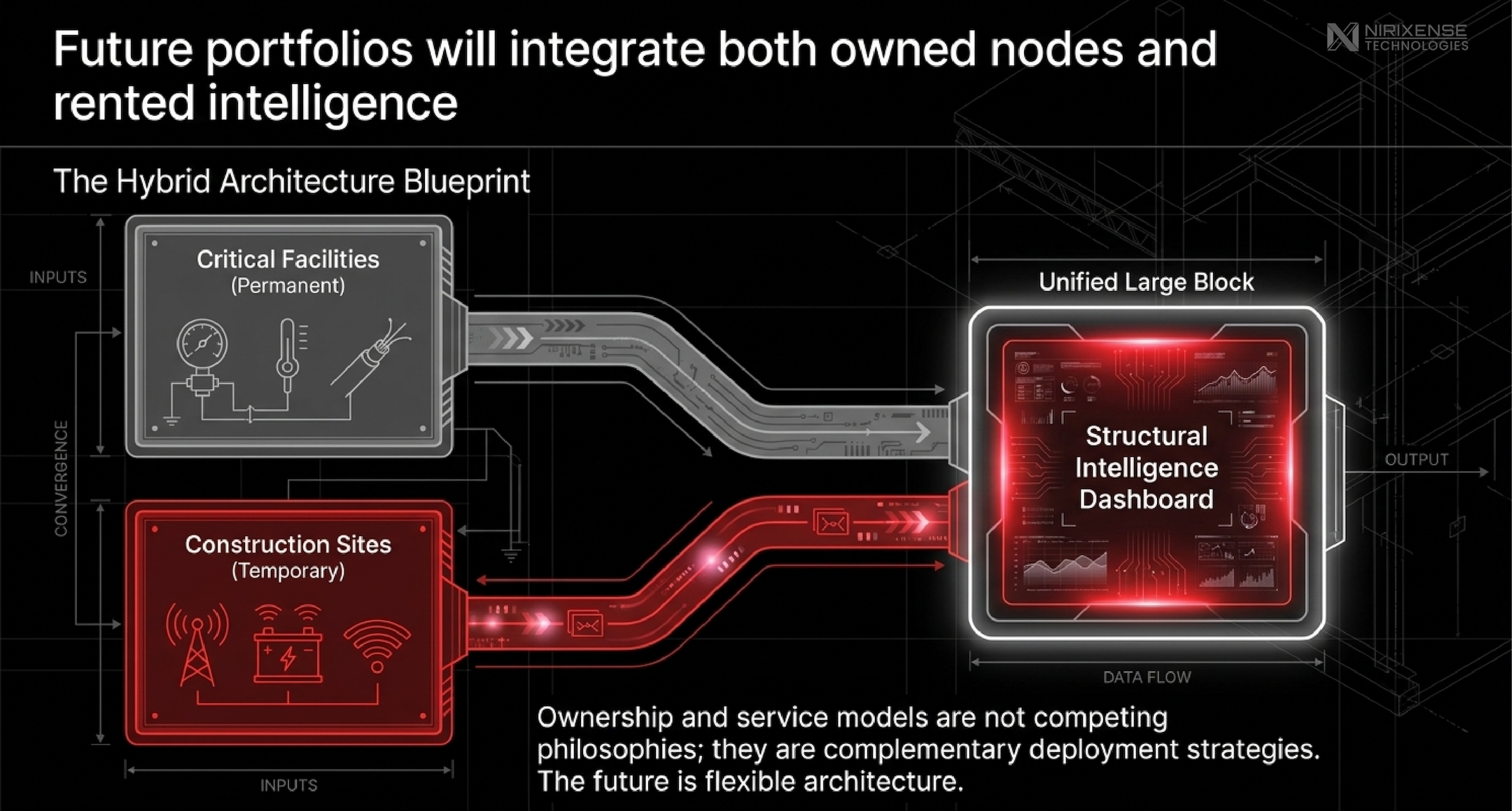
Certain projects will continue to favour outright ownership. Others will benefit from fully managed monitoring services. Many will adopt hybrid architectures where sensing infrastructure, analytics platforms, cloud services, and engineering support are sourced through different mechanisms.
The more significant trend is the emergence of flexibility in how monitoring capabilities are delivered.
At Nirixense, this is the direction we see the industry moving toward. Rather than treating ownership and service models as competing philosophies, they can be viewed as complementary deployment strategies addressing different operational realities. The objective is not to promote a particular commercial structure, but to ensure that infrastructure owners can access the level of monitoring, analytics, and decision support appropriate for their assets.
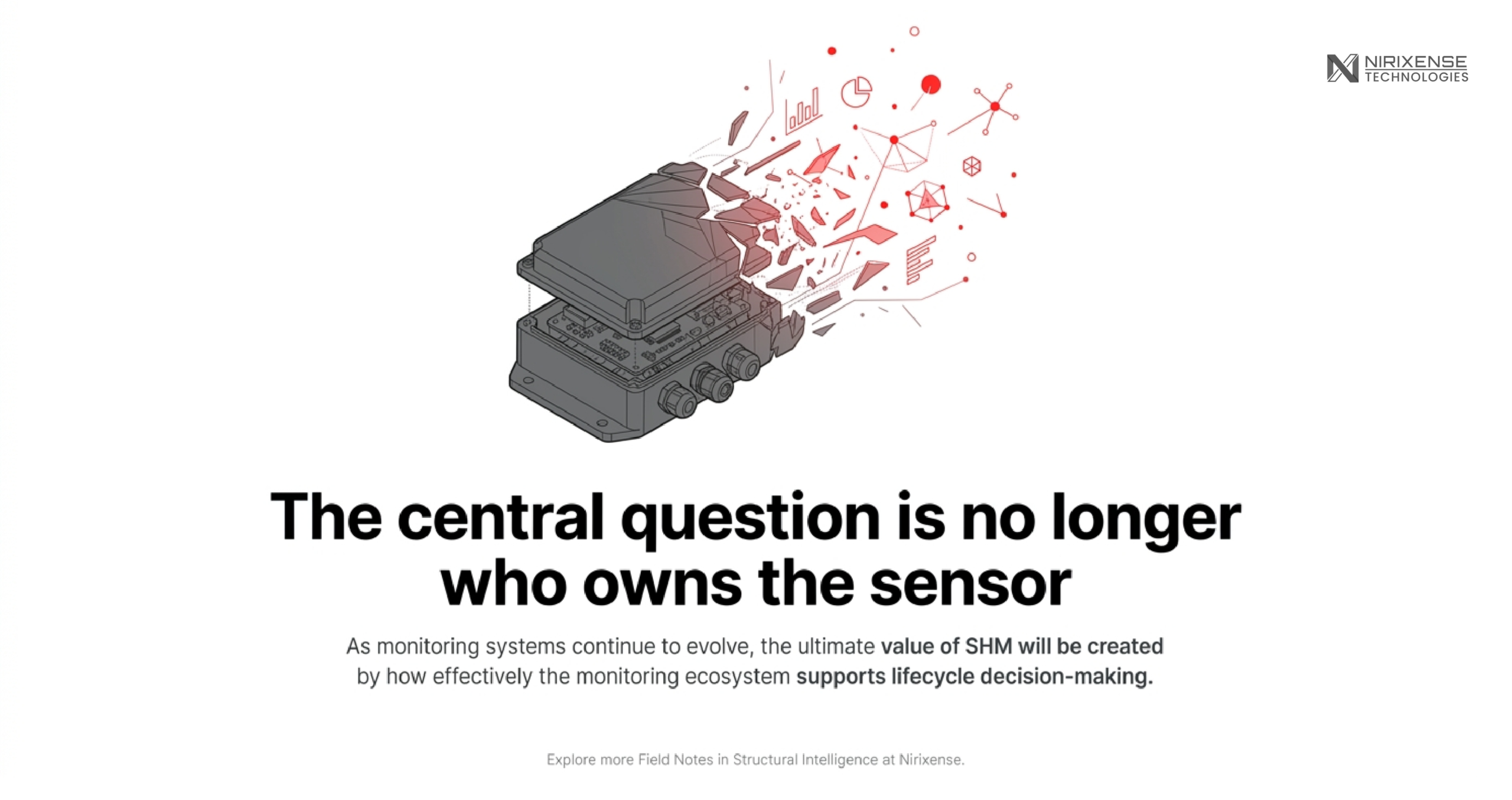
As monitoring systems continue to evolve, the central question may no longer be who owns the sensor.
The more relevant question is how effectively the monitoring ecosystem supports lifecycle decision-making. That, ultimately, is where the future value of SHM will be created.
© 2026 Nirixense Technologies Pvt. Ltd. All rights reserved. email: connect@nirixense.com
About this series: Field Notes in Structural Intelligence is a thought leadership series by Nirixense Technologies, where we engage with experts across structural engineering and monitoring to understand how SHM actually works in practice and where it needs to evolve next.