
What if the system understood the asset, not just the dataset?
Divya Koppikar, Product and UI/UX Designer, Nirixense Technologies
Om Narayan Singh, Applications Engineer, Nirixense Technologies
(September 2026)
Infrastructure has always been difficult to monitor for one simple reason: structures do not speak in numbers.
A monitoring system reports an unusual reading.
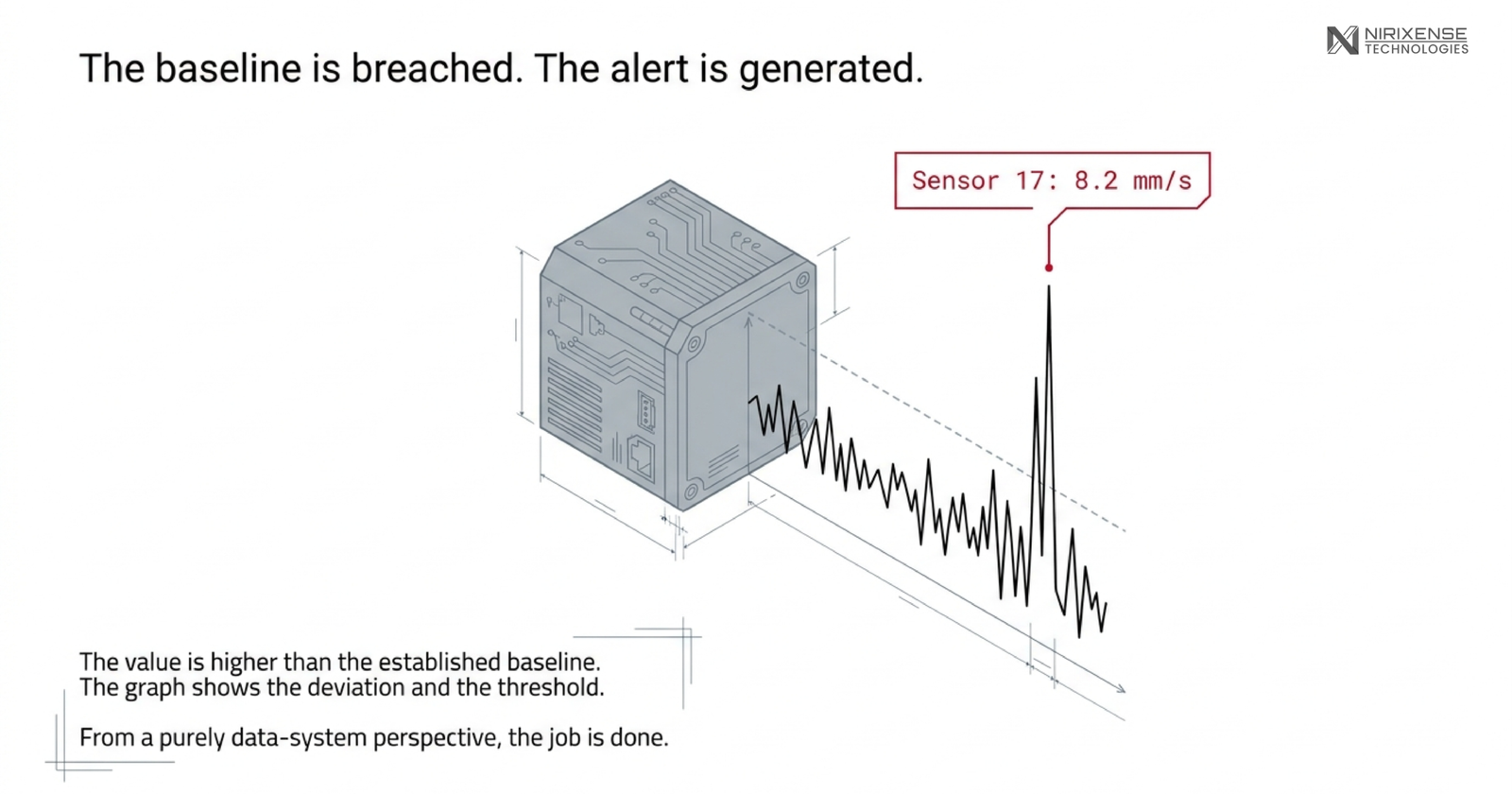
Sensor 17: 8.2 mm/s.
The value is higher than the established baseline, so the system generates an alert. The graph clearly shows when the deviation began, how large it is, and how it compares with the configured threshold. From a data-system perspective, the job appears to be done.
But an engineer looking at the same alert is unlikely to stop there.
The first question may be: Where is Sensor 17?
If it is installed on Pier 3, the reading acquires a physical location. If it sits in the bearing zone, the context becomes more specific. If the sensor was installed to monitor transverse response, the measurement now has an engineering purpose. If the system knows that related sensors have remained within their expected behaviour, that the current operating conditions are comparable to the established baseline, and that a similar response was recorded at the same location during an earlier event, the meaning changes again.
The value has not changed. What has changed is everything around it.
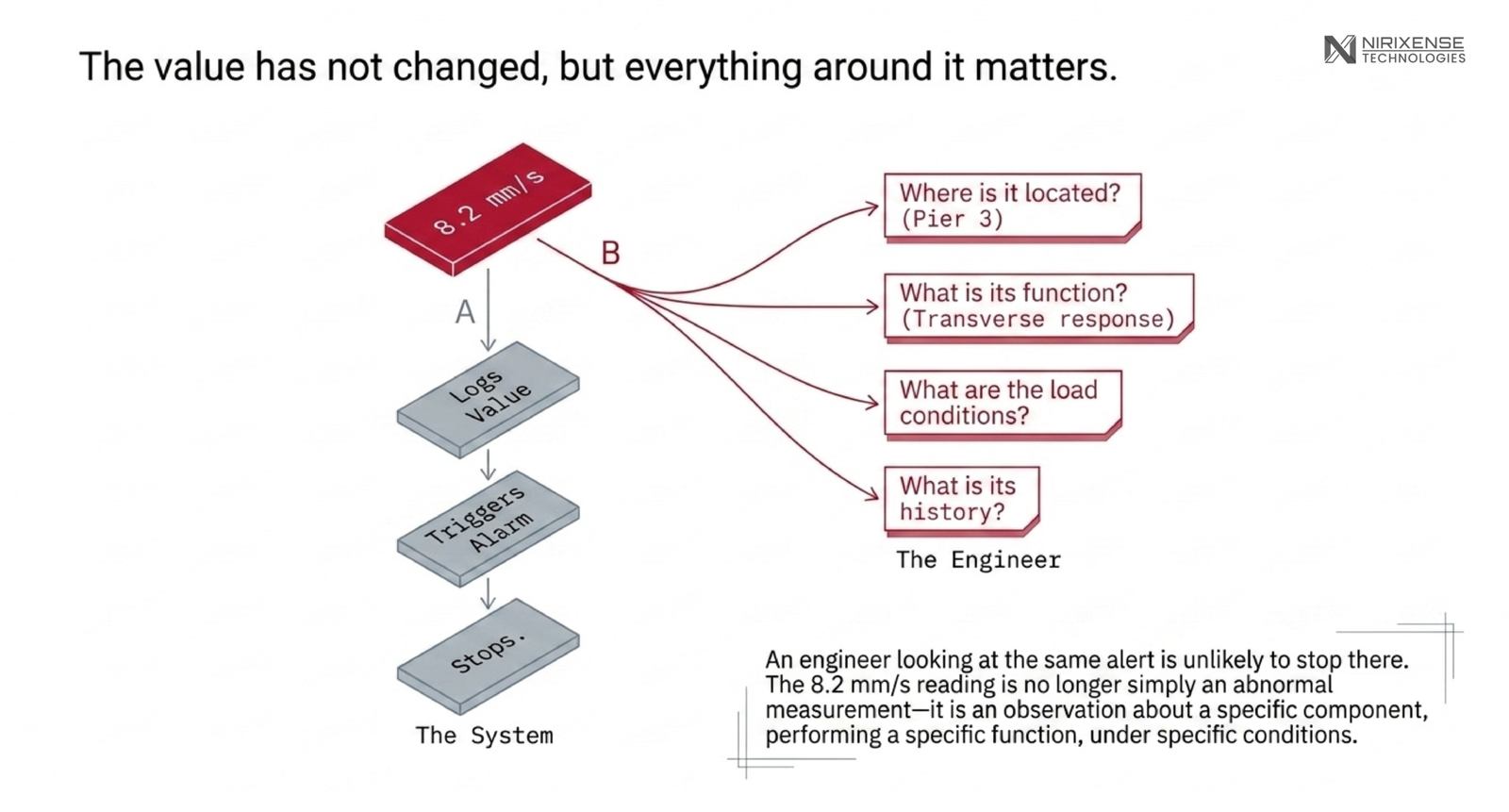
The 8.2 mm/s reading is no longer simply an abnormal measurement produced by Sensor 17. It has become an observation about a particular component, in a particular location, performing a particular function, under a particular set of conditions, with a particular history.
That distinction is fundamental to the future of structural monitoring.
The challenge is no longer simply to collect more measurements or detect more deviations. The more important question is whether monitoring systems can begin to understand the asset that produced the dataset.
The dataset is not the structure
Most monitoring systems are naturally organised around data.
A sensor has an identifier. It is connected to a channel. The channel produces a parameter. The parameter produces measurements over time. Those measurements are stored, visualised, compared against thresholds and eventually converted into alerts or reports.
This architecture makes sense from a technical perspective because data needs to be acquired, transmitted, stored and analysed reliably.
Engineering reasoning, however, does not begin with the dataset.
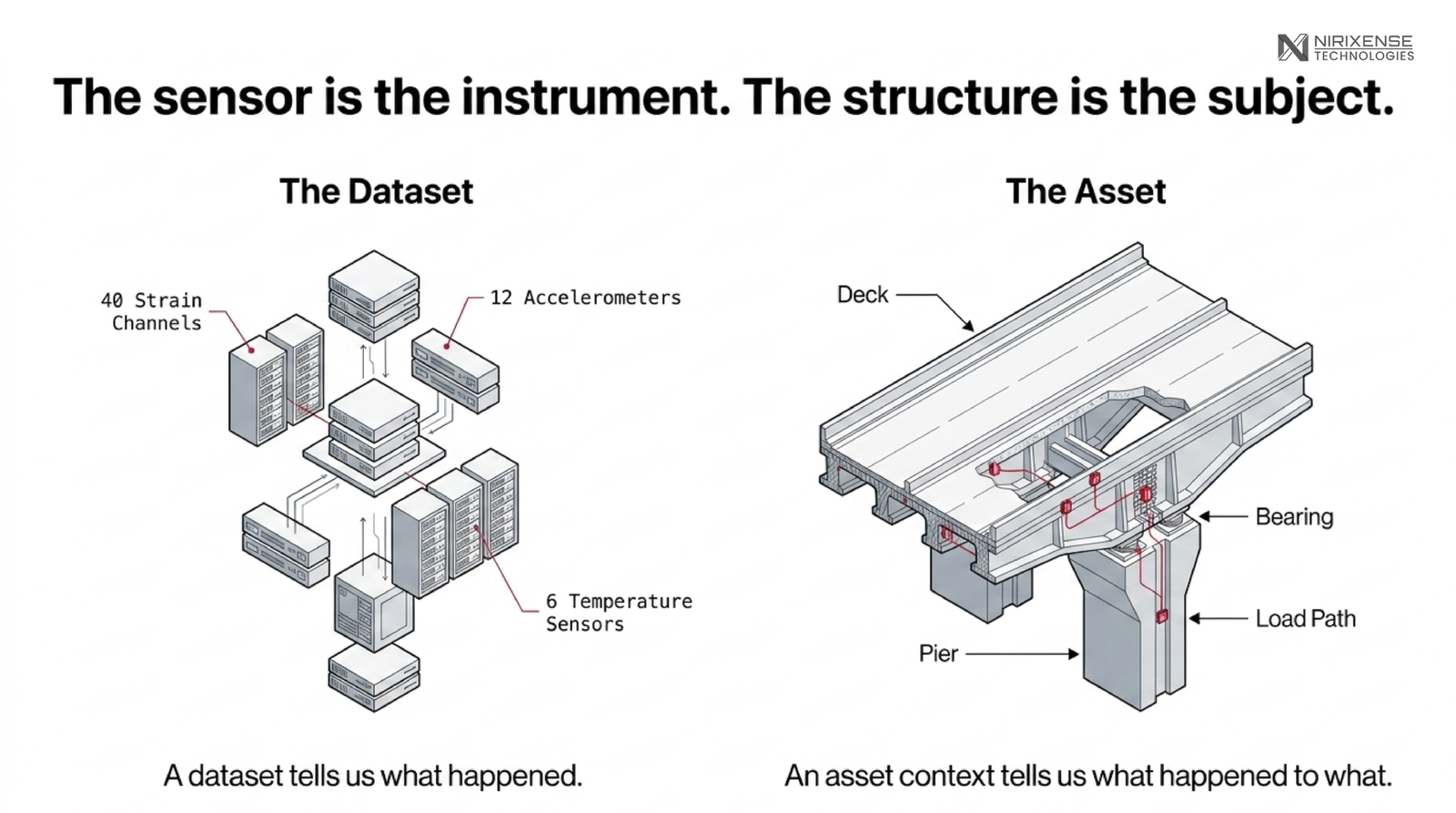
An engineer does not think of a bridge as 40 strain channels, 12 accelerometers and six temperature sensors. The engineer thinks about a deck, a pier, a bearing, a joint, a connection, a load path and the relationships between those physical elements. Measurements matter because they provide evidence about how those elements are behaving.
The sensor is therefore not the thing being monitored. The structure is.
The sensor is an instrument through which we observe one particular aspect of that structure.
This distinction becomes important when deciding what a measurement actually means.
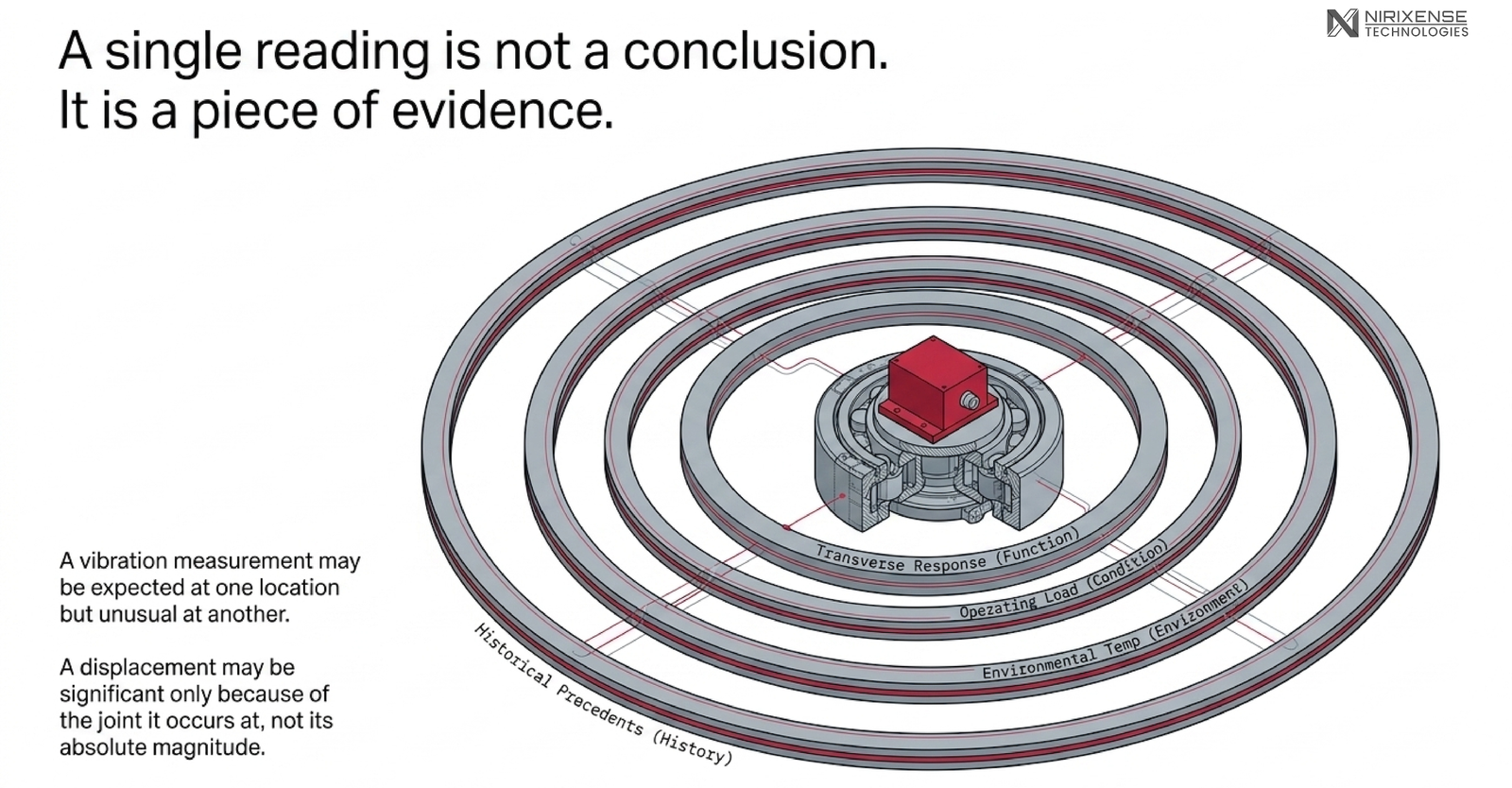
- A vibration measurement may be expected at one location but unusual at another.
- A displacement may be significant because it occurs at a particular joint rather than because of its absolute magnitude.
- A strain response may only become meaningful when considered alongside loading conditions, temperature, neighbouring measurements or the historical behaviour of the same component.
A dataset can tell us what happened.
An asset context can begin to tell us what happened to what.
And that is a much more useful form of information.
When the same number means different things
Consider the original 8.2 mm/s reading.
In isolation, the system can establish that it is above the configured baseline or threshold. But the engineering significance of that deviation depends on what the sensor is observing.
Suppose the sensor is positioned near a bearing and is intended to capture transverse structural response. The system now has a reason to care about the measurement beyond its numerical value.
It can ask whether other measurements associated with that structural behaviour changed at the same time. It can examine whether the asset was operating under an unusual load. It can determine whether temperature or another environmental condition provides a plausible explanation. It can check the sensor’s data quality. It can compare the event with previous occurrences.
The measurement becomes part of a chain of evidence.
This is particularly important because structural behaviour rarely conforms to the simplicity of a single threshold.
A reading can be unusual without being dangerous. It can be technically valid but poorly explained. It can be caused by an operational condition rather than deterioration. It can indicate a genuine localised response while surrounding sensors remain normal. It can also be caused by the measurement system itself.
The difficulty is therefore not always detecting that something has changed.
The difficulty is understanding what the change belongs to.
The problem of conflicting evidence
This becomes clearer when different sources of information disagree.
Imagine Sensor 17 reports a significant increase, while the sensors around it remain within their expected ranges.
There are several possible explanations. The structural response may genuinely be localised. The neighbouring sensors may be measuring different modes of behaviour. The operating condition may have changed in a way that affects only one component. The sensor may be degrading. The acquisition channel may have developed a problem. Or the established baseline may not adequately represent the current operating state.
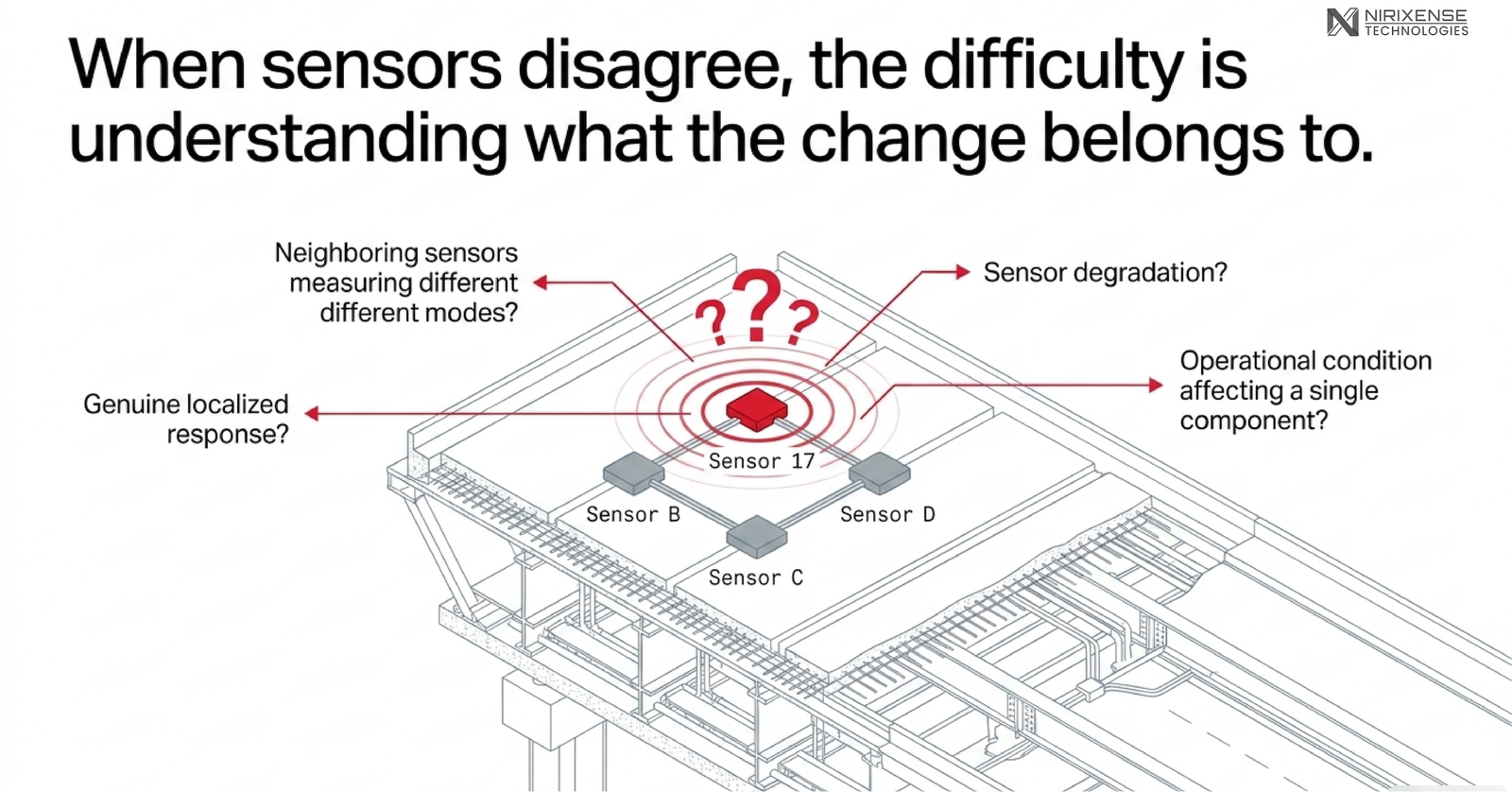
A conventional monitoring platform can identify the disagreement.
A more context-aware system should help an engineer understand why the disagreement matters.
Importantly, that does not mean the system should immediately choose which sensor to trust.
The more useful question is often whether the evidence is sufficient for the decision that needs to be made.
There is a meaningful difference between saying:
“Sensor 17 is abnormal.”
and saying:
“Sensor 17 is abnormal, but the available evidence is not sufficiently consistent to establish whether the change represents structural deterioration.”
The second statement does not claim more certainty than the evidence supports. It makes the uncertainty visible, while still moving the investigation forward.
That is an important characteristic of an engineering system: it should not only recognise evidence, but also recognise the limits of that evidence.
Context depends on the decision
There is also no single definition of what constitutes “enough context.”
The information required to decide whether an anomaly should continue to be monitored is different from the information required to decide whether an inspection should be scheduled.
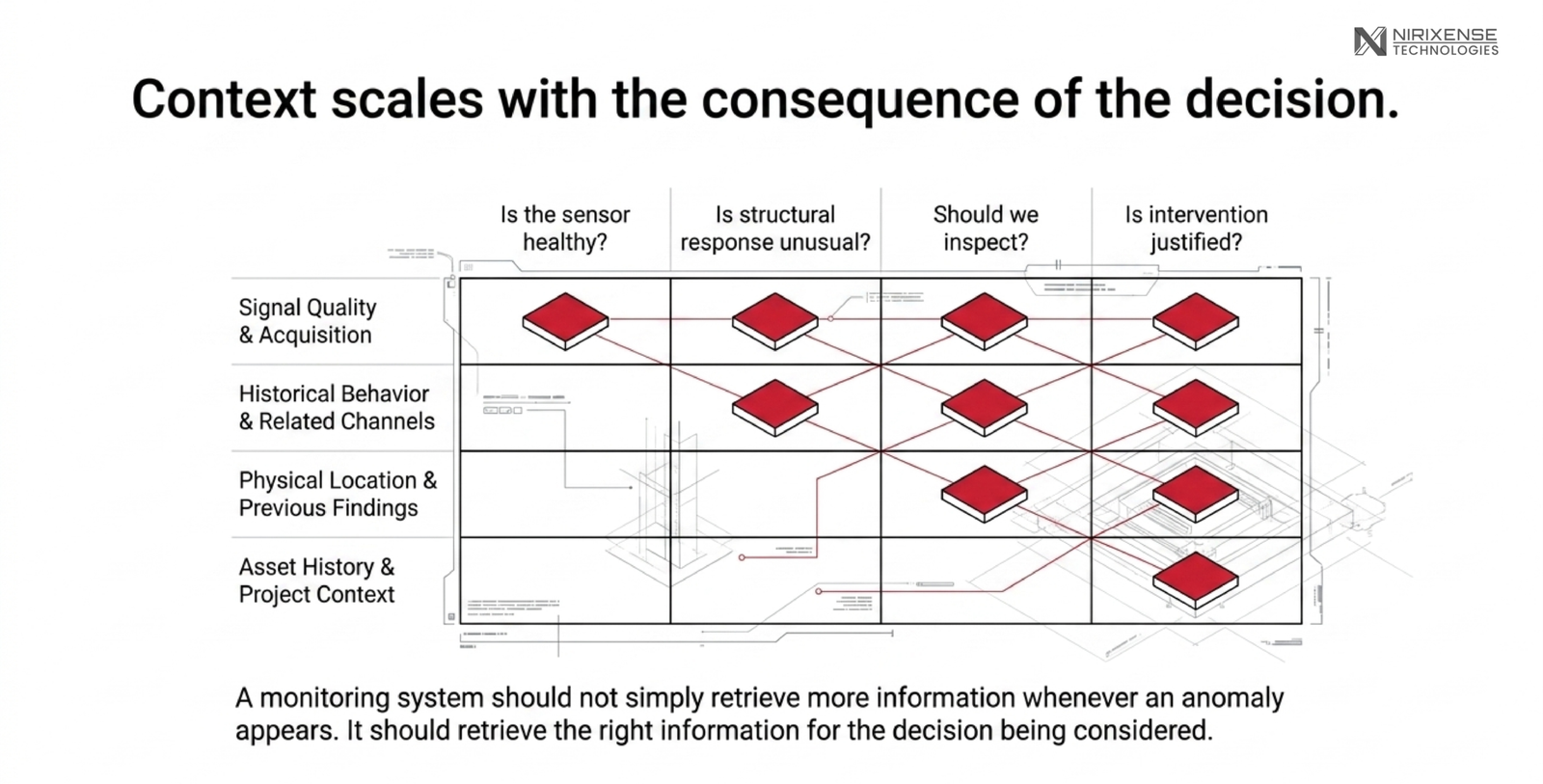
If the immediate question is whether the sensor is healthy, recent signal quality and acquisition behaviour may be sufficient.
If the question is whether the structural response is unusual, historical behaviour and related measurements become more important.
If the question is whether a physical component should be inspected, its location, previous inspection findings and asset history become relevant.
If the question is whether an intervention or operational restriction is justified, the evidence may need to extend further still.
This means that a monitoring system should not simply retrieve more information whenever an anomaly appears.
It should retrieve the right information for the decision being considered.
That is a subtle but important shift.
The objective is not to overwhelm an engineer with every available measurement, report and document. The objective is to reduce the amount of reconstruction the engineer has to perform before the evidence becomes usable.
The engineer as the missing connector
Much of this information already exists.
- The drawing knows the geometry.
- The sensor database knows the instrumentation.
- The monitoring platform knows the measurements.
- Inspection reports record physical observations.
- Maintenance records document interventions.
- Project documentation contains design and operational context.
- Engineers carry the understanding of how these pieces relate to one another.
The problem is that these sources are often separated from each other.
An engineer investigating an anomaly may therefore have to locate the sensor on a drawing, determine what component it is associated with, understand why it was installed, examine historical trends, check operating conditions, search previous inspection reports and reconstruct what happened during earlier events.
The system may technically contain all of this information.
But the engineer is still doing the work of connecting it.
This is one of the less visible costs of structural monitoring.
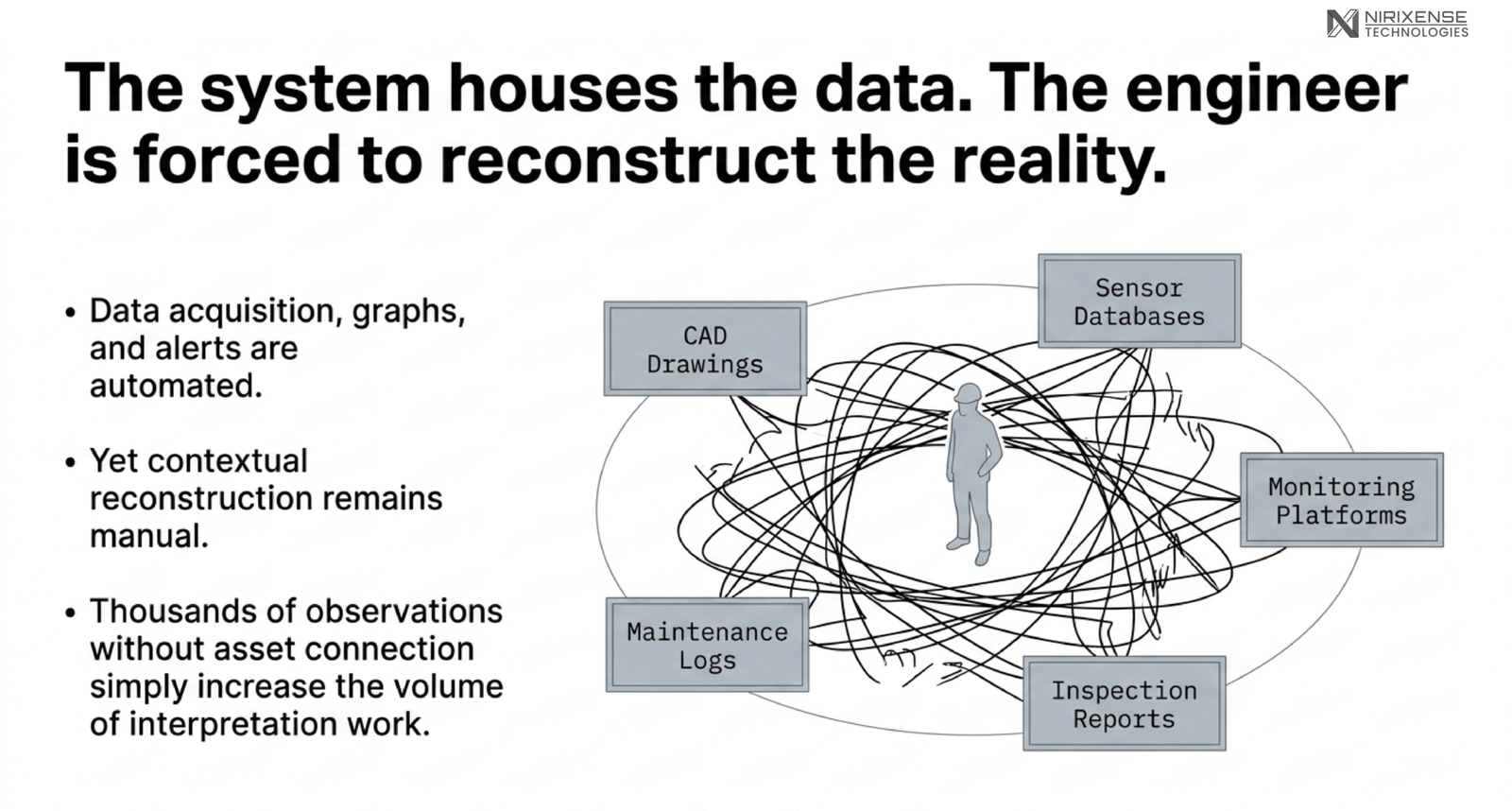
The data acquisition may be automated. The graph generation may be automated. The alert may be automated.
Yet the contextual reconstruction can remain manual.
And as monitoring systems become more continuous, this problem becomes increasingly significant.
A system that generates thousands of observations without helping engineers connect those observations to the physical asset may simply increase the volume of work that has to be interpreted.
What does an asset remember?
Structures also have something that datasets alone struggle to represent: history.
- A bearing was replaced.
- A crack was observed.
- A strengthening intervention was carried out.
- A sensor was relocated.
- An unusual vibration event occurred under a particular operating condition.
- An inspection followed.
- A decision was made.
Months later, another event occurs at approximately the same location.
If those events remain separate records, the new anomaly can appear to be an isolated event. If they are connected through the asset, the same anomaly acquires a history.
That history changes interpretation.
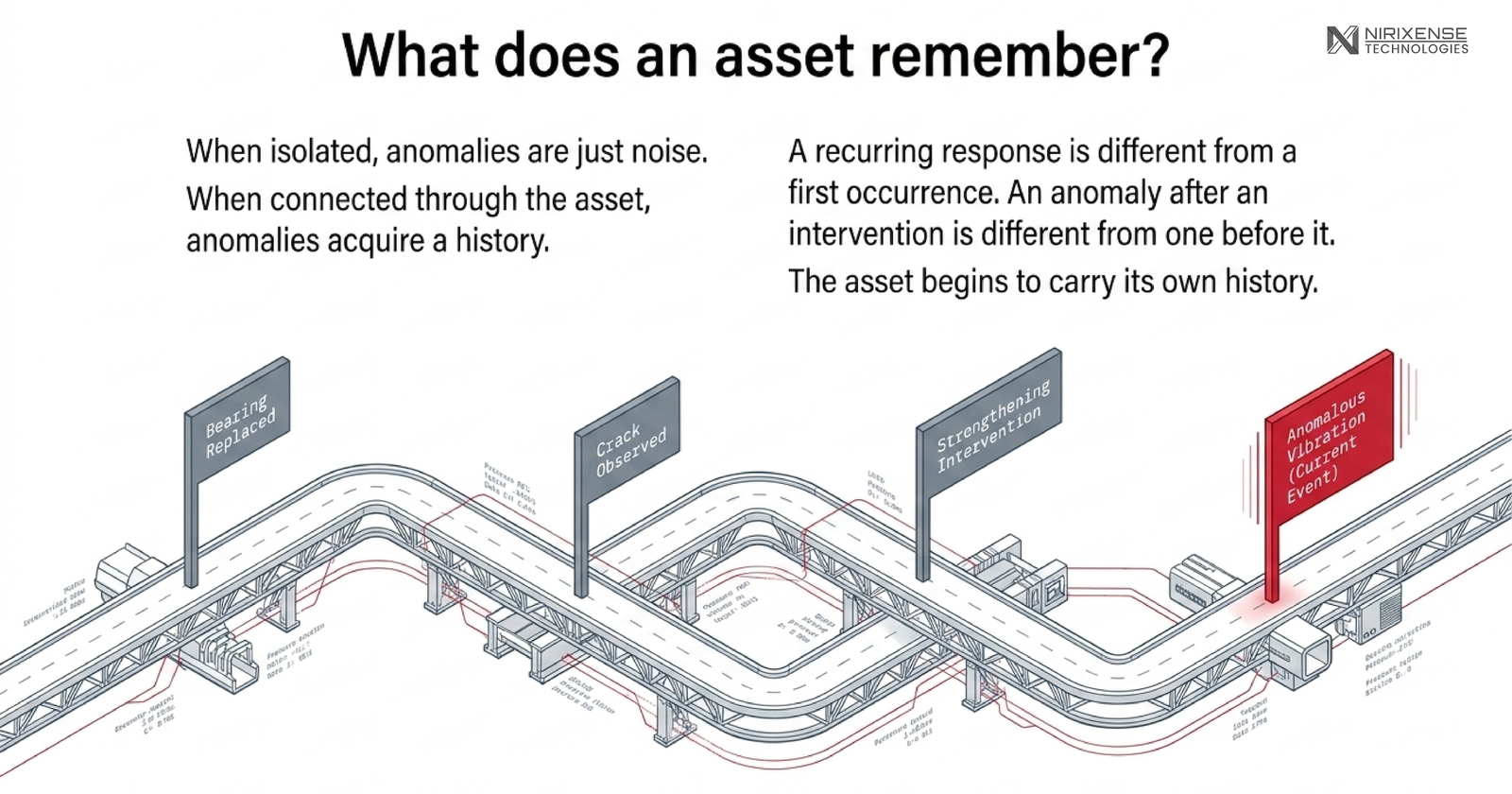
A recurring response is different from a first occurrence. An anomaly after an intervention is different from an anomaly before it. A response that repeatedly appears under the same operating condition is different from an unexplained isolated deviation.
Over time, this history becomes more than a record of past events.
It becomes institutional memory for the asset.
That matters because infrastructure often outlives the people who designed, constructed, inspected and maintained it. Knowledge that once existed in the experience of an engineer can disappear when people move between projects or organisations.
A monitoring system that maintains relationships between measurements, inspections, interventions and decisions can preserve some of that knowledge as part of the asset itself.
The asset begins to carry its own history.
From data retrieval to engineering context
This suggests that the next generation of monitoring systems may need to solve a different problem.
Today, an engineer can ask:
“Show me the data for Sensor 17.”
A more useful system should eventually be able to support a question closer to:
“Show me what I need to understand the current behaviour around Sensor 17.”
The first question is primarily a data-retrieval problem.
The second is a context-retrieval problem.
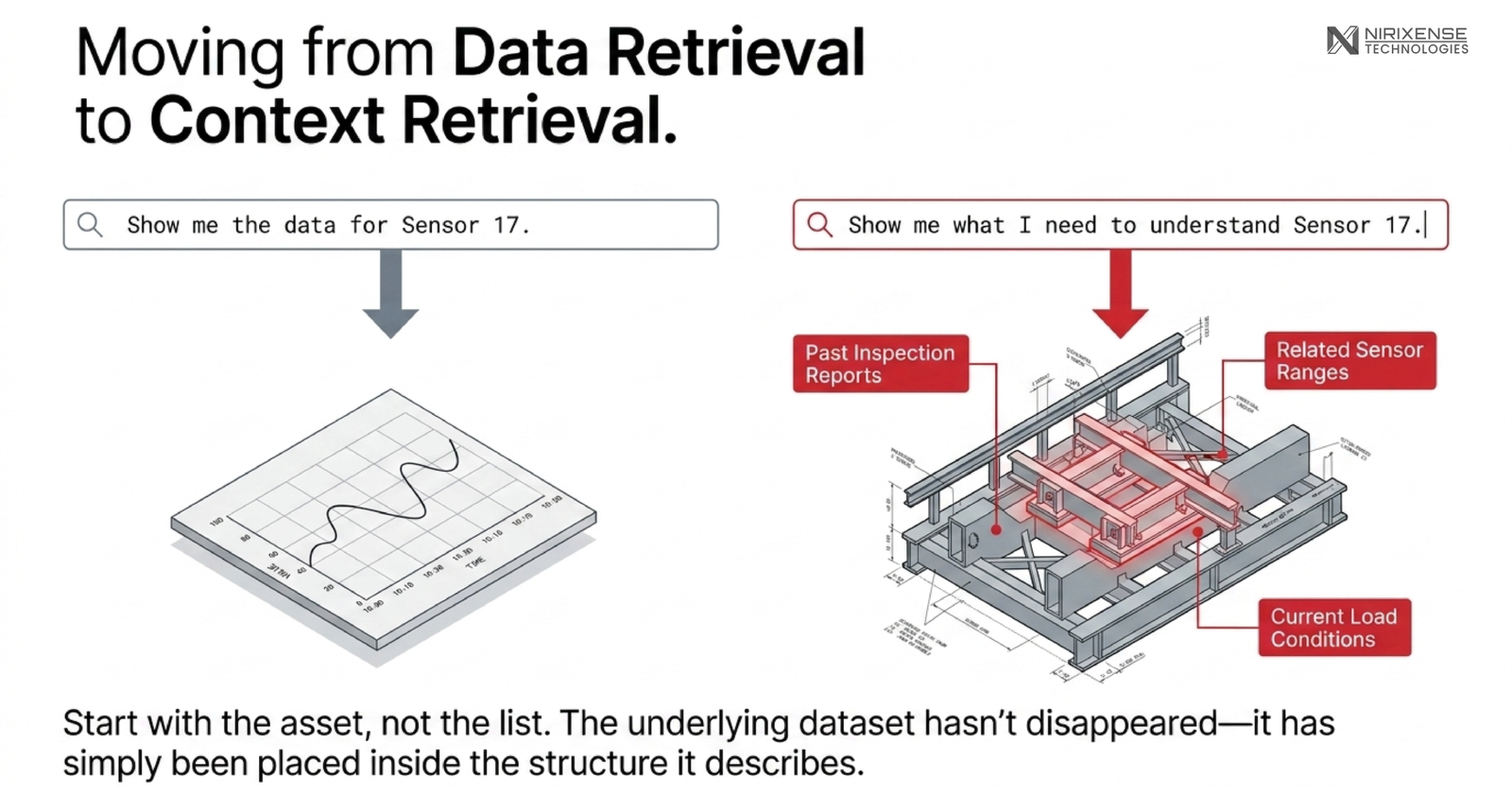
To answer it, the system needs to understand the relationships between the sensor, its physical location, the component it monitors, its monitoring objective, its expected behaviour, related measurements, current operating conditions, historical events, inspections and previous decisions.
This changes how a monitoring interface itself can be structured.
Instead of beginning with a list of sensors, an engineer could begin with the asset.
The asset could lead to the relevant zone or component. The component could lead to the associated instrumentation. An anomaly could then reveal the measurements supporting it, the measurements that contradict it, the environmental and operational conditions surrounding it, and the previous events that occurred at the same location.
The underlying dataset has not disappeared.
It has simply been placed inside the structure it describes.
Where automation becomes useful
This is also where automation becomes meaningful.
Not because the objective is to remove the engineer from the decision, but because much of the work that happens before the decision is repetitive.
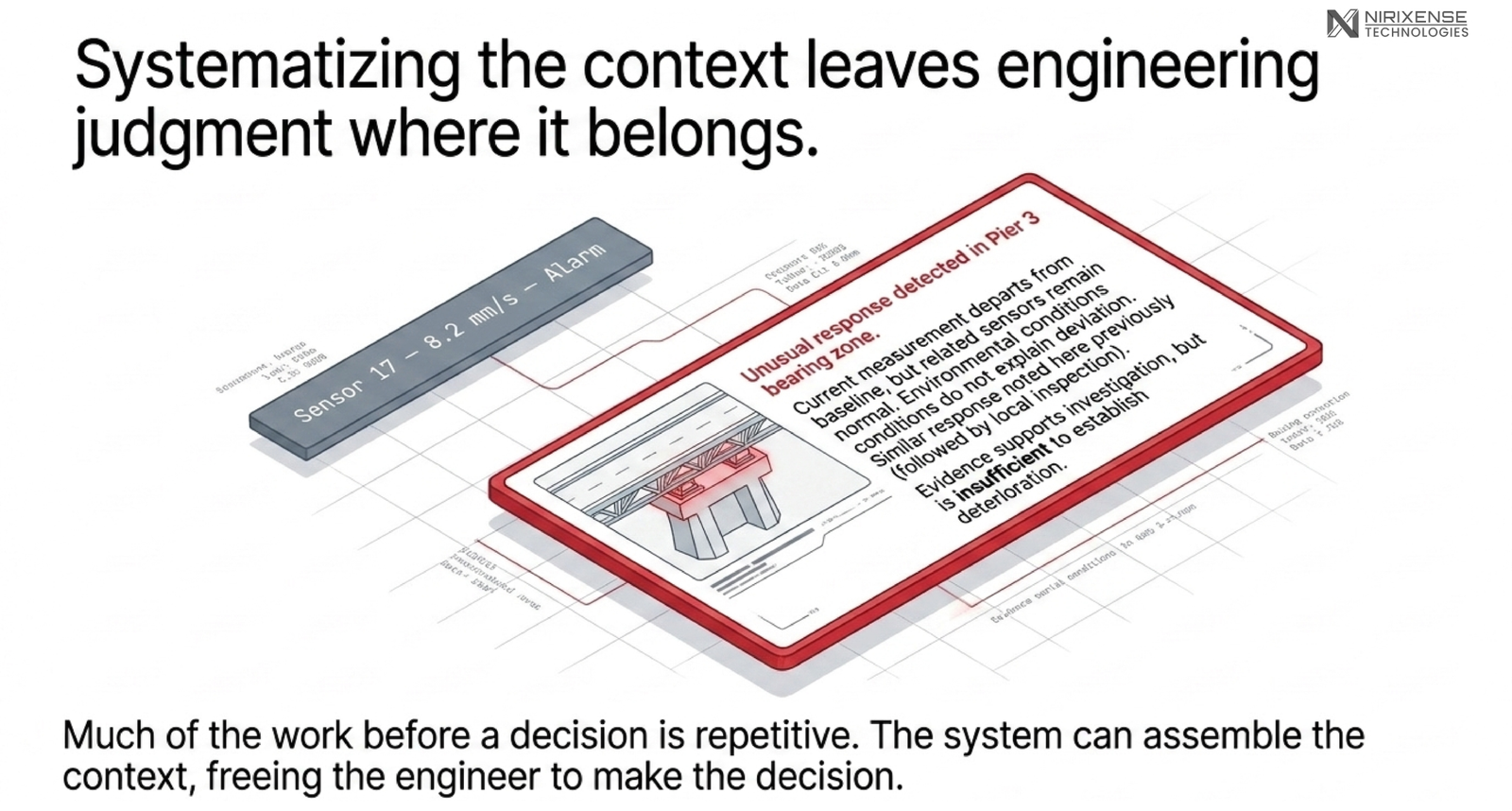
Locating the sensor, identifying the component, retrieving the relevant drawing, checking the monitoring objective, comparing historical behaviour, examining related channels, checking data quality, reviewing operating conditions and searching previous events are all activities that can increasingly be systematised.
The system can assemble the context before the engineer begins the investigation.
Instead of presenting:
Sensor 17 — 8.2 mm/s — Alarm
it could present something closer to:
An unusual response has been detected in the Pier 3 bearing zone. The current measurement differs from the established behaviour, while related sensors remain within their expected range. Current environmental and operating conditions do not adequately explain the deviation. A similar response was previously recorded at this location and was followed by a local inspection. The available evidence supports further investigation, but is not sufficient to establish structural deterioration.
The important difference is not that the second notification contains more words. It is that the system has connected the observation to the asset, its evidence and its history.
The engineer is no longer starting with a number and reconstructing its meaning manually.
The system has already assembled the relevant context, while leaving the engineering judgement where it belongs.
Building systems that understand the asset
This points toward a broader shift in how structural monitoring systems can be designed.
The goal should not simply be to create systems that process more measurements, detect more anomalies or generate more sophisticated graphs.
The goal is to create systems that understand the relationships between assets, components, instrumentation, measurements, operating conditions, inspections, interventions and decisions.
That understanding does not require the system to replace engineering judgement.
In many cases, it makes engineering judgement more effective.
A useful monitoring system should know what an observation belongs to, why that observation exists, what other evidence should be considered alongside it, what has happened at the same location before, how confident the available evidence is, and what kind of decision the current situation requires.
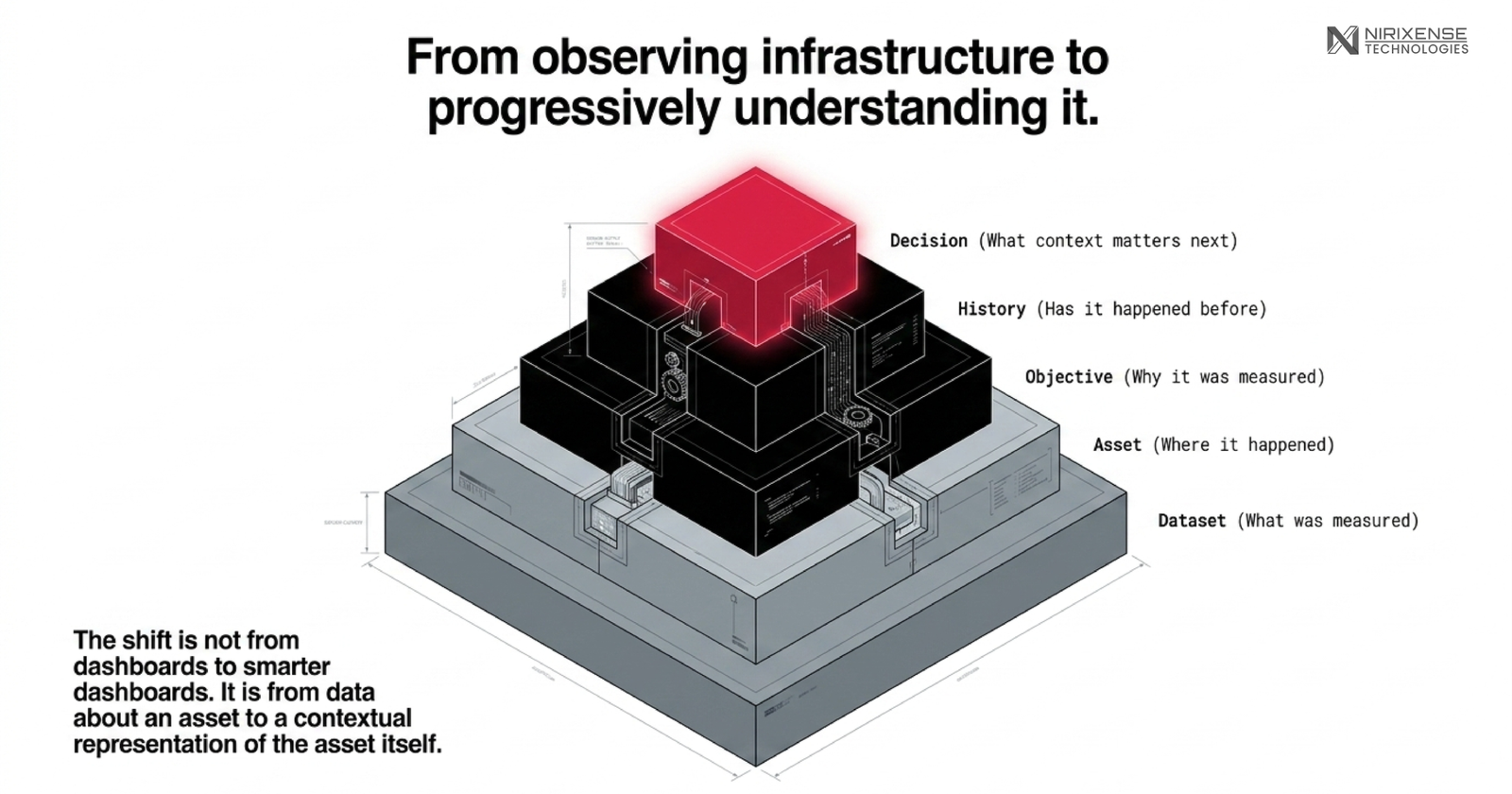
The shift is therefore not simply from dashboards to smarter dashboards.
It is from data about an asset to a contextual representation of the asset itself.
- The dataset tells us what was measured.
- The asset tells us where it happened.
- The monitoring objective tells us why it was measured.
- The surrounding evidence helps explain what it means.
- The history tells us whether it has happened before.
And the decision determines which context matters next.
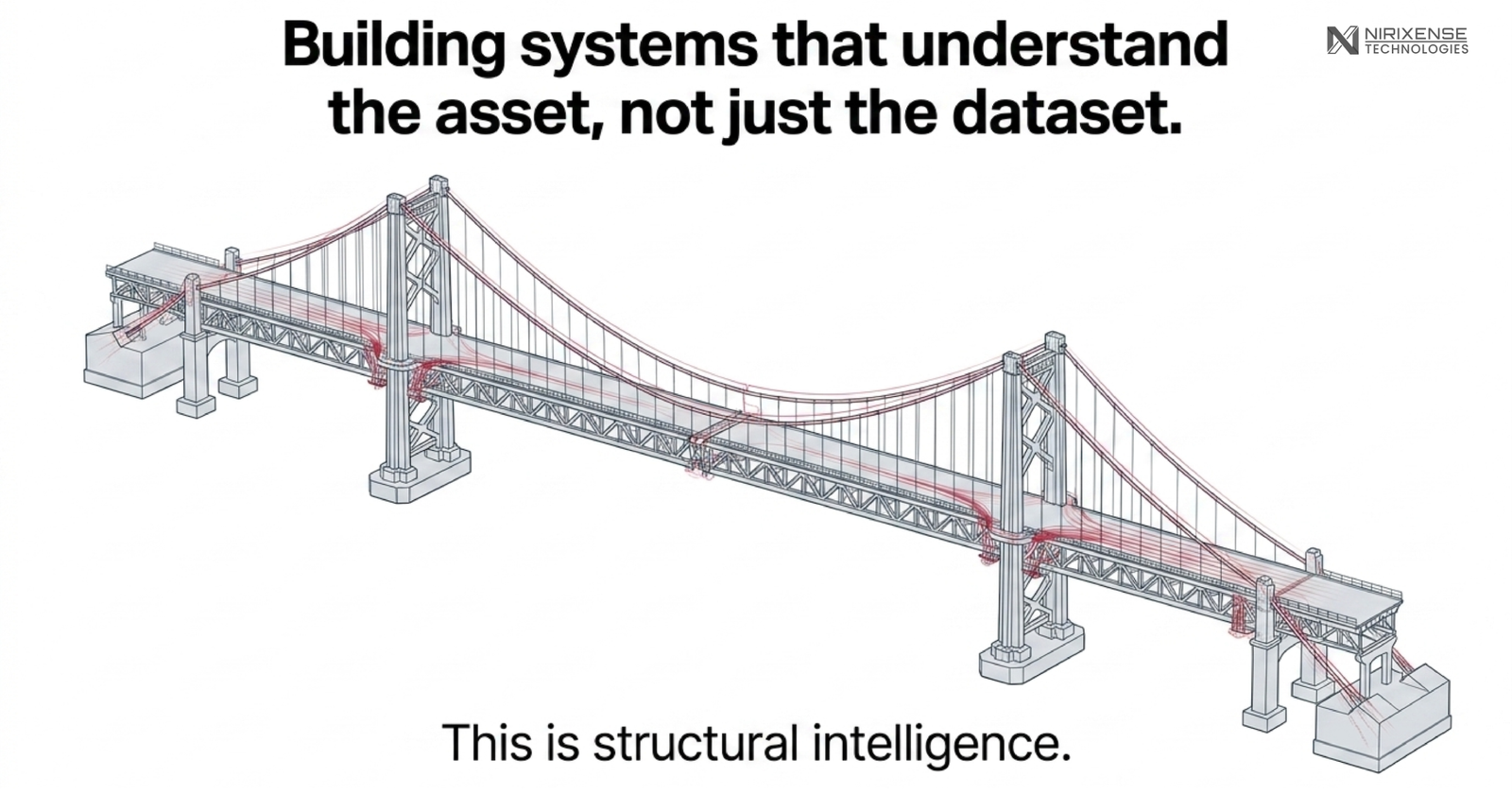
That is the direction structural intelligence needs to move toward: systems that do not merely observe infrastructure, but progressively build an understanding of the infrastructure they observe.
This is something Nirixense is building toward — building systems that understand the asset, not just the dataset.
© 2026 Nirixense Technologies Pvt. Ltd. All rights reserved. email: connect@nirixense.com
About this series: Field Notes in Structural Intelligence is a thought leadership series by Nirixense Technologies, where we engage with experts across structural engineering and monitoring to understand how SHM actually works in practice and where it needs to evolve next.