
Why structural monitoring fails before it even begins
In conversation with Prof. Anjan Dutta
Technology Perspective
Divya Koppikar, Product and UI/UX Designer, Nirixense Technologies
Om Narayan Singh, Applications Engineer, Nirixense Technologies
(April 2026)
Prof. Anjan Dutta is a Professor in the Department of Civil Engineering at the Indian Institute of Technology (IIT) Guwahati, with expertise in structural engineering and computational mechanics. His research spans finite element mesh generation, structural optimization, and the monitoring, control, and retrofitting of civil infrastructure systems. Through his work, he has advanced methodologies that enhance the safety, resilience, and performance of engineered structures. His contributions have significantly influenced both academic research and practical approaches to addressing real-world infrastructure challenges.
For years, infrastructure assessment has relied on Non-Destructive Testing (NDT) a method that is precise, reliable, and yet inherently limited in scope.
It tells you what is, but rarely what is changing.
“Inspection gives you a condition. It does not give you behavior.”
That distinction is where the gap begins. NDT operates as:
- A point-in-time evaluation
- Dependent on manual scheduling and interpretation
- Focused on defect detection, not progression
Which raises a deeper concern are we diagnosing structures, or just documenting them?
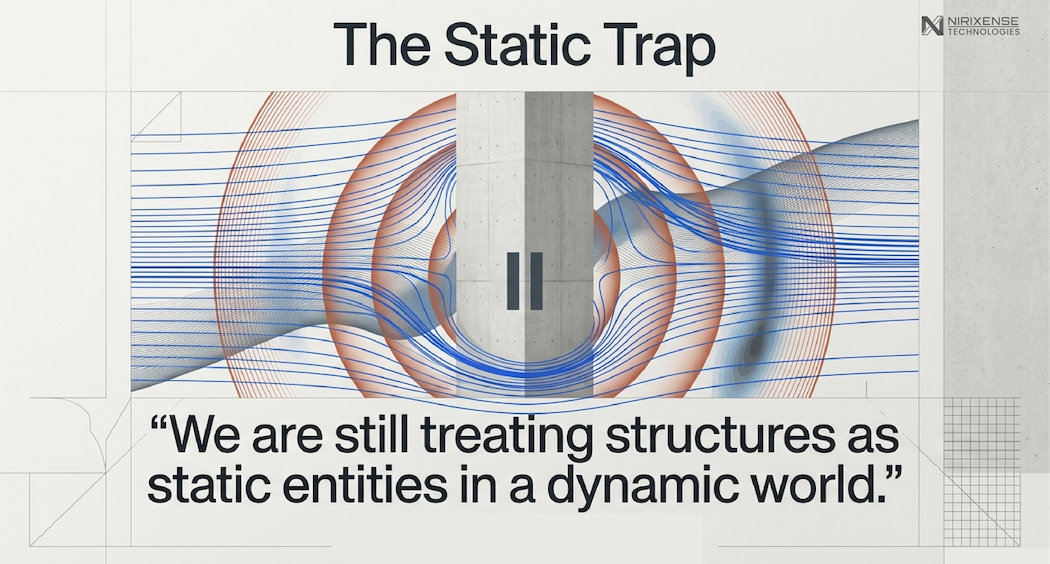
As the conversation moved toward Structural Health Monitoring (SHM), the expectation was clear: continuous data should solve this limitation. But the reality is more complex.
“We are collecting more data than ever before but not necessarily understanding more.”
The issue isn’t instrumentation. It’s interpretation. Across projects, a few patterns consistently emerge:
- Sensors deployed without a clearly defined hypothesis
- Data streams that remain underutilized
- Decision systems that rely on static thresholds instead of evolving context
This creates an illusion of intelligence: data abundance without behavioral clarity.
What’s missing, then, is not another layer of sensing but a shift in how we define value.
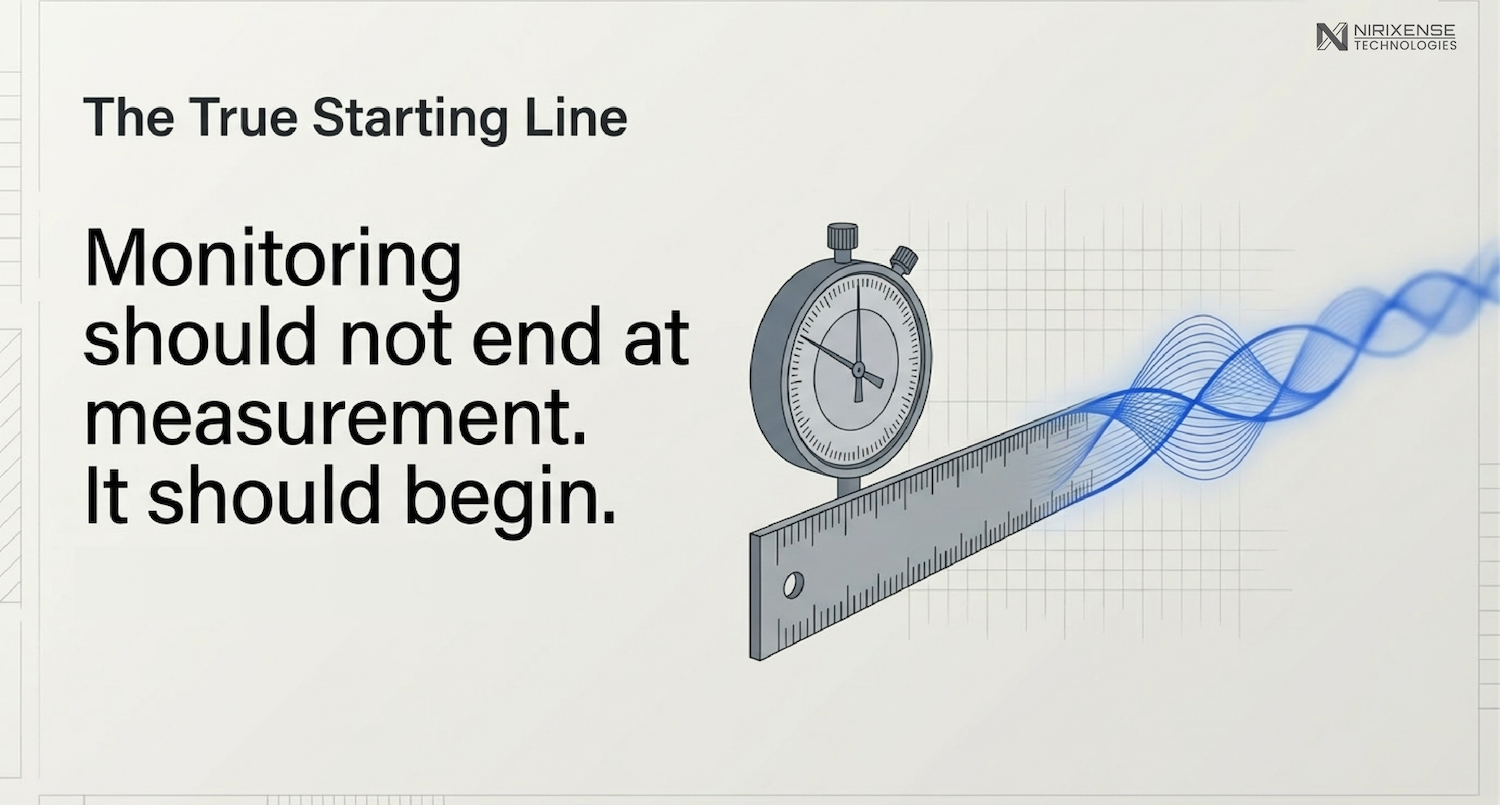
“Monitoring should not end at measurement. It should begin.”
This is where the idea of Structural Intelligence starts to take shape.
Not as a product but as a capability. A system that:
- Interprets data over time, not in isolation
- Understands load, environment, and response as interconnected variables
- Moves beyond alerts to contextual insights and forward-looking decisions
In simpler terms:
- From detecting damage → to understanding behavior
- From flagging anomalies → to explaining them
Interestingly, one of the more understated shifts enabling this transition is wireless sensing.
It’s often positioned as a logistical upgrade, but its implications are more foundational.
“When deployment becomes easier, experimentation becomes possible.”
Wireless systems enable:
- Higher density of instrumentation across large assets
- Flexible and iterative monitoring strategies
- Access to previously unmonitored zones
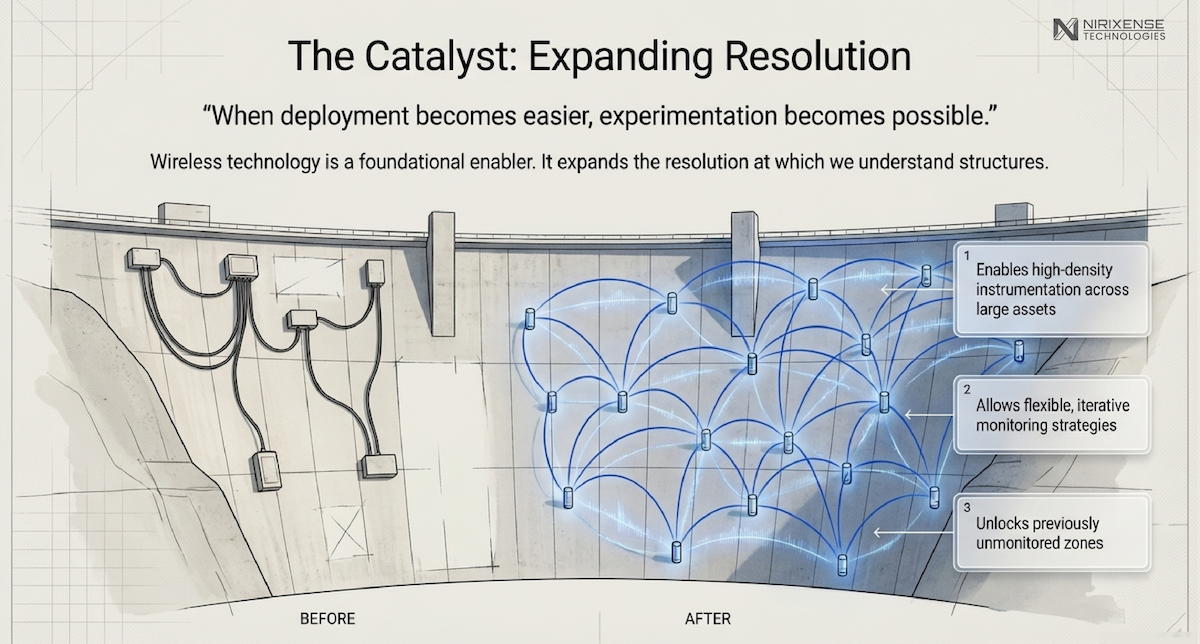
This doesn’t just improve efficiency, it expands the resolution at which we understand structures.
But even with better tools, a critical misstep persists in how systems are deployed.
Too often, projects begin with: Where can we install sensors?
Instead of: What are we trying to learn about this structure?
“Instrumentation should follow inquiry not the other way around.”
A more effective approach reframes deployment around:
- Failure modes we want to anticipate
- Behaviors we want to observe over time
- Decisions the data is expected to inform
This shift leads to:
- More purpose-driven sensing
- Cleaner, more interpretable datasets
- Stronger alignment between engineering and analytics
What emerges from this conversation is not a critique of existing systems but a call for evolution.
The trajectory is becoming clearer:
- Structures that are continuously observed, not periodically checked
- Systems that are remotely diagnosable, not physically dependent
- Decisions that are predictive, not reactive
But this transition is not purely technological.
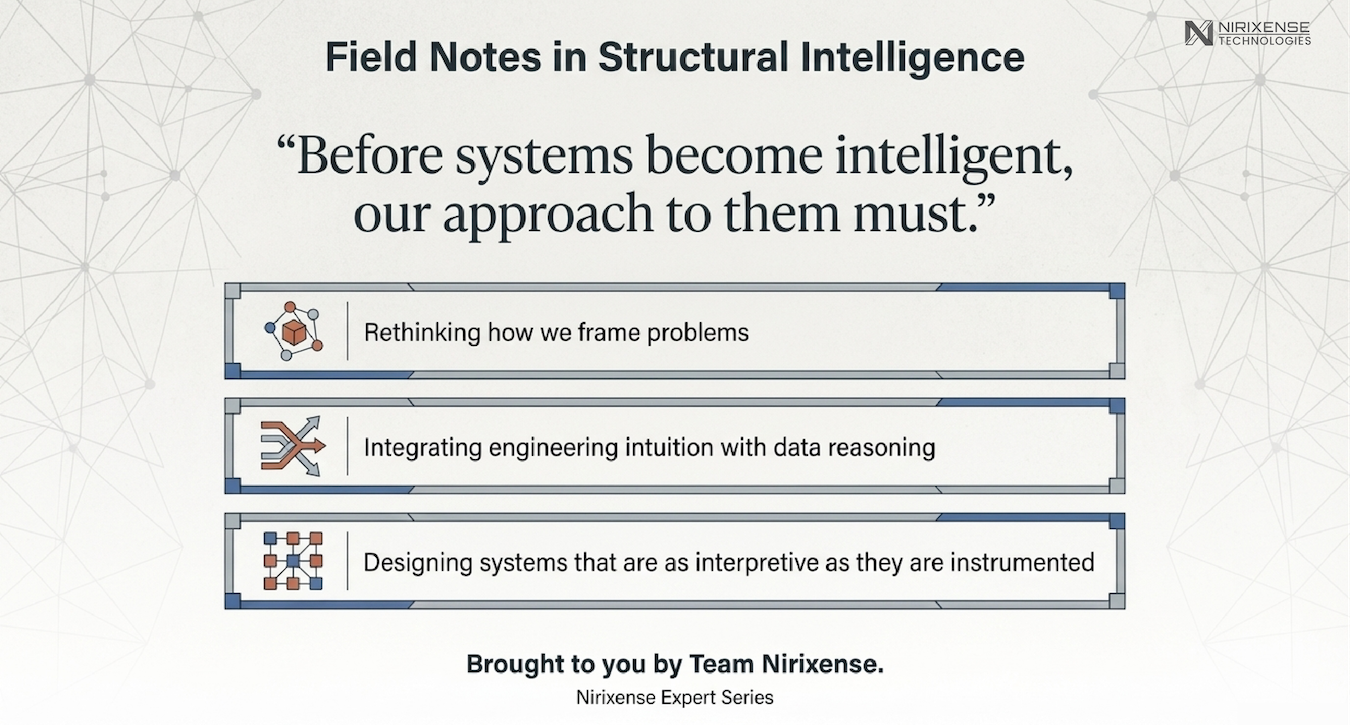
“Before systems become intelligent, our approach to them must.”
It requires:
- Rethinking how we frame problems
- Integrating engineering intuition with data reasoning
- Designing systems that are as interpretive as they are instrumented
The shift from NDT to SHM to Structural Intelligence is often described as a progression.
But in reality, it’s a layering of perspectives.
And perhaps the most important shift of all is this:
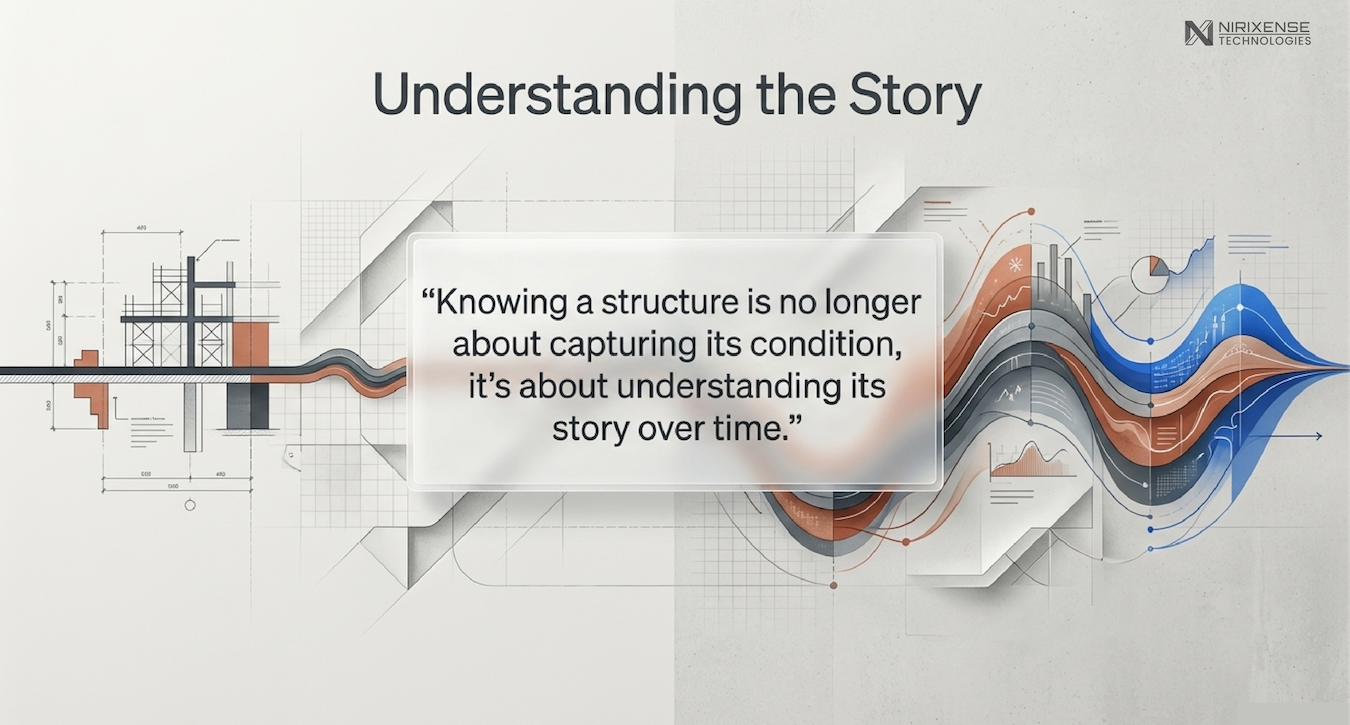
“Knowing a structure is no longer about capturing its condition, it’s about understanding its story over time.”
At Nirixense, these conversations are shaping how we build for that future not just with better sensors, but with sharper questions and more meaningful systems.
© 2026 Nirixense Technologies Pvt. Ltd. All rights reserved. email: connect@nirixense.com
About this series: Field Notes in Structural Intelligence is a thought leadership series by Nirixense Technologies, where we engage with experts across structural engineering and monitoring to understand how SHM actually works in practice and where it needs to evolve next.