
Who owns the data? Or more precisely, who understands it?
In conversation with Prof. Anjan Dutta
Technology Perspective
Divya Koppikar, Product and UI/UX Designer, Nirixense Technologies
Om Narayan Singh, Applications Engineer, Nirixense Technologies
(April 2026)
Prof. Anjan Dutta is a Professor in the Department of Civil Engineering at the Indian Institute of Technology (IIT) Guwahati, with expertise in structural engineering and computational mechanics. His research spans finite element mesh generation, structural optimization, and the monitoring, control, and retrofitting of civil infrastructure systems. Through his work, he has advanced methodologies that enhance the safety, resilience, and performance of engineered structures. His contributions have significantly influenced both academic research and practical approaches to addressing real-world infrastructure challenges.
In our discussion with Prof. Dutta, the question of data ownership in structural health monitoring (SHM) systems did not come up directly. It emerged gradually, through a more grounded concern: what actually happens after a monitoring system is deployed.
Who owns the data generated by these systems?
The instinctive answers—client, agency, vendor—felt technically correct, but incomplete. Because in practice, the usefulness of data is not determined by who holds it, but by whether it is used.
“Instrumentation alone will not do. Those data should come regularly to the people who can actually interpret them.”
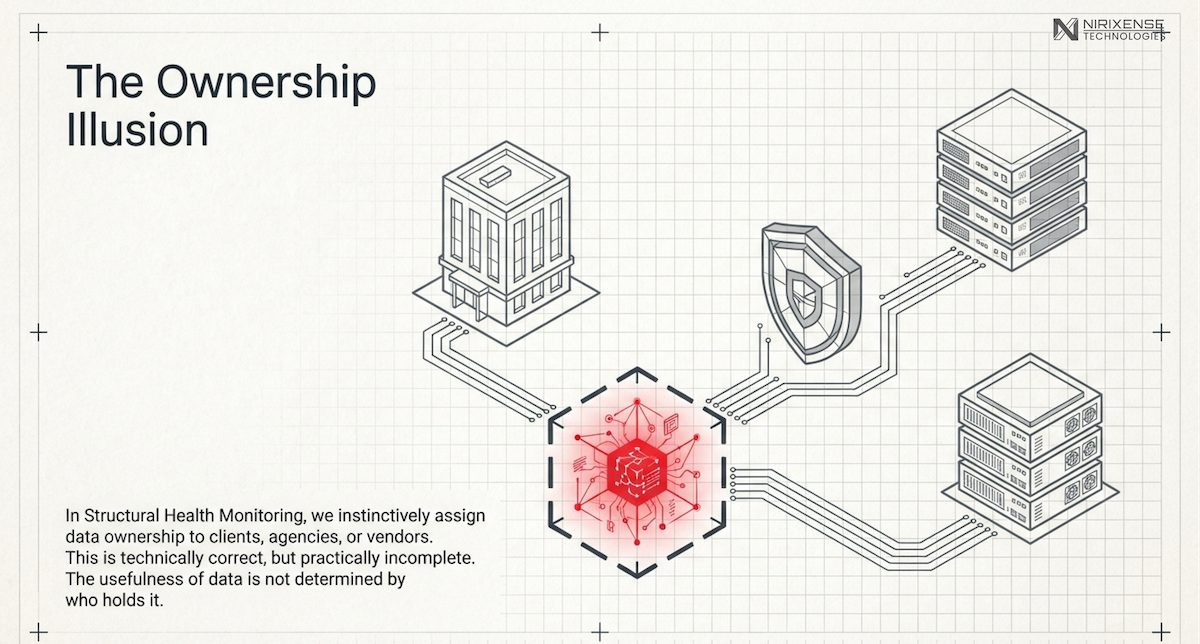
That distinction reframes the problem entirely. Ownership without interpretation has limited engineering value.
The point where systems quietly plateau
Most SHM systems today are not failing at the level of hardware. Sensors are installed correctly. Data acquisition is reliable. Wireless or wired transmission ensures continuity. The infrastructure to generate and store data is, in many cases, robust.
And yet, systems tend to plateau.
They reach a state where data is being generated continuously, but its role in actual decision-making becomes unclear. The system is active, but its impact is passive. Prof. Dutta pointed to this ambiguity in the context of large, instrumented infrastructure:
“Even in major urban infrastructure, systems are often fully instrumented, but whether that data reaches the right institutions for interpretation is not always clear.”
The issue here is not technological. It is systemic. Data is being produced, but it is not clearly embedded into any decision loop.
Why more data doesn’t solve the problem
One of the implicit assumptions in monitoring is that increasing data volume will naturally improve understanding.
In reality, it introduces a different challenge. As datasets grow across parameters, locations, and time, the effort required to interpret them increases significantly. Signal processing, model correlation, and anomaly detection all require context, not just computation.
“We are collecting more data than ever before, but not necessarily understanding more.”
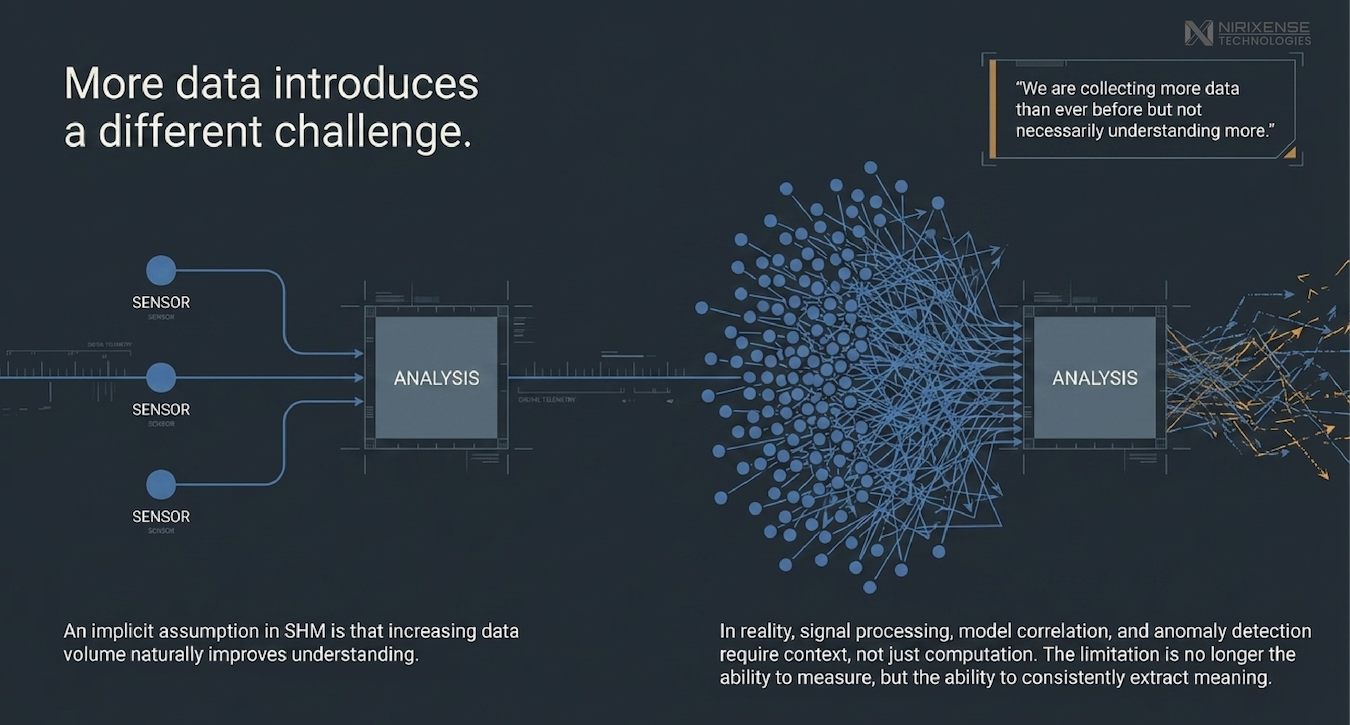
This is where many systems struggle. The limitation is no longer the ability to measure. It is the ability to consistently extract meaning from what is measured.
The gap no one explicitly owns
If we map out a typical SHM deployment, responsibilities are clearly defined up to a point. Instrumentation teams handle sensor placement and calibration. Vendors manage acquisition systems and data transmission. Asset owners oversee budgets and implementation.
But the interpretive layer often sits in between, unassigned.
There is no explicit owner for answering questions such as:
- Does this trend require intervention, or is it within expected behavior?
- What does this variation in strain actually indicate?
- Is this shift in frequency operational or structural?
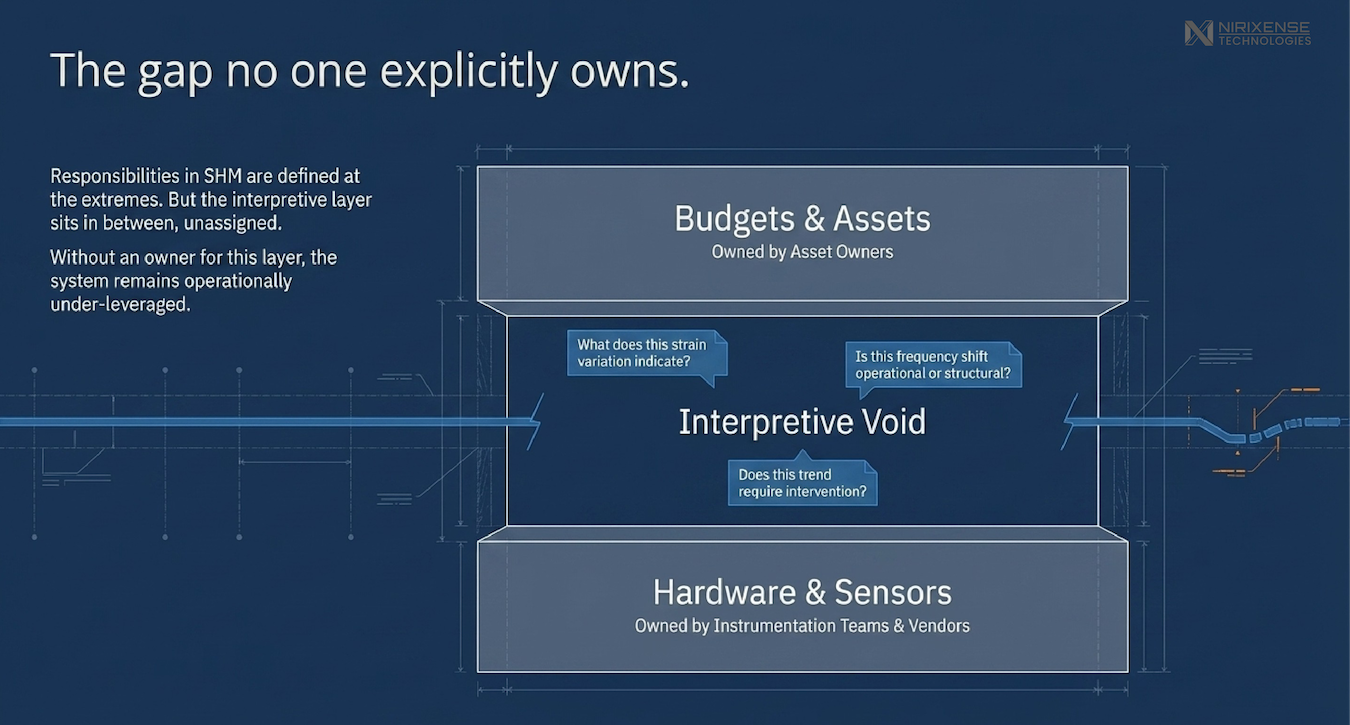
Without this layer, the system remains technically sound but operationally under-leveraged.
Ownership vs. use
This leads to a useful distinction. Ownership is about control, who stores the data, who can access it. Use is about application, who interprets it, and what actions follow.
Most monitoring systems solve for the former. Very few are designed around the latter. As a result, data often ends up being archived, reported, or revisited after an event, rather than being used as part of ongoing decision-making.
When data actually drives decisions
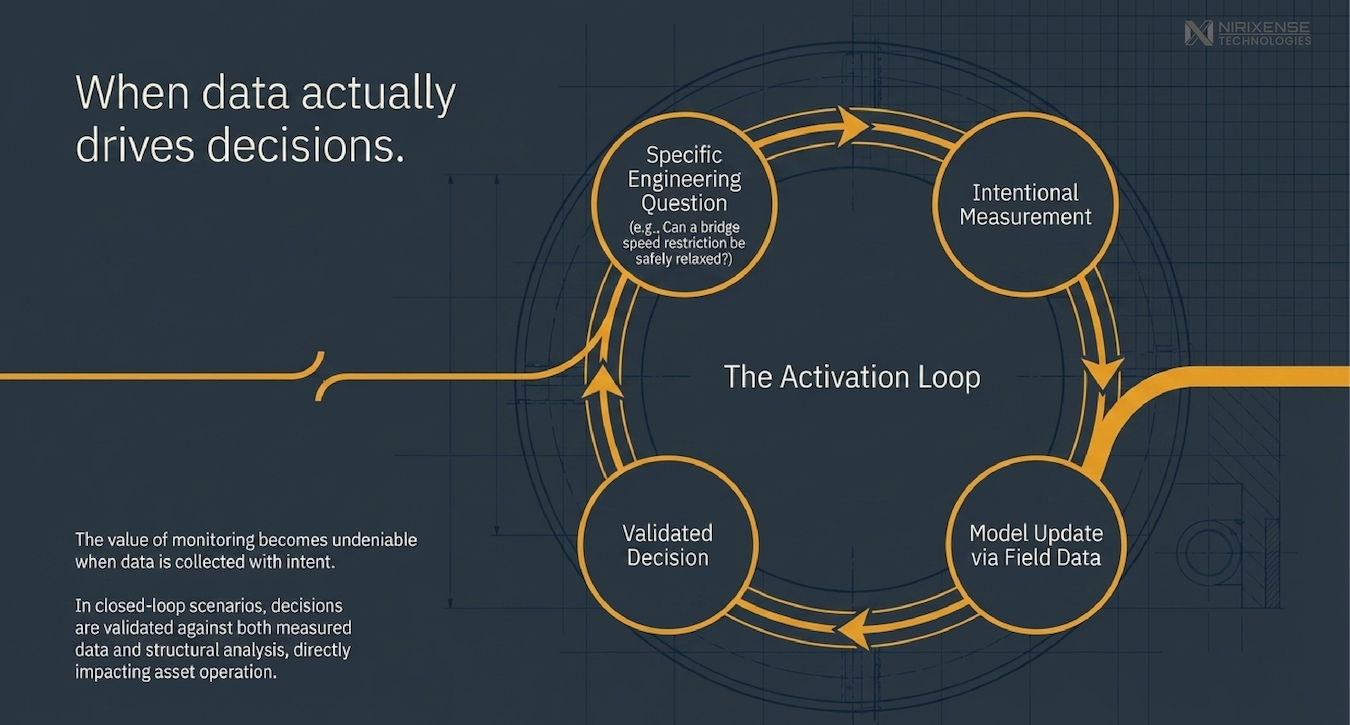
Interestingly, the value of monitoring becomes immediately clear in scenarios where the objective is well-defined.
Prof. Dutta described cases where bridges under speed restrictions were instrumented to answer a specific question: can the restriction be safely relaxed? In such cases, the workflow is tightly coupled. Data is collected with intent. Models are updated using field measurements. Decisions are validated against both data and analysis.
What we are building at Nirixense
At Nirixense, this gap is not treated as a downstream problem; it is treated as a design problem. The focus is not only on simplifying how sensors are deployed through wireless, easy-to-install systems, but on ensuring that the data generated does not remain isolated within acquisition layers.
The systems are being built with a clear objective: to make data usable, not just available. This means integrating interpretation into the monitoring pipeline itself, linking measurements to structural behavior, aligning outputs with engineering questions, and ensuring that insights are directly usable in decision-making contexts.
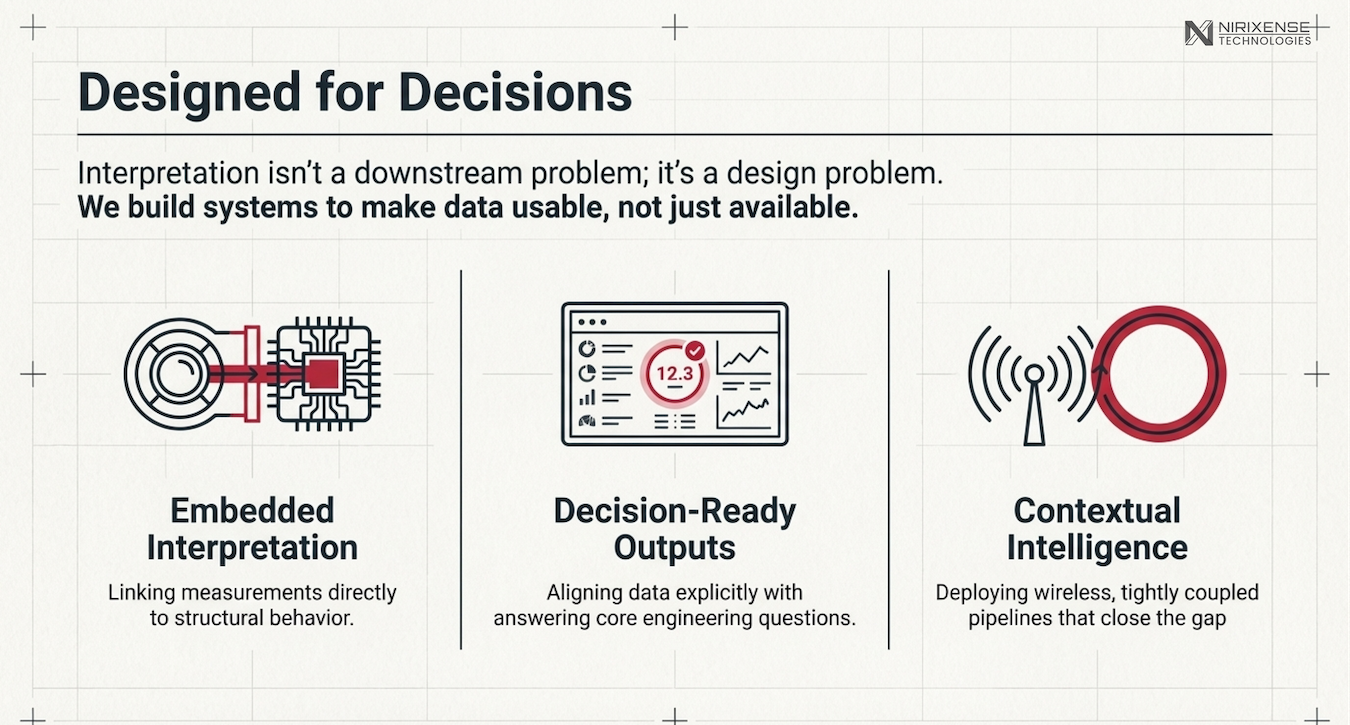
Closing that gap is what turns monitoring into intelligence and data into something that is not just owned, but actually used.
© 2026 Nirixense Technologies Pvt. Ltd. All rights reserved. email: connect@nirixense.com
About this series: Field Notes in Structural Intelligence is a thought leadership series by Nirixense Technologies, where we engage with experts across structural engineering and monitoring to understand how SHM actually works in practice and where it needs to evolve next.