
Why structural monitoring in India needs a different starting point
In conversation with Dr. Jaswant Arlekar
Technology Perspective
Divya Koppikar, Product and UI/UX Designer, Nirixense Technologies
Om Narayan Singh, Applications Engineer, Nirixense Technologies
(April 2026)
Dr. Jaswant Arlekar is a visionary leader in structural engineering, renowned for his profound expertise in seismic resilience and pioneering advancements in Structural Health Monitoring (SHM). His decades of innovative contributions continue to shape safer, smarter infrastructure worldwide.
Our team shares insights from a conversation with Dr. Arlekar, that are less about finding answers and more about reframing the questions the industry has been asking for decades.
A gap worth paying attention to
Structural Health Monitoring (SHM) is increasingly seen as essential for modern infrastructure. With the shift toward continuous monitoring and data-driven decision-making, its value is clear: better safety, earlier interventions, and improved lifecycle management. However, when applied in the Indian context, a key gap emerges. Most SHM systems today are designed for highly engineered assets, bridges, dams, and critical infrastructure with well-defined design inputs.
But that is only a small part of the story.
“Over 85% to 90% of buildings in India are ‘non-engineered’… current codes only cater to the remaining 10% to 15%, and an even smaller number of these are monitored.”
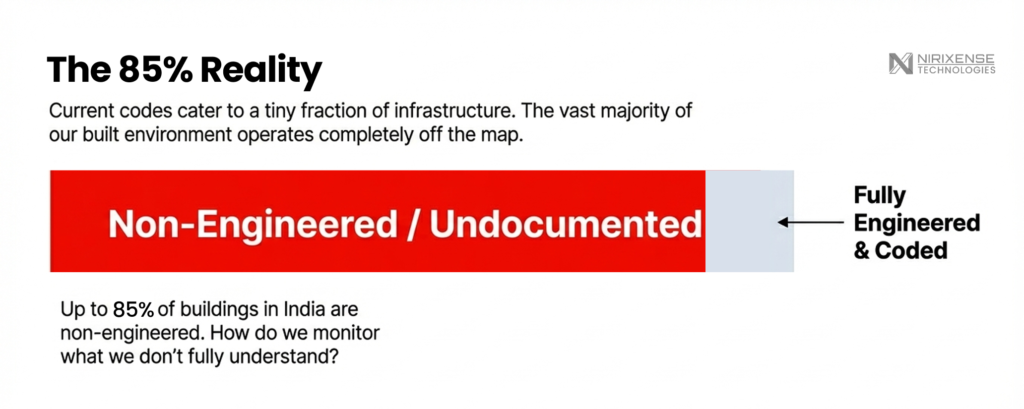
This raises an important question: How do we monitor the infrastructure that actually exists?
When the starting point is uncertain
In many Indian buildings, especially older or urban assets, basic structural information is often incomplete or unavailable. Drawings may be missing, material properties unknown, and modifications undocumented.
“For buildings over 30 years old… structural drawings are frequently lost, necessitating tedious physical measurements and reverse-engineering. Most structural components are hidden behind expensive cladding, designer paints and false ceilings, to which the owner is emotionally attached…”
This changes the nature of the problem. SHM is no longer just about measuring behavior, but about first understanding what the structure is.
Traditional workflows, which begin with analytical models and predefined assumptions, are ineffective and struggle in such conditions. So, how does one solve a problem that cannot be defined? As noted in our conversation:
“Analytical models (FEM) are based on idealized assumptions… that rarely match as-built reality.”
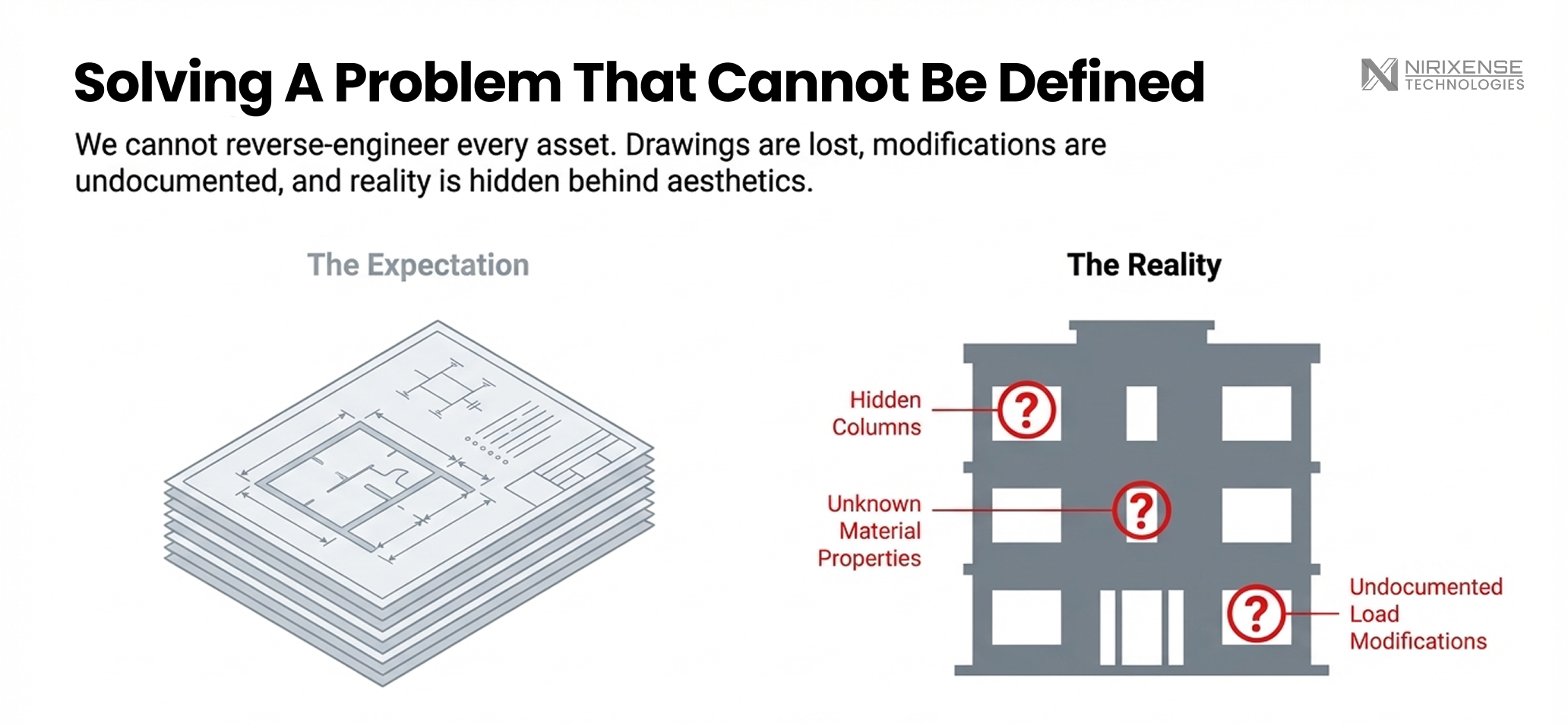
In practice, this means monitoring systems must operate with a degree of uncertainty from day one. Logical estimates based on statistics and probability come into play.
From measurement to meaning
Even when data is successfully captured, interpreting it is not straightforward. Without a clear baseline or reference condition, it becomes difficult to distinguish between normal behavior and early signs of structural change. A fundamental challenge emerges:
“How do you determine whether a variation… represents a meaningful structural change versus normal operational variability?”
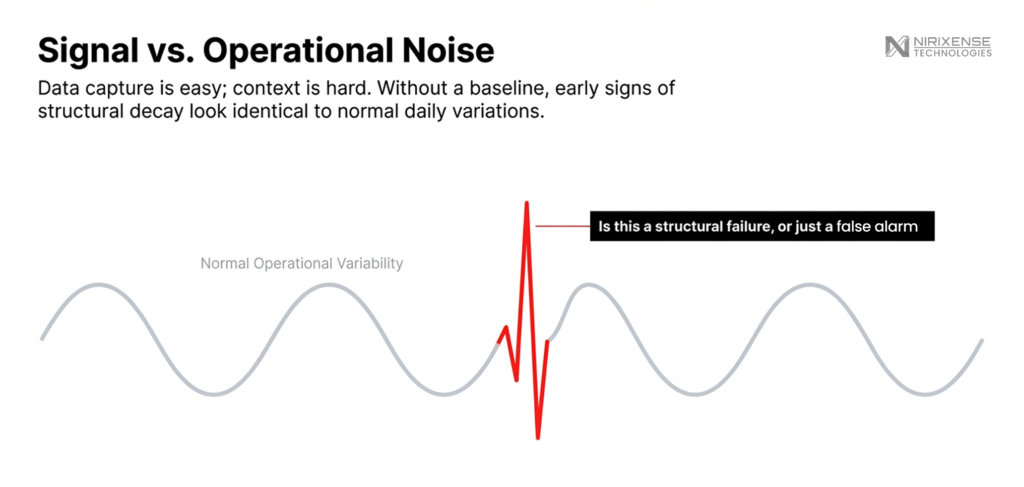
This is where many SHM deployments lose effectiveness not due to lack of data, but due to lack of context. For monitoring to be useful, it must bridge this gap between measurement and decision-making.
Designing SHM for real-world conditions
Addressing this requires a shift in how SHM systems are conceived. Instead of assuming ideal inputs, systems need to be:
- Adaptive to incomplete structural information
- Robust to variability in construction and materials
- Focused on actionable insights rather than raw data
In this sense, SHM becomes less about validating a predefined model and more about progressively building one.
“SHM acts as a ‘blood test’… to fine-tune models until they reflect real behavior.”
This approach aligns us better with the realities of infrastructure, where uncertainty is not an exception, it is the default condition. There is a need for capturing ranges of behavior rather than pin-pointing them, this enables statistical interpretation of data, and in such a scenario even partial data is very useful.
What we’re building at Nirixense
At Nirixense, this perspective shapes how we are approaching SHM. Our starting point is not ideal infrastructure, but real-world constraints. A key observation from our work is:
“A large part of SHM complexity today is not analysis, but installation and data acquisition.”
In many projects, deployment challenges, wiring, coordination, time taken on site become the primary bottleneck. This is especially true in environments where access is limited and documentation is incomplete. We are therefore building systems that simplify this layer:
- Faster, low-dependency installation
- Reduced reliance on extensive wiring
- Practical deployment in existing structures
The objective is to make SHM not just more advanced, but more accessible, particularly for the large segment of infrastructure where it is currently absent.
Closing thought
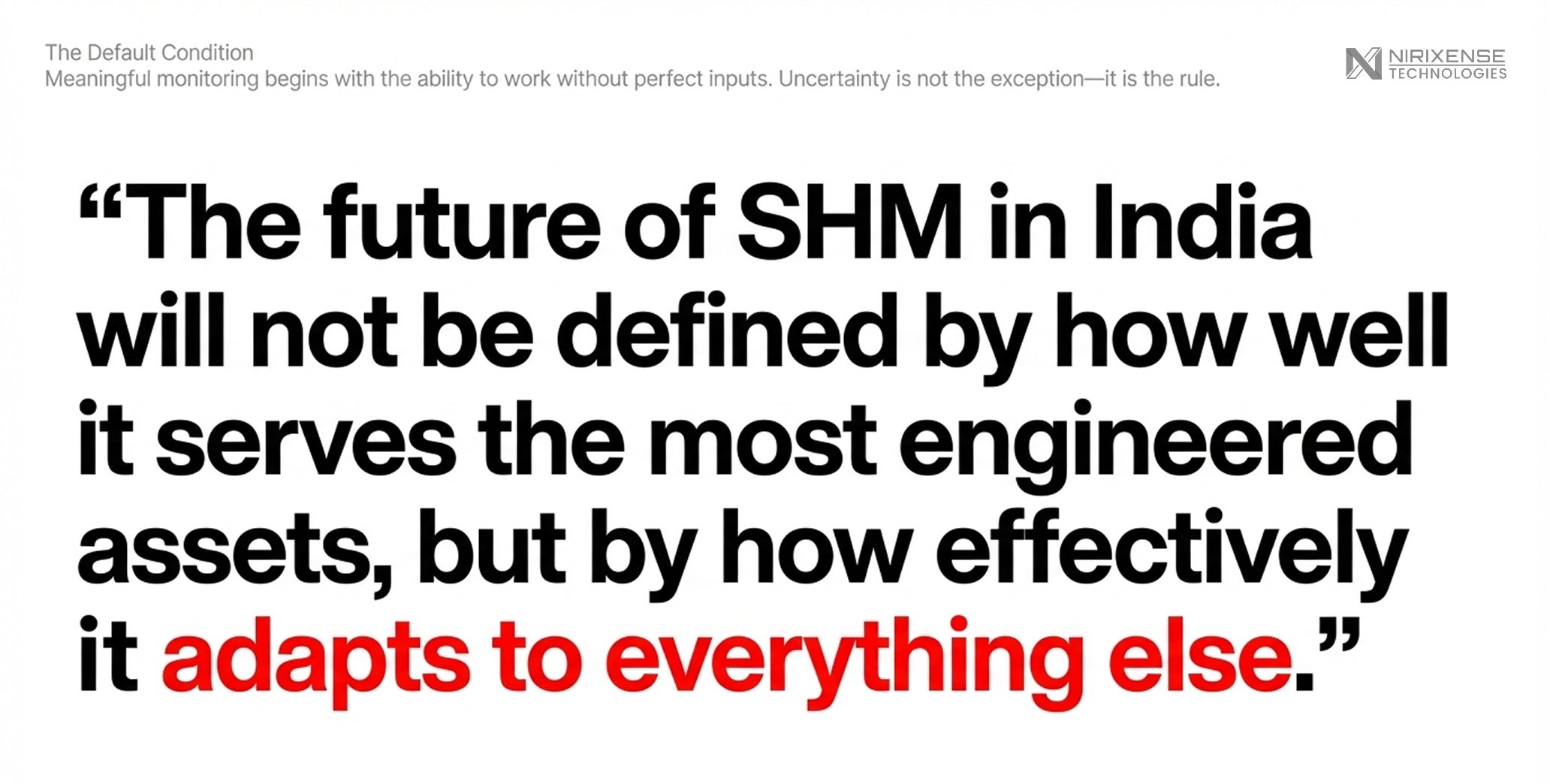
The future of SHM in India will not be defined by how well it serves the most engineered assets, but by how effectively it adapts to everything else.
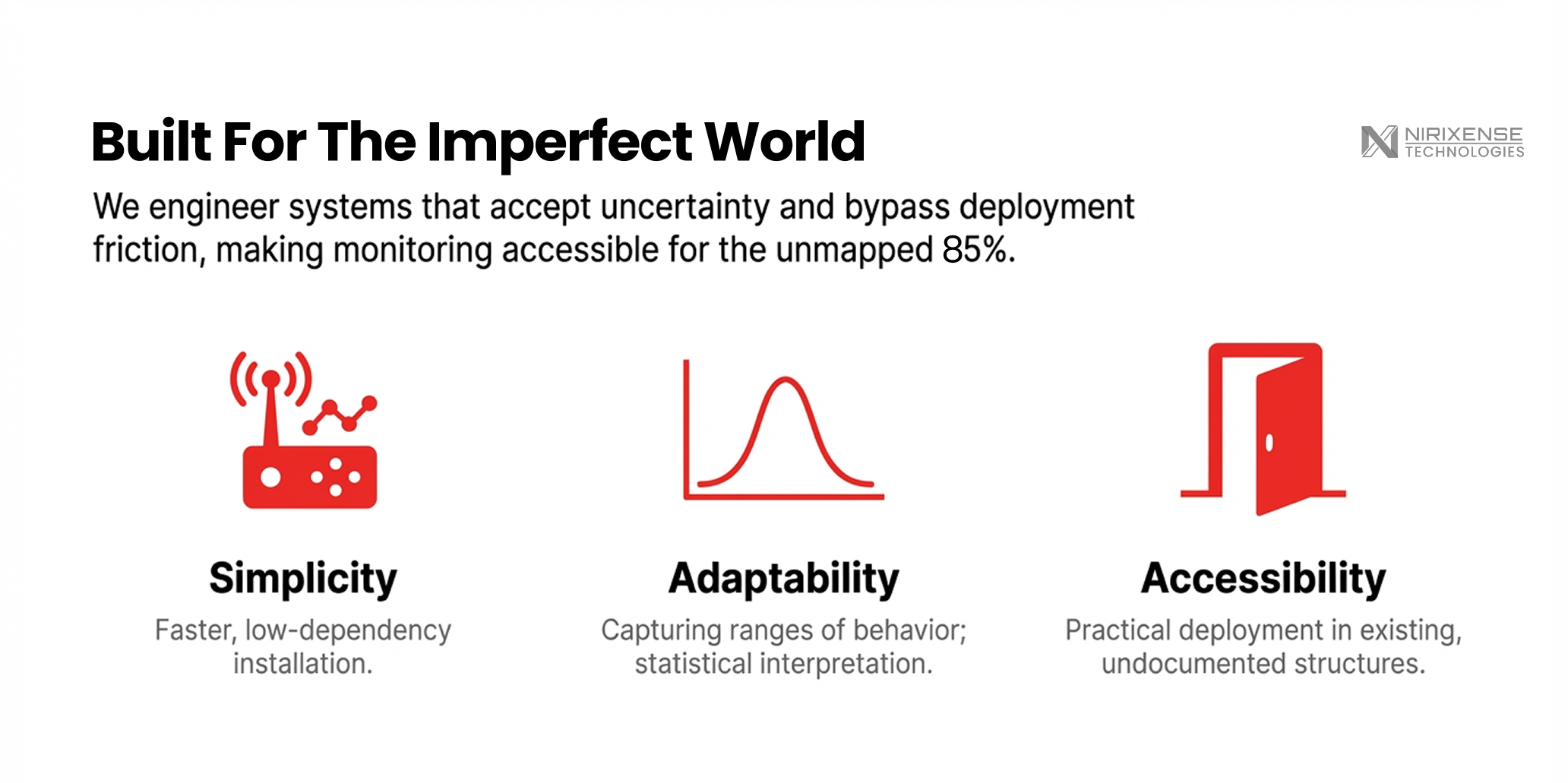
As the industry moves toward continuous monitoring, the real opportunity lies in designing systems that work with uncertainty, not with ideal systems. Because meaningful monitoring begins not with perfect inputs, but with the ability to work without them.
© 2026 Nirixense Technologies Pvt. Ltd. All rights reserved. email: connect@nirixense.com
About this series: Field Notes in Structural Intelligence is a thought leadership series by Nirixense Technologies, where we engage with experts across structural engineering and monitoring to understand how SHM actually works in practice and where it needs to evolve next.